
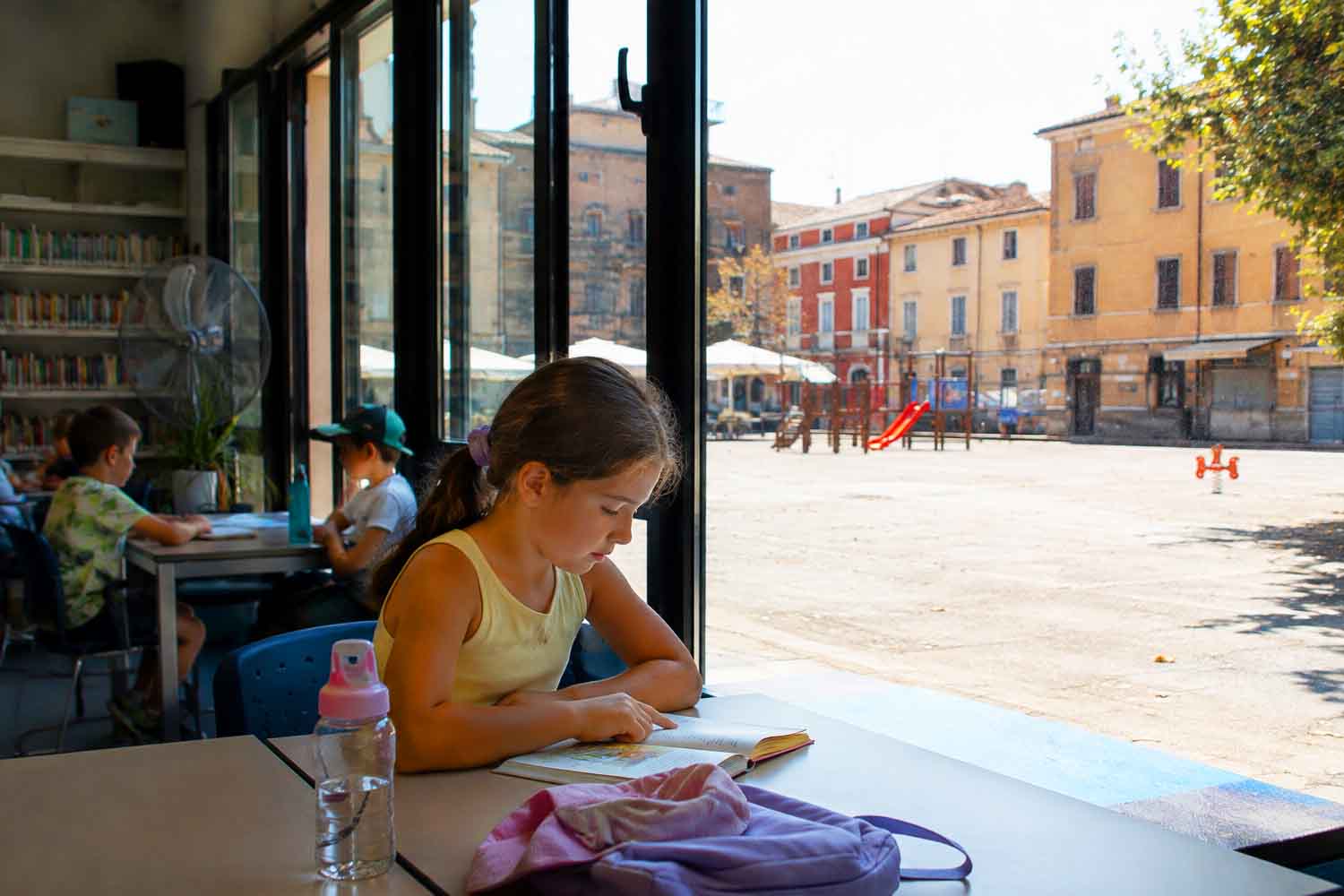
Between 11am and 6pm, when the heat is strong, the Ministry of Health recommends limiting children’s physical activities. In cities, during the hottest hours, he also recommends avoiding parks and green areas when ozone levels are high, especially for those suffering from asthma. The “good season”, at certain temperatures, begins to have several off-limits time slots.
Now a global study puts a number on this shrinking summer. For approximately 560 million children aged 0 to 9, climate change caused by human activities has already added at least thirty days of humid heat stress per year. They are 43% of all children in this age group.
The data comes from the study Age-specific exposure to human-induced increases in humid heatpublished August 26, 2026 on Science Advances by an international group led by the Vrije Universiteit Brussel. The researchers combined demographic data, climate models and attribution science to estimate how much of the heat stress experienced today can be attributed to human-induced warming.
Among people aged 60-69, those exposed to at least thirty additional days are around 190 million, 30%. The comparison concerns geographical exposure to heat, therefore how many days different populations reach in the places where they live. It does not directly measure how many children or adults get sick.
For 350 million children, humid heat already occupies at least five months
Humid heat is particularly insidious because the body loses efficiency in its simplest cooling system: sweat evaporates with greater difficulty when the air is already full of humidity.
In children the margin is narrower. The World Health Organization includes infants and young children among those most vulnerable to extreme heat, and in June 2026 called on governments and cities to strengthen heatwave health plans. Toddlers also depend on adults to drink, stop an activity, find shade, or get to a cool place.
Then comes the five months.
According to the study, today approximately 350 million children, 27% of those between 0 and 9 years old, are exposed to at least 150 total days of humid heat stress every year. In a world without anthropogenic warming there would be around 120 million, 9%. Climate change has almost tripled that audience.
The greatest burden falls on South Asia, South-East Asia and West Africa, hot regions where a very high share of the child population lives. And often right here a cool house, an air conditioning system or a healthcare system capable of withstanding heat waves are less accessible.
When it gets too hot, the game moves inside
The transition from climate data to daily life is already quite visible. In 2025 a systematic review published on EnvironmentalResearch collected available studies on environmental conditions and active outdoor play. Among the effects observed are the tendency to stay indoors and reduce outdoor play during extreme heat, fires and other unfavorable environmental conditions, together with the shift of activities towards less critical hours.
In Arizona this subtraction of outdoor time has even been counted. A study of 61 Maricopa County elementary schools found that 93% of schools had modified their regular outdoor recess due to heat in the first quarter of the 2023-2024 school year. On average the changes lasted three and a half weeks; almost half of the schools had changed organization for four to six weeks. The most frequent solutions were to move the recess inside or cancel it, or shorten it and bring it forward.
And staying inside isn’t necessarily a perfect substitute. Another study published in 2026 on Journal of School Health followed 317 fourth- and fifth-graders in the Phoenix area during six weeks with temperatures between about 100 and 100 degrees Fahrenheit. After recess, children showed higher levels of positive emotions when they played outdoors or in the gym than when they remained in classrooms. He is a single US champion, but he captures the compromise well: protecting from the heat can mean taking away one of the daily opportunities for movement, free play and socializing.
On a much larger scale, UNICEF calculated that extreme weather events disrupted the education of at least 242 million students in 85 countries in 2024 alone. Heat waves were the phenomenon that had the greatest impact: they affected approximately 171 million students during the year and over 118 million in the month of April alone. In some countries schools have closed, in others the school day has been shortened.
Far from a distant problem confined to the tropics. In Italy, adaptations have already entered the ordinary management of children’s services.
In Sassuolo, after the critical temperatures recorded in June, the Municipality has launched a specific plan to make the school buildings usable also in the summer and has established that the activities of the summer centers for the little ones are held in environments with adequate air conditioning. In Scandiano the plan against the heat includes air conditioners in nurseries and summer centres, ceiling fans in nursery schools, new urban shade and mapping of heat islands.
Milan had to face the same problem on a much larger scale: in the response published on the municipal portal dedicated to participation, the administration reports having purchased 609 portable air conditioners, 1,817 fans and 368 umbrellas, as well as having strengthened the shaded areas of the complexes and given priority to the locations of nursery schools and summer centers.
Libraries and cinemas become places to spend the hottest hours
Then there are the cities, which have begun to build a parallel geography of summer: that of climate refuges.
In Bologna the network has reached 28 free public spaces by 2026, including libraries, neighborhood houses, museums, courtyards and shaded green areas. Florence has mapped 53. Brescia has transformed libraries, civic centers, museums, reading rooms, parks and sports facilities into a city network against the hottest days.
In Rome, the “Il Grande Freddo” initiative opened cinemas, libraries and other air-conditioned cultural spaces for free during the heat wave of summer 2026. Between 23 July and 4 August over 20 thousand people used them, so much so that the Municipality extended the program until 14 August. The library as a refuge from the heat seems like a dystopian scene until you discover that there is already a map to find one near your home.
This change weighs especially on families with fewer alternatives. If the yard becomes impassable for a few hours, you can stay home with the air conditioner on, go to the pool, pay for an indoor activity, or look for a cool public place. They are very different options also in price. Urban greenery, shade in schoolyards, buildings designed not to overheat and free climate shelters therefore become part of social policy, as well as adaptation to climate change.
With 2°C of heating it would be almost six out of ten children
The study’s projections explain why adapting spaces alone is not enough. With 1.5°C of global warming compared to the pre-industrial era, approximately 620 million children between 0 and 9 years old, 49%, would be exposed to at least thirty additional days of thermal stress each year.
At 2 °C they would become around 650 million, 59%. Almost six out of ten children. And around 420 million would spend at least five months a year in hot, humid conditions above the threshold considered by the research.
The authors therefore call for both: rapidly reducing emissions from fossil fuels and preparing cities, schools and healthcare systems for higher temperatures. The WHO now speaks of extreme heat as a critical public health issue and invites cities and governments to equip themselves with real health plans against heat waves.
Air conditioners, cool libraries and shifted schedules can protect children when it gets too hot outside. In the meantime, however, part of the cost of adaptation is already measured in hours of play, school and life outdoors transferred under one roof. Studies have begun to count them.
