
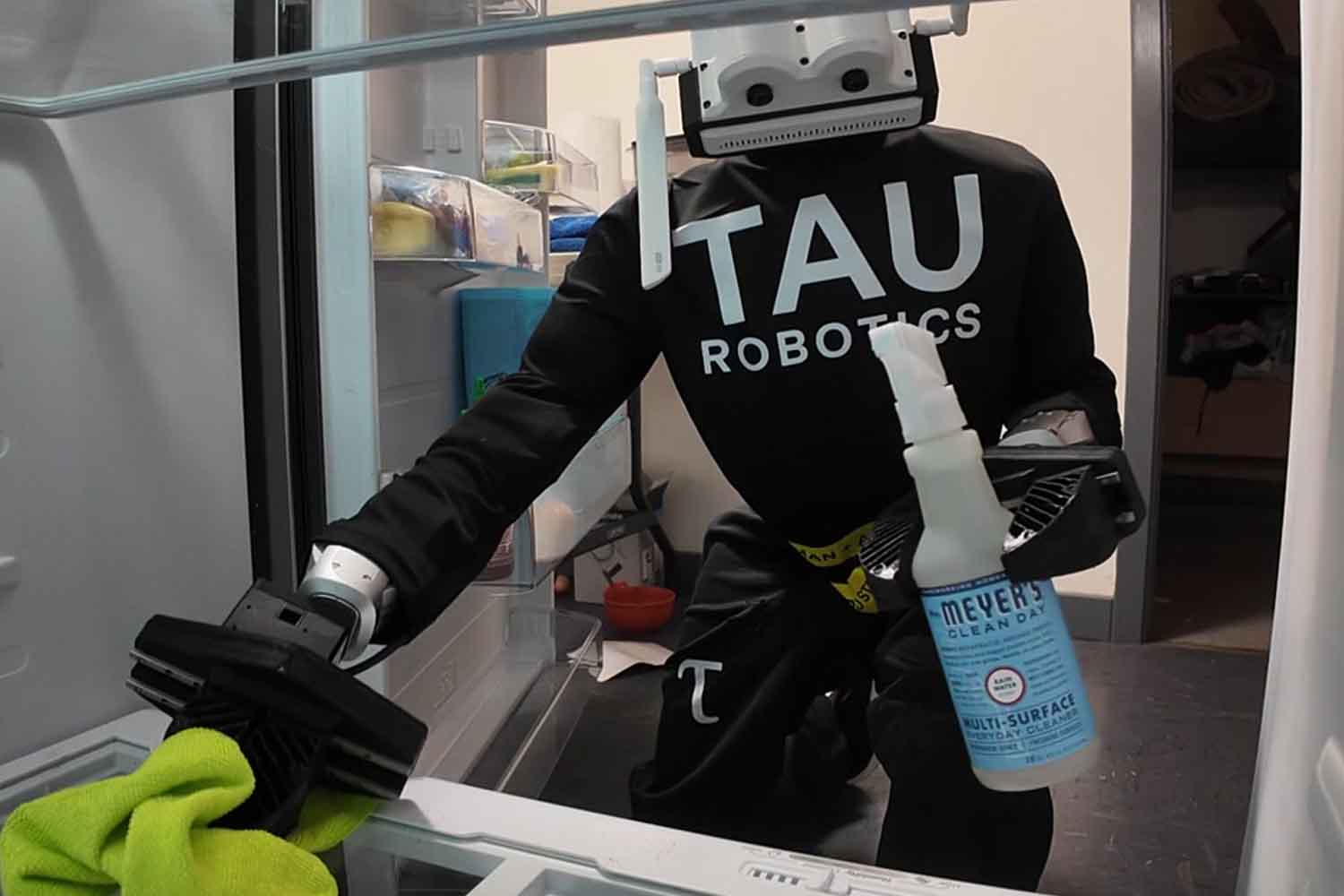
Coast $30 an hourvacuums, cleans shelves and takes out the trash. In the meantime he films the house. In San Francisco, Tau Robotics has started sending humanoid robots into real homes to do household cleaning. The service, for now, is only available by invitation and there is a waiting list. The scene already seems to have come from the future, until you look a little more carefully behind the robot: there is still a human being moving it.
The operator works from the company’s headquarters in San Francisco and sees what the robot sees through its cameras. Tau also uses artificial intelligence systems, but in his documents he immediately makes things clear: the machine, today, . Someone on the other side still has to tell her where to go and what to do. More than Rosie from the Jetsons, in short, we are faced with a cleaner with a robotic body and several kilometers away.
©TAU Robotics
For 30 dollars the robot comes in, but the operator also watches the house
A visit lasts an hour and costs $30. An adult must remain in the home for the duration of the service and the connection must work well enough to allow remote control. Pets should be kept away from the work area. It’s probably for the best: explaining to a cat why a humanoid is moving its basket would be the true test of artificial intelligence.
In the terms of service Tau also describes what the machine can and cannot do. It can vacuum floors and carpets, clean surfaces, pick up small objects, empty bins and move chairs or baskets to work around obstacles. Bedrooms and bathrooms are excluded from standard cleaning, unless the customer expressly authorizes access. Activities considered risky and the handling of objects such as drugs, weapons and cash are also excluded.
Up to this point there is already enough material for a good technological demonstration. The detail that makes the experiment much more interesting, however, concerns what happens while the robot mops.
https://www.instagram.com/reels/Dcef9K5Ci-d/
Cleaning serves to train the robot
Every visit comes recorded continuously. The cameras on the head and wrists record rooms, furniture, objects and people in the house. The microphones are muted: Tau claims not to listen to or record the audio of the house. On the other hand, it collects the images, the movements of the robot, the commands given by the operator and information on the depth and geometry of the environments, until obtaining a spatial representation of the places in which the machine moves.
The company doesn’t even try to hide the purpose behind a fluffy corporate formula. In its privacy policy dedicated to the service it explains that video, telemetry and commands become training data for artificial intelligence models. The goal is to arrive at a robot capable, one day, of carrying out those same cleaning operations without a person at the controls. And Tau adds that this data collection is one of the reasons why he is able to offer the service at that price.
That $30, then, buys something in both directions. The customer receives one hour of cleaning. The company receives an hour of experience inside a real house: badly placed chairs, objects left on the floor, different furniture, human beings walking through a room. Everything that an orderly laboratory can reproduce only up to a certain point.
Faces are not blurred and footage can remain for years
The most delicate part is written a few lines below. Faces in movies are not blurred. Tau specifies that it does not use facial recognition, does not try to identify people and does not build biometric models, but the images enter the system as they were recorded. This may also include other people in the home.
Those who book must notify their partners. And here the company itself recognizes a rather elementary limit: one person cannot give consent in place of all the other inhabitants. Anyone present can ask the operator to interrupt the session.
Retention is also generous, at least from an algorithmic perspective. Video, telemetry and commands can be retained indefinitelyuntil the customer requests its cancellation. Tau explains that data collected today could be reused years later to train models and architectures that don’t yet exist.
Deletion of raw material may be required, but there is one passage that can hardly be rewound. If that data has already been used to train a model, the effect it has had on its parameters. You can remove the video from the archive; much more complicated is to take away from the robot what it has already learned by watching it.
The fully autonomous robotic home has therefore yet to arrive in San Francisco. For now, behind every vacuum cleaner passed there is a person driving and in front there are cameras taking notes. The robot cleans today’s house to learn to work, perhaps alone, in tomorrow’s house.
