
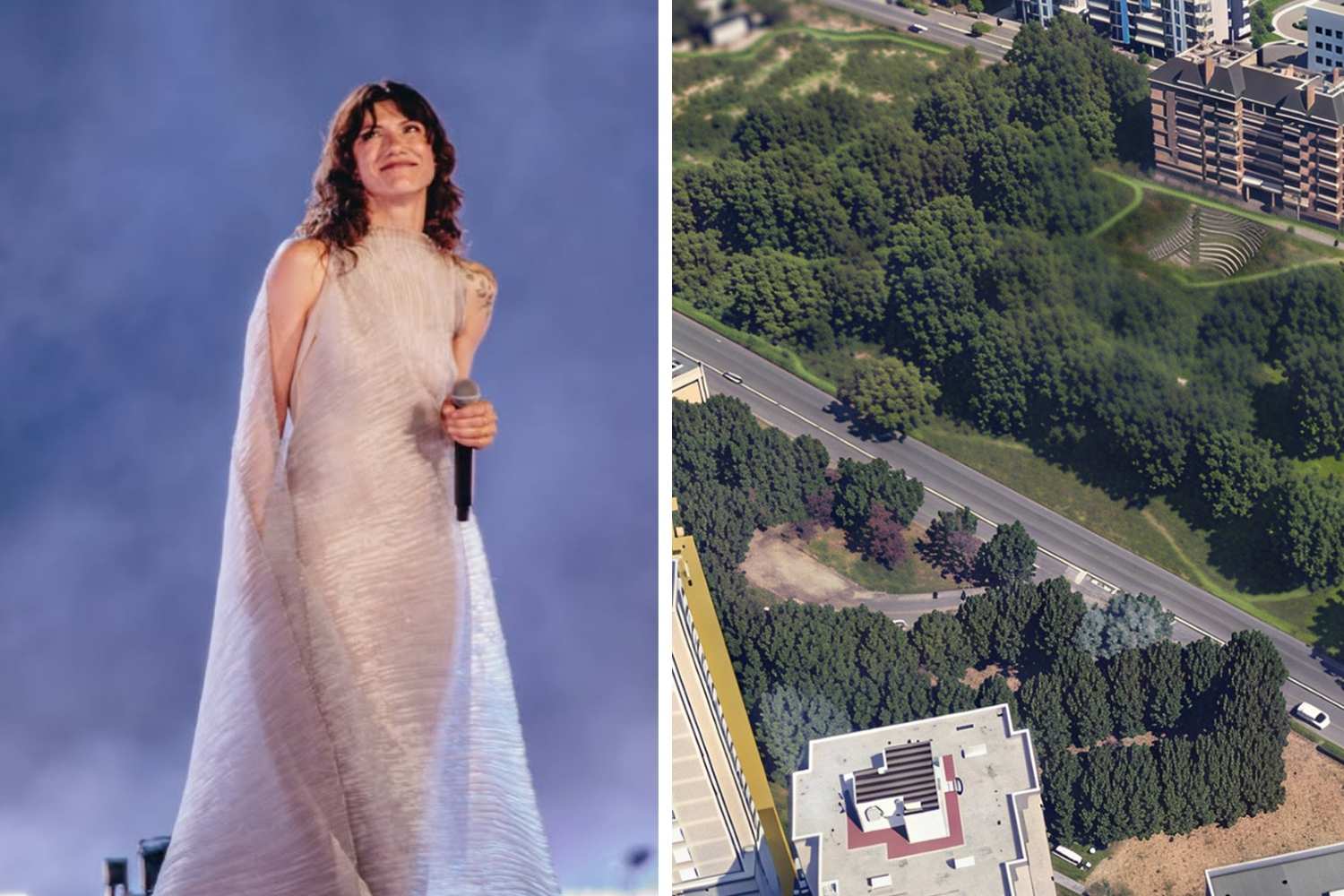
Elisa has long chosen to bring sustainability out of conversations and into her projects. It did so through music, choices linked to events, attention to the environment and initiatives aimed at the new generations. Now that trajectory arrives in Milan, with a project that starts from a place that is anything but easy: a former quarry of around 40 thousand square meters in via Quarenghi, in Municipality 8.
View this post on Instagram
It is called Plantasia and it is the first project born from the alliance between Elisa and Giovanni Caccamo and the non-profit organizations Lotus ETS Foundation and Youth & Future – Word to Youth APS. The idea is to build a sound park in which environmental recovery proceeds together with cultural production and the participation of young people. For now, however, Plantasia is above all an area to be studied. And this is precisely the most interesting point of the project.
@Elisa (IG)- Plantasia.org
Before planting, you need to know the soil
Preliminary investigations are underway for the possible testing of the phytoremediation, a technique that uses plants to contribute to the recovery of contaminated land, water or sediments. The expected sequence is therefore to analyze the soil, identify the most suitable species and only then proceed with planting. This phase is expected to start in spring 2027.
The project already has an initial public funding: the Municipality of Milan has committed around 300 thousand euros. The promoting organizations also aim to raise another 200 thousand euros by December 31st through private funding. These are important numbers, above all because they allow us to measure Plantasia for what it is: an urban regeneration intervention that will have to deal with degraded land and with the times and checks typical of any environmental recovery operation.
Green also becomes a musical instrument
The peculiarity of the project comes after the work on the ground. Plantasia should in fact become a place in which to experiment with phytoacoustics, making the vegetal component part of the sound experience. It is a passage that tries to shift the traditional relationship between music and environment to build an environment in which nature and sound dialogue.
The park will also be able to host open-air exhibitions and other cultural events. In this sense, music becomes one of the functions of the new space, together with the use of greenery and sociality.
Elisa’s sustainability also passes through young people
Then there is a second axis of the project, less visible but equally significant: youth participation. Plantasia should also become a “Forest of Change”, connecting to the path started in 2021 by Youth & Future – Word to Young People APS.
That project collected the responses of thousands of young people in different countries to two questions: “What would you change about the society you live in and in what way?” and “What is your word of change?”. It is a component that gives the park a further function compared to the physical redevelopment of the area: to build a space in which the environmental theme can also be addressed through culture, creativity and direct involvement of the new generations.
For Elisa it is a further chapter in a journey that in recent years has linked her artistic activity to choices and initiatives on sustainability. In 2025, for example, biofuel was used for energy production for one of his concerts at San Siro; his commitment also touched on regenerative agriculture and artistic projects with a social and environmental component.
The proof will be in the earth
The project will have to demonstrate that a compromised area can be recovered with an intervention capable of producing environmental benefits and, at the same time, becoming a public space that can be used by the city. The decisive step will be in the coming months, when the investigations will establish which interventions are really possible and which species can be planted. It is there that Elisa’s environmental commitment will meet the most important part, of sustainability: analysis, times, maintenance, results and transparency.
If Plantasia manages to transform these 40 thousand square meters into an accessible and environmentally functioning park, Milan will have a new green space and an interesting regeneration model. And the music, for once, will have left a trace even under the stage.
