
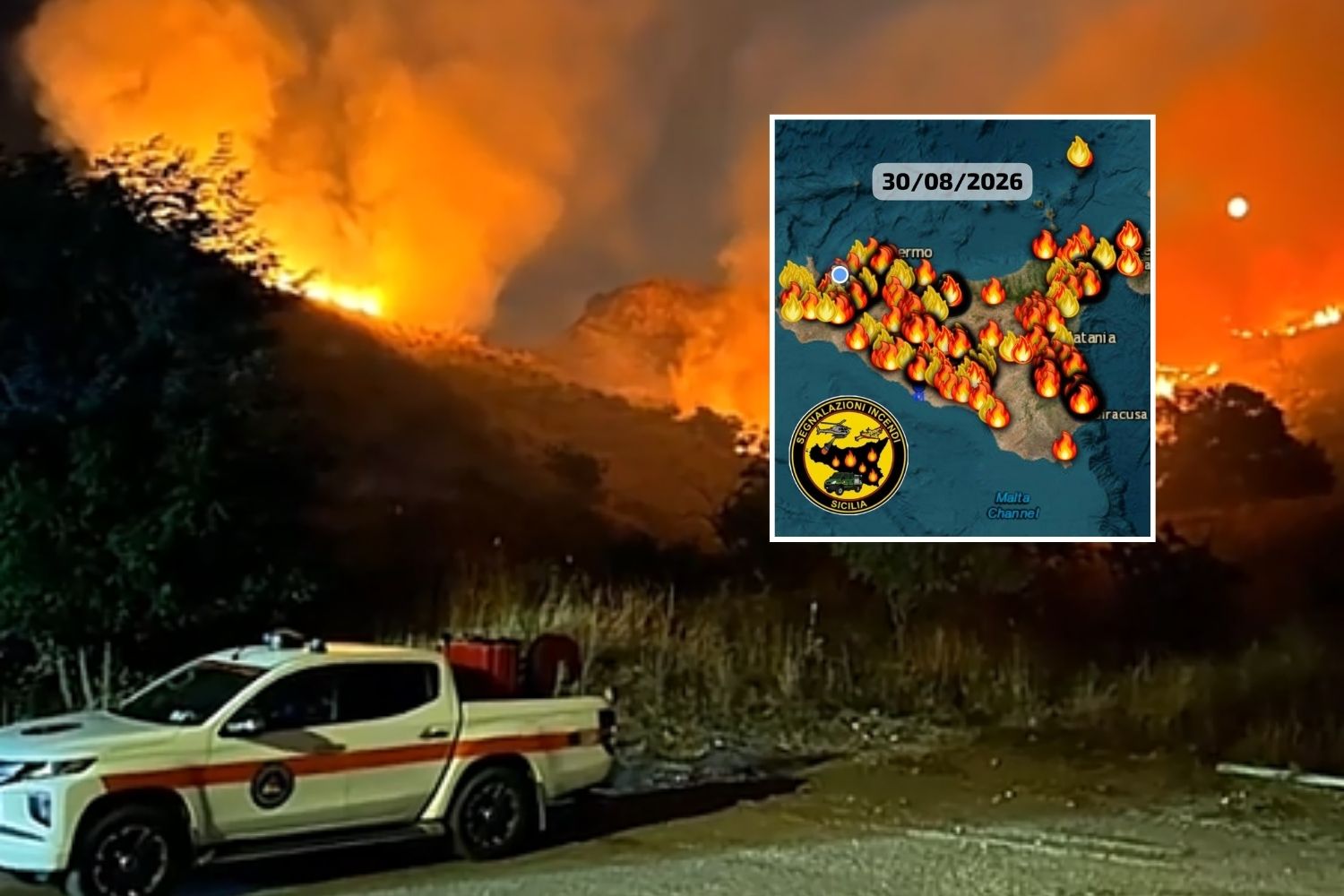
I live in Riposto, a small town on the slopes of Etna, and in the last few days the background sound I hear is that of the comings and goings of the Canadairs going to collect water from the sea. All around you can see flames and smoke, which are devastating woods and threatening homes.
Temperatures approaching 40°C, the heat combined with the sand coming from the Sahara (which makes the air unbreathable) and the usual criminal arsonists have given rise to an emergency. The fires are affecting practically all the provinces: the most affected areas are those of Palermo and eastern Sicily. And the Civil Protection and Fire Brigade are working tirelessly, with ground vehicles and helicopters, to put out the flames.
From Palermo to Catania, the island burns
In the Catania area, moments of apprehension near the Acireale motorway toll booth, where yesterday a fire broke out in a used oil depot, generating a huge black cloud
Flames also in Scordia, in the Fico district, and in Linguaglossa, where a fire in via Croceferro grazed a house and in the countryside of Mascali, where a fire also threatened houses. The flames also affected the Syracuse area, with interventions in Lido Sacramento – where several families were evacuated -, along the Carlentini-Brucoli provincial road and in Baia Arcile, in Augusta. In the Messina area the fires involved the territories of Gioiosa Marea and Piraino, while other fires were reported in Gallodoro and Furnari. The fire emergency is affecting the Silemi and Andreana districts of Letojanni, where the fire has reached inhabited areas.
In the Ragusa area a large fire broke out in the Santa Lucia district, in Chiaramonte Gulfi. The flames burned the pine forest and approached the rock church and some houses, also requiring the intervention of air vehicles. Not even the Agrigento area is saved, in particular Menfi, where the Serrone Cipollazzo burned down, an area subject to environmental restrictions, with mobile dunes where animals nest.
On the western front, several firefighting teams are engaged in the Trapani area in Mazara del Vallo, Poggioreale and Partanna. Meanwhile, the conditions of Salvatore Giglia, 26, who was burned during the fire in Ciminna, in the Palermo area, remain serious. The young man apparently tried to defend his campaign before being overwhelmed by the flames and is now hospitalized in the Civic hospital of Palermo, with a guarded prognosis.
The images coming from Polizzi Generosa (Palermo), where the fire reached the town center, are painful.
Polizzi burns and burns badly. The next day, for those who wander around the affected places for a first summary analysis of the damage, a nightmare scenario presents itself, a lunar landscape that has taken everything away. The spectacle is truly spooky, with the people who suffered the most damage wandering like so many desperate people among the soot and destruction. – writes the mayor – Everything has been exposed, that is, the skeleton of a fragile territory, once again struck to death.
Yes, we are safe, but we have the feeling of those who survive. Waiting for the further, umpteenth test. For example, but I don’t want to be either Cassandra or a jinx of misfortune, those that could promptly occur when the rainy season arrives. How do you think a territory that, from its high altitudes, has been stripped and razed to the ground of all its arboreal, shrubby and vegetative cover will react, if not by creating an uncontrolled sliding of the land from its levels to the lowest altitudes, with avalanches, landslides and mudslides? From the first inspection, the signs of a news story of an announced death, to paraphrase a well-known title, are all there.
The script repeats itself
And so, once again, Sicily finds itself in the grip of flames without having really managed to prevent them. Every summer the same alarms, the same fires and the same devastation are repeated, while the malicious hand continues to strike an island already bent by drought and by those who exploit it without scruples. The forests are burning, but they are also burning olive groves, vineyards, citrus groves, pastures and agricultural land which represent the work and income of thousands of families.
And in a region where water is already an increasingly scarce resource, each fire further aggravates the problem: it depletes the soil, destroys the vegetation that retains moisture, increases the risk of erosion and makes the area’s ability to resist heat waves and lack of rain even more difficult. The fire, therefore, does not just leave ashes: it leaves a weaker agricultural economy, a more vulnerable environment and the bitter feeling that, despite everything that has already happened in the past years, we continue to chase the emergency instead of preventing it.
