
We are used to thinking of technology as something that remains. You buy it, you use it, you forget it in a drawer or you let it end up in some opaque circuit that manages electronic waste. Meanwhile, the world fills with objects that continue to exist even when they are no longer needed, as if they had not received instructions on how to conclude their story.
A novelty is inserted into this habit that changes the ending itself. A group of researchers designed a compostable robot capable of working for a long time and then dissolving, without leaving unwanted traces. A machine that, after having done its job, returns to the earth and becomes nourishment. And this image alone shifts something.
In recent years, electronic devices have colonized every space of our daily life. Small, useful, often indispensable objects that accumulate in silence until they become a continuous flow of waste that is difficult to manage. In 2022, around 62 million tonnes of e-waste was reached globally, a figure that says more than many words.
Soft robots also end up inside this mass, those designed to bend, adapt, interact with the environment and with the human body. We find them in medicine, in agriculture, in exploration. They work thanks to thin, layered structures built with elastic polymers, metal alloys and semiconductors which intertwine in an almost inseparable way. When they stop working, they remain there, difficult to recover, impossible to reintroduce into a natural cycle.
This new generation of technology brings with it a real question about what happens next. The final moment becomes part of the project, not a detail to be postponed.
From extreme durability to natural decomposition
The project is a collaboration between Seoul National University, Sogang University and Johannes Kepler University Linz. The team led by Seung-Kyun Kang, Sang-Yup Kim and Martin Kaltenbrunner has built a system that brings together two dimensions that rarely coexist: high performance and complete biodegradability.
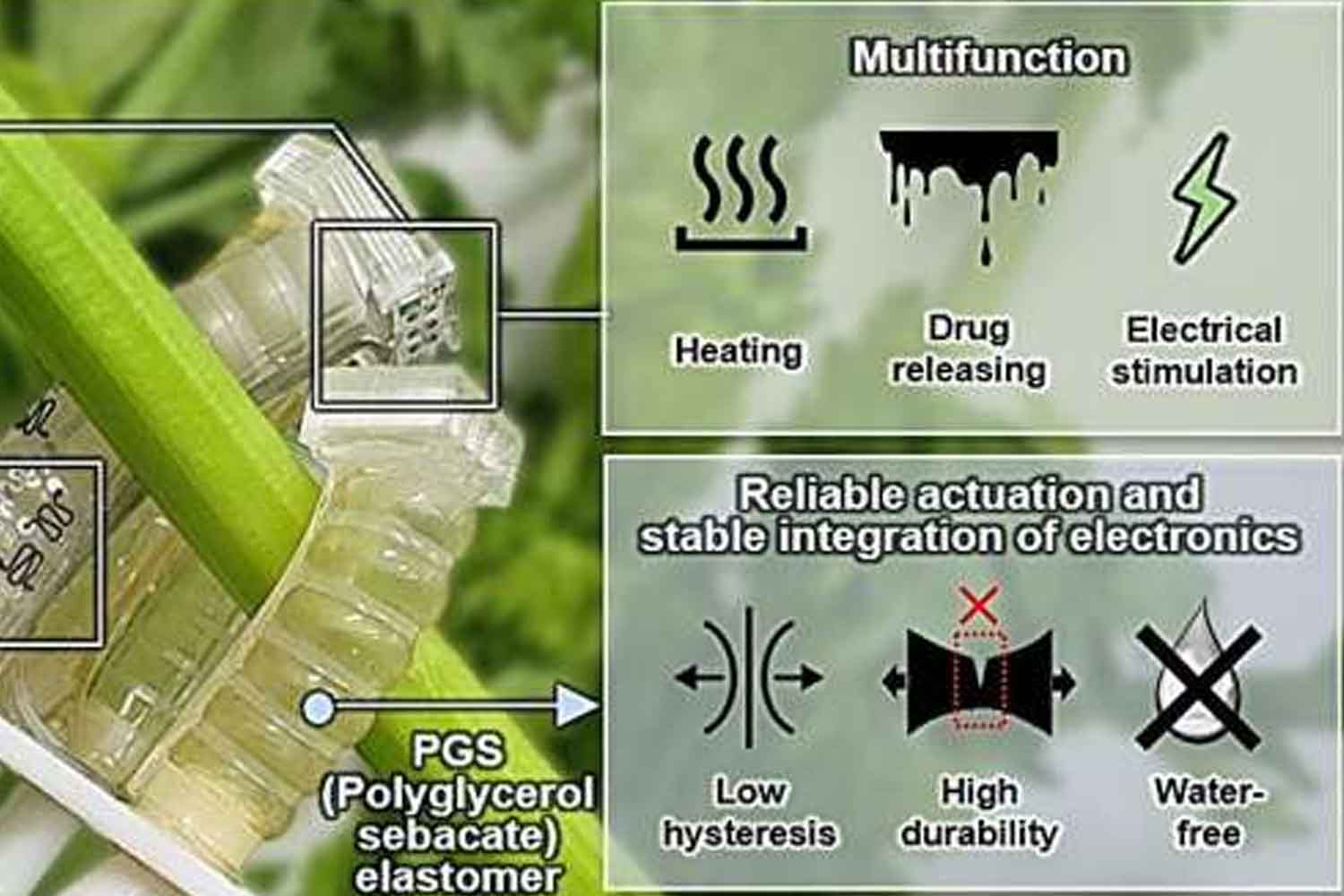
The structure of the robot uses a precise material, the poly(glycerol sebacate) (PGS)a biodegradable water-free elastomer that allows fluid, precise movements with a stable elastic response. This detail makes the difference because it allows the robot to really work, without functional compromises.
The tests reveal surprising resistance. The actuator holds constant bending angles and strength even after over one million cyclesas if time could not affect their behavior. Even after long periods of inactivity it continues to work stably, without sudden failures.
Inside this structure there are electronic components made with biodegradable materials such as magnesium, molybdenum and silicon. Curvature, strain, temperature, humidity and pH sensors coexist with heating systems, electrical stimulation and drug delivery modules. All integrated into a single soft robotic finger, capable of interacting with the environment in a sophisticated way.
Then comes the phase that changes the meaning of everything. Under industrial composting conditions, the entire system decomposes within a few months. The structure disappears, the electronic components dissolve, and the resulting material becomes fertile ground. Plant growth tests confirm absence of toxicityas if that technology had always known where to return.
The researchers’ words convey the scope of the work well. There is talk of a new standard for sustainable robotics, of a platform capable of uniting durability, biodegradability and environmental safety without sacrificing performance. This idea changes the way we imagine the objects that accompany us. A robot that completes its task and then disappears without leaving any traces introduces a different logic, closer to the natural cycles that we have always known, even if we often ignore them.
