
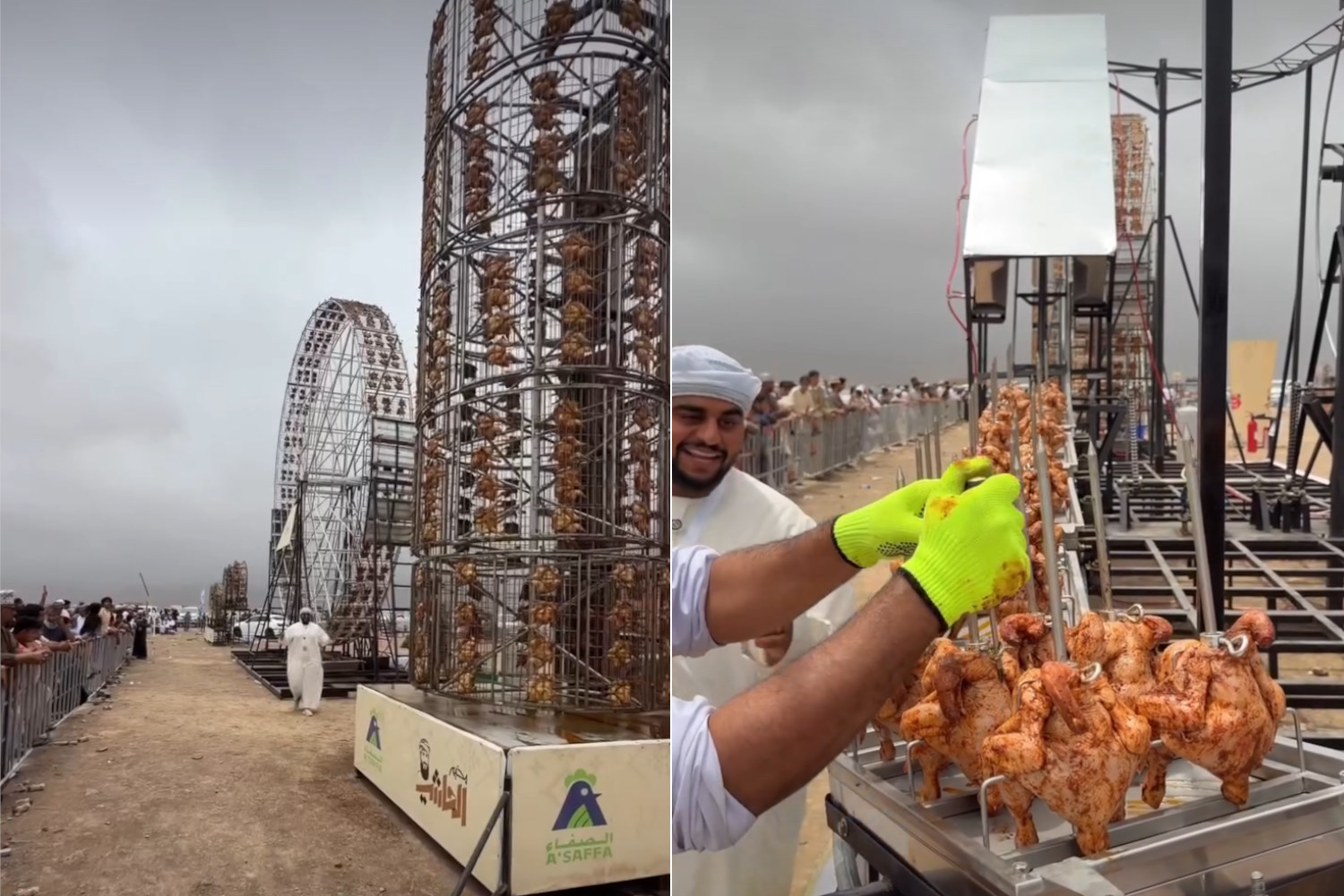
Between July 30th and August 1st 2026, the town of Salalah, located in the Dhofar Governorate in Oman, was transformed into the setting for one of the most disturbing and inhuman performances of recent digital culture, becoming the scene of a culinary installation transformed into a funfair attraction. The initiative was conceived and promoted by Ahmed Al Saadi, a famous Omani content creator and social media broadcaster followed by approximately 1.7 million users on Instagram.
During the Khareef tourist season, at Al Hashi Camp on Ayn Razat Road, the influencer set up what was billed as the largest rotating grill in the world. The mechanical system, structured like a real roller coaster integrated with ovens and Ferris wheels, transported hundreds of raw or partially roasted chickens along a track over charcoal embers. The facility’s operators secured the meat to the metal seats by simulating the safety procedures of human passengers, transforming the preparation of shawarma into a high-impact visual spectacle for digital platforms.
View this post on Instagram
The obsession with virality at all costs
To encourage public participation and fuel this media circus, Ahmed Al Saadi promised immediate gifts and participation in a prize competition with two Mercedes cars up for grabs. To enter the lottery, visitors had to shoot videos of the facility, post them online and tag the organizer’s profile.
The network’s response was as frightening as the installation itself: millions of views, tens of thousands of interactions, thousands of shares and crowds of curious people flocked to applaud the absolute commodification of food and the spectacularization of bad taste. A horrifying show to say the least that was anything but funny but rather a macabre parody of food and life: hundreds of plucked chickens tied to the metal seats of an electric track, slid over the embers as if they were human passengers in an amusement park.
View this post on Instagram
The raid by the authorities and the closure for uncooked meat
The parable of this massacre was interrupted not by an ethical awareness of the grotesque nature of the event, but by the pure and simple technical failure of the ride. The media coverage triggered by the images online has in fact pushed the health inspectors of the Municipality of Dhofar to carry out an immediate inspection of the event area. The technicians took samples of the meat being processed and sent them to a specialized laboratory for biological analysis. The first analytical findings confirmed a reality that was as predictable as it was serious: the mechanical system did not guarantee cooking and the product had large traces of blood and raw meat, representing a serious risk for public health.
Following the findings, the authorities of the Dhofar Governorate ordered the temporary closure of the Salalah plant to protect consumers. The municipal intervention interrupted the event and blocked the supply of meat to the public exiting the carousel. While further laboratory tests on the seized samples are underway, the hygiene department has extended checks to all food service establishments in the region.
The episode leaves behind a desolate image: the parable of an entertainment society willing to transform death and food into a macabre mechanical ballet in order to beg for a few seconds of attention on social networks. A sad and harsh representation of the reality in which we live chasing likes at any cost, even speculating on the lives of poor animals.
