
On warmer nights the problem often begins before you even turn off the light. The room retained heat for hours, the mattress looks like a small domestic greenhouse, the sheets become flypaper. Opening the window only helps when the air outside has really dropped; during heat waves, health indications invite you to keep windows and screens closed during the hottest hours and to let in fresh air only when the outside temperature allows it. The bed, meanwhile, remains there: hot, humid, personal in the worst possible way.
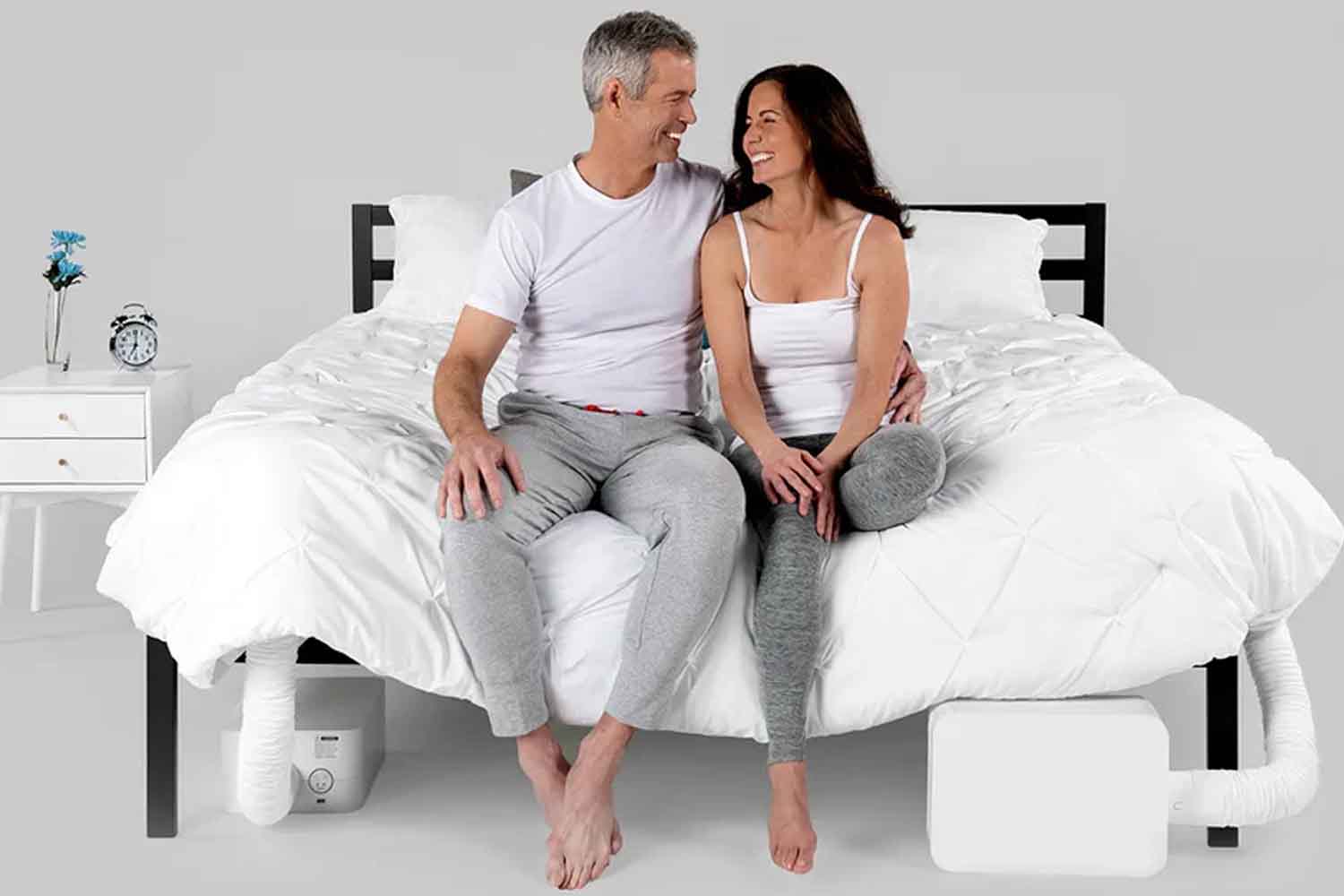
The BedJet tries to intervene precisely at that point, without promising to transform the room into a hotel room with air conditioning turned on at 19 degrees. It is a system composed of a small unit to be placed under or next to the bed, connected to a tube that pushes air between the mattress and sheets. The idea is simple: circulate air close to the body, dry the humidity, disperse the heat accumulated under the covers. The European version is designed for 220-240V sockets and is offered, at the time of verification, at 399 euros in the single configuration, with optional accessories such as the Cloud Sheet.
The air reaches where the normal fan stops
A fan placed in the room moves the air in the room. Sometimes it’s enough, sometimes it just moves the heat from one wall to the other, with that tired helicopter noise that accompanies three in the morning. The BedJet narrows the field: it blows inside the bed, in the area where sweat and heat remain trapped between the body, fabrics and mattress. For those who sleep on memory foam, for those who wake up with a wet back, for those who experience every summer as a diplomatic negotiation with their body temperature, the principle has its own logic.
The technical data sheet talks about air coolingsweat drying and warm mode for winter. The system can be controlled with remote control or app, includes a call function Biorhythm to program temperature variations during the night and, in the version for couples, allows you to manage two different areas of the bed. Translated into domestic life: one half can receive cooler air, the other can stay warmer. A technological truce for those couples in which one person sleeps with a sheet in January and the other takes out the duvet on August 15th.
The declared consumption in cooling mode reaches up to 40 wattsa figure closer to a fan than an air conditioner. The situation changes when heat comes into play: the hot mode can absorb much more, while the turbo reaches high powers for a few minutes. Here the BedJet becomes interesting especially if used wisely: fresh air in summer, rapid pre-heating of the bed in winter, no entire room to bring to temperature when comfort is needed only under the sheets.
The promise holds as long as the room cooperates
The part to look at most carefully lies precisely in the limits declared by the manufacturer. The BedJet works with the air already present in the room. This means that if the room remains very hot, the device can improve the sensation under the sheets, dry out humidity and provide relief, but it remains far from the power of real air conditioning. The same official sheet warns that above i 26°C approximately in the room the heat can overwhelm the convective cooling of the system. It is an important detail, almost more important than the price, because it brings the object back to its real perimeter.
In Italian homes this detail weighs heavily. In many rooms facing west, in attics, in poorly insulated apartments or in cities where the asphalt releases heat until late at night, exceeding 26°C while trying to sleep is far from uncommon. In those conditions the BedJet can act as a comfort ally, drying the wet sensation and moving air in the right place. The promise of “cold” must be taken with sturdy tongs, the kind used to remove the pan from the oven.
The theme, moreover, goes beyond the gadget. High night temperatures worsen the quantity and quality of sleep. A study published in 2025 on Nature Communications linked increased temperature to reduced sleep duration and a greater likelihood of insufficient sleep. CDC guidance on fans also remains cautious when indoor air gets too hot: Above about 100°F, a fan can increase body temperature rather than reduce it.
Useful for sweat and hot flashes, without miracles
The BedJet is also often presented as a support for those suffering from night sweats and hot flashes. Compared to water systems, the practical advantage is evident: no tank to fill, no pipes full of water under the body, no too cumbersome maintenance. The sheet talks about washable filter, remote control, app, quick installation and no wires or electrical components inside the bed, just air flow.
However, there remains an extra object in the room, with a visible tube, a motor, a space to manage and a ventilation noise which, at the highest settings, can be heard. Anyone who sleeps in absolute silence risks being considered an indiscreet roommate. Those who wake up several times a night due to the heat may find it less annoying than a fan pointed in their face or an air conditioner turned on for hours.
Then there is the cost. The European single version starts from 399 euros in the promotion detected, while the double zone configuration reaches much higher figures. The dedicated sheet, designed to better distribute the air, is paid separately. For some it may be a sensible expense, especially in the face of increasingly longer summers, high bills and rooms in which turning on the air conditioning all night seems excessive. For others it remains a bedroom luxury, a cross between an advanced fan and an accessory for technological insomniacs.
The question is where you put it in your home life
Its usefulness depends on three very concrete things: actual room temperature, noise tolerance, type of nighttime discomfort. In an already quite cool room it can make the difference, because it removes humidity and heat from the microclimate under the sheets. In a hot room it promises less. In a couple with opposing needs it can avoid thermostat civil wars. In a house without any strategy against the heat it risks becoming yet another object bought during a sleepless night.
In short, the BedJet works better when it is considered for what it is: a system targeted ventilation for the bednot a climate shortcut. It can make humid nights more bearable, help those who sweat a lot, avoid cooling the whole room when you only need to remove heat from the body. Then comes the most severe test, the one that no technical sheet can soften: an Italian room at 29 degrees, at two in the morning, with the sheet stuck to the skin. There the promises either hold, or they fail.
