
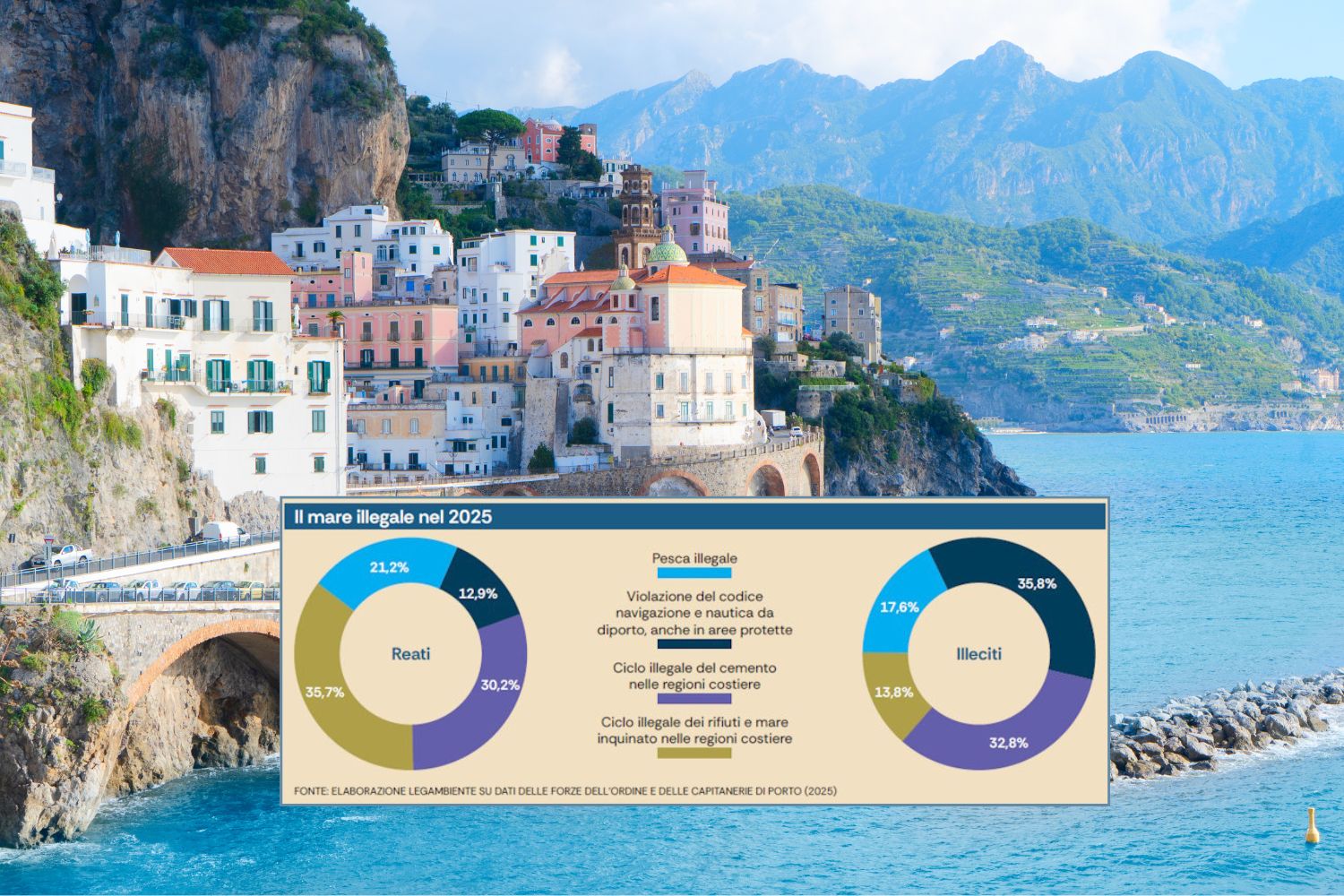
Every day, along the Italian coasts, an average of around 156 crimes are committed or contested, more than 6 every hour. In total, in 2025, law enforcement agencies and port authorities ascertained 20,490 crimes and 36,322 administrative violations, for a total of 56,812 violations.
They are the numbers of Mare Monstrum 2026the twenty-eighth edition of Legambiente’s report on the illegality that besieges the seas and coasts of our country, drawn up on data collected in 15 regions and 61 coastal provinces and presented on the occasion of the sixteenth anniversary of the murder of the fisherman mayor of Pollica, Angelo Vassallo.
Compared to 2024, confirmed crimes decreased by 20.4% and administrative offenses by 10.3%. But, experts say, reading these numbers as a sign of a clear improvement would be misleading: in the same period, in fact, checks dropped by 19.8%, stopping at 750,828. According to Legambiente, the deterrent effect produced by the tightening of penalties for environmental crimes also plays a role in the decrease.
The numbers of Mare Monstrum 2026 only photograph the tip of the iceberg: the share of submerged illegality continues to seriously threaten marine ecosystems, summarizes Stefano Ciafani, national president of the association.
Pollution returns to the forefront
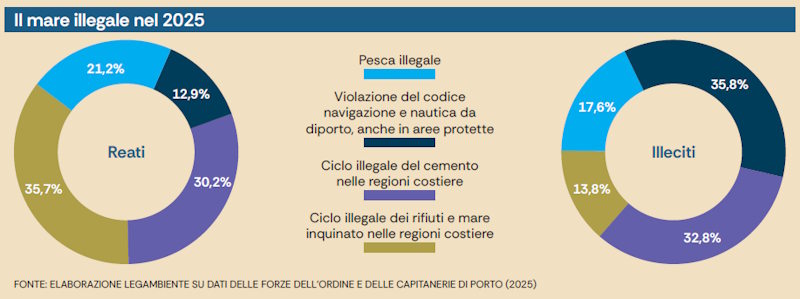
The hierarchy of threats is also changing. In 2025, pollution will surpass the illegal cement cycle and become the first item among the crimes committed along the Italian coasts. There are 7,317 crimes related to pollution, equal to 35.7% of the total. This figure includes above all illegal waste management and problems linked to poor purification.
They follow:
This last category, however, goes against the trend: crimes grew by 17.4% compared to 2024, including violations committed within protected areas.
On the pollution front, 8,397 people were reported, 86 precautionary measures were issued and 2,452 criminal seizures were carried out. The overall value of the criminal and administrative seizures is close to 146 million euros.
@Legambiente
Where is the most polluted sea in Italy located?
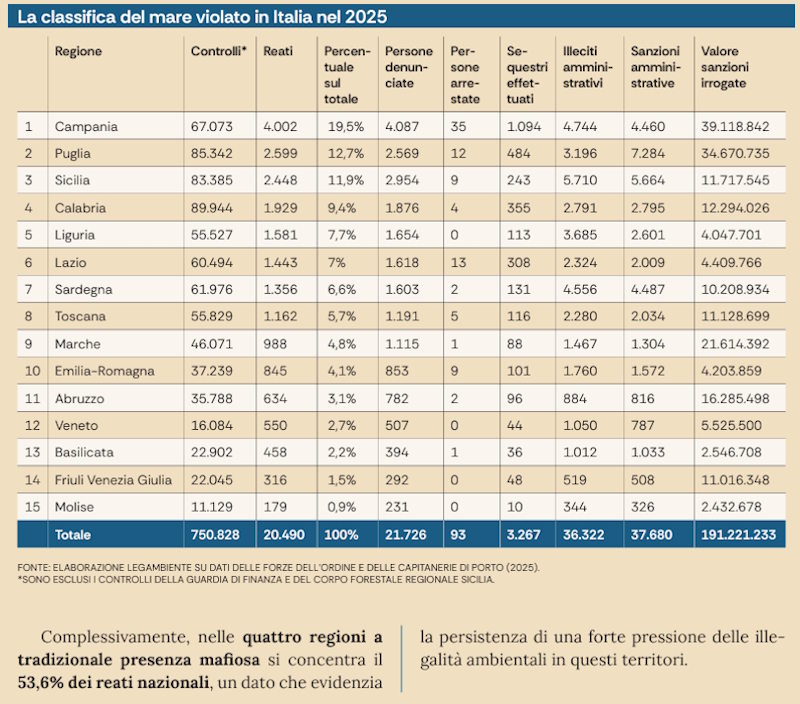
These are the regions that together account for 53.6% of all crimes detected on the Italian coasts.
In first place is once again Campania, with 4,002 crimes, followed by Puglia with 2,599, Sicily with 2,448 and Calabria with 1,929. A figure that does not represent an anomaly limited to a single year. Looking at the last 26 years, since 1999, Legambiente has recorded 483,195 crimes, and 260,399 – 53.9% – are concentrated precisely in the four regions with a traditional mafia presence.
@Legambiente
Liguria appears in fifth place, with 1,581 crimes: 9% more than the previous year, a trend opposite to the decrease recorded at a national level. Followed by Lazio, Sardinia and Tuscany.
Illegal cement
Concrete continues to represent one of the heaviest pressures on coastal ecosystems. In 2025, 6,189 crimes related to the illegal cement cycle were confirmed. The people reported were 6,485, while the criminal seizures were 653.
Also in this case the weight of Campania, Puglia, Calabria and Sicily is enormous: almost 57% of all crimes linked to illegal cement are concentrated in the four regions.
Campania alone accounts for 18.8% of crimes detected at a national level, followed by Puglia and Sicily.
The issue does not only concern illegal buildings, but also the illegal occupation of maritime state property and the failure to demolish works built without authorization: phenomena that remove land and coast from public use and increase pressure on territories that are often already fragile.
Illegal fishing
Impressive numbers also come from poaching: during 2025, 4,194 people were reported and seizures involved over 11 thousand fishing gear and more than 721 thousand kilograms of fish products.
That means around 1,977 kilos of fish seized every day.
Sicily leads the ranking with 816 crimes and is also first in terms of quantity of fish products seized, over 312 thousand kilograms. Liguria and Calabria follow in terms of number of crimes, while Veneto and Tuscany occupy second and third place respectively in terms of quantity of fish seized. A phenomenon that does not only mean violation of the rules: illegal fishing takes away resources from marine ecosystems and risks further compromising fish populations already subjected to strong pressure.
@Legambiente
Fewer complaints and seizures, but also fewer controls
The overall picture for 2025 also shows a reduction in people reported, 21,726, 19.2% less, in arrests, down to 93, and in seizures, 3,267.
On an administrative level, 37,680 sanctions were imposed, for a total value of more than 191 million euros, but the parallel decline in controls requires caution in interpreting the data.
If there was a drop in crimes in 2025, this is due both to the preventive effectiveness of the new environmental penalties and to a reduction in controls on the territory, underlines Ciafani. And this is why Legambiente asks the institutions not to lower their guard.
Purification, illegal construction and controls: what Legambiente asks for
The report also puts a series of proposals on the table. Among the main ones is the strengthening of environmental controls and the National System for Environmental Protection (SNPA), together with the completion and adaptation of sewerage networks and purification plants.
Legambiente also calls for speeding up the reuse of purified waste water, combating illegal occupations of maritime state property more effectively and making the demolitions of illegal buildings more effective.
Among the requests there are also the full application of the European directive on port facilities for the collection of waste produced by ships, stricter measures against discharges at sea and effective sanctions against illegal, unreported and undocumented fishing.
On the illegal front, the association proposes to allocate 100 million euros a year to the fund for the Municipalities carrying out demolitions and another 50 million to the General Prosecutor’s Offices and Prefectures to carry out the sentences.
A decisive change of pace is needed on the part of the institutions, warns Ciafani, asking for interventions capable of “protecting the environmental heritage and the tourist economy of the sea”.
The numbers of Mare Monstrum in short, they tell one thing with particular clarity: the attack on the Italian coasts is a problem of legality, yes, but also one of the ways through which we continue to consume, contaminate and impoverish some of the most precious and vulnerable ecosystems of the country.
HERE you can find the complete report.
