
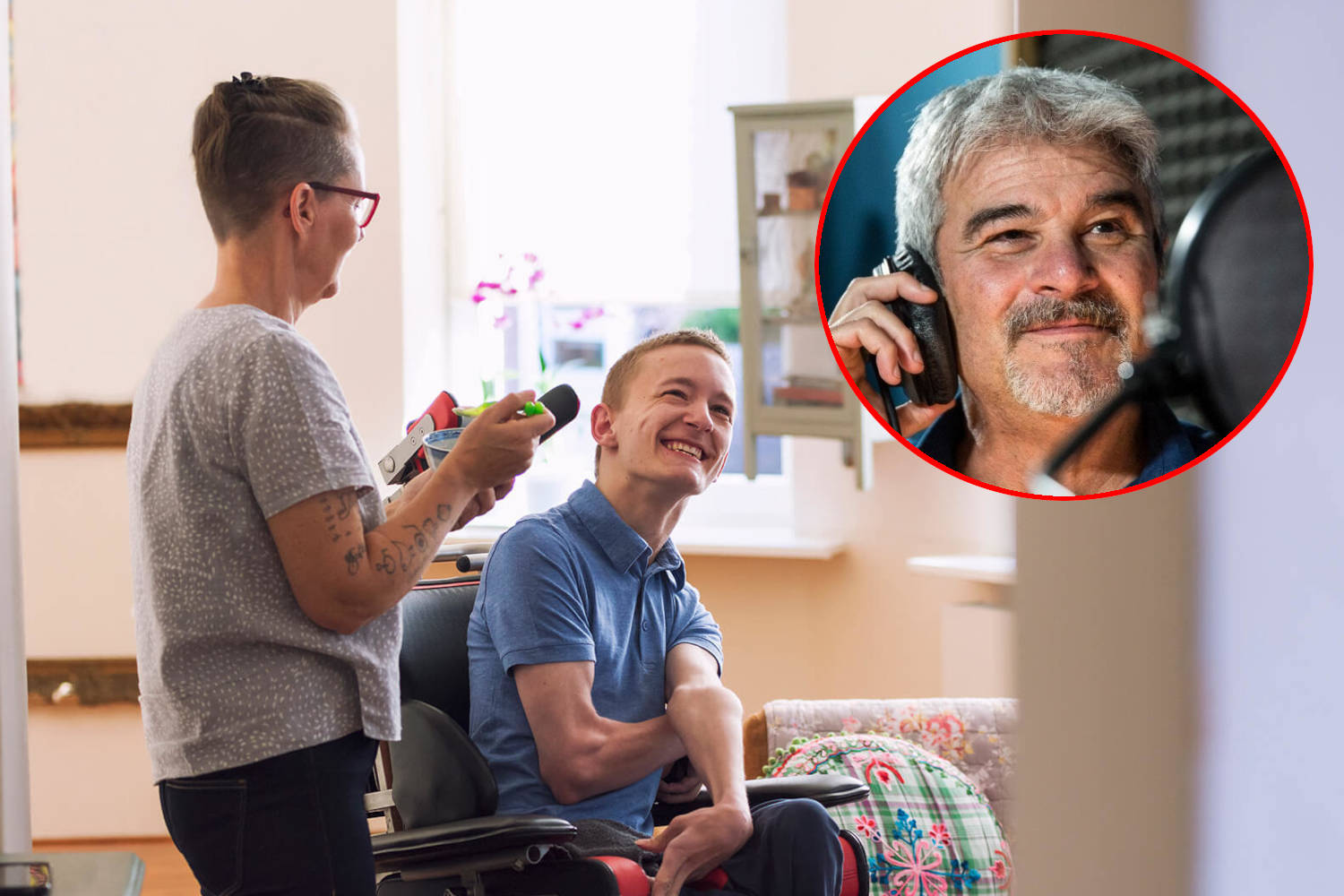
The voice is not just a means of pronouncing words, but it constitutes our first imprint and our profound way of being in the world and bonding to those we love. When a ruthless and degenerative pathology such as Amyotrophic Lateral Sclerosis tears it away, it not only deprives the person of speech, but isolates them and erases their identity.
To respond to this drama, Voice for Purpose was born, an innovative project and global consortium started in 2023 from an intuition of the actor and voice actor Pino Insegno and developed thanks to the close collaboration between excellent entities such as the Campus Bio-Medico University of Rome, the NeMO Clinical Centers, Nemo Lab, Translated, Dream On and with the support of AISLA and Sapio Life. The primary objective is to overcome the cold and robotic traditional vocal syntheses, offering those who have lost the ability to speak a digital vocal prosthesis capable of restoring not only verbal contents, but authenticity, rhythm, frequencies and human expressiveness.
The extraordinary numbers of the platform and the methods of donation and self-donation
What initially appeared as a futuristic frontier is today an operational and consolidated service. The most recent data highlights an exceptional achievement: in just over 3 years, over 6000 entries in 5 different languages have been collected, creating a true digital bank accessible via the dedicated platform.
The system provides two fundamental paths for patients and donors. On the one hand there is self-donation, which allows those who receive a diagnosis of a potentially disabling pathology to record their vocal timbre in advance over a period of time between one hour and 3 hours, even dividing it into several days, so as to secure their sound identity for the future. On the other hand, for those who were unable to record their voice in advance, there is a library of voices donated by common volunteers who do not require professional skills, but only generosity.
Speech syntheses can be provided through the National Health Service
The vocal syntheses generated through this advanced technology have an extraordinary versatility of use, being compatible with smartphones, tablets and computers, and being able to be perfectly integrated into Augmentative Alternative Communication systems, known as CAA, such as communicators equipped with the Matrix or The Grid3 software also used with eye pointing. An aspect of significant clinical and social importance concerns economic accessibility: the vocal syntheses produced can be prescribed directly by the specialist and provided free of charge by the National Health Service by referring to the Tariff Nomenclator code 22.39.07.003.
Although the main application remains linked to ALS and other serious conditions such as stroke, spinal muscular atrophy, cerebral palsy or Rett syndrome, research is already looking beyond. In fact, team coordinator Fabio Minazzi underlines the ambition to create a national database of voices to study, in a research horizon yet to be validated, the use of speech as a possible biomarker for the early diagnosis of neurological diseases, confirming how the voice continues to guard the deepest secret of the human being.
