
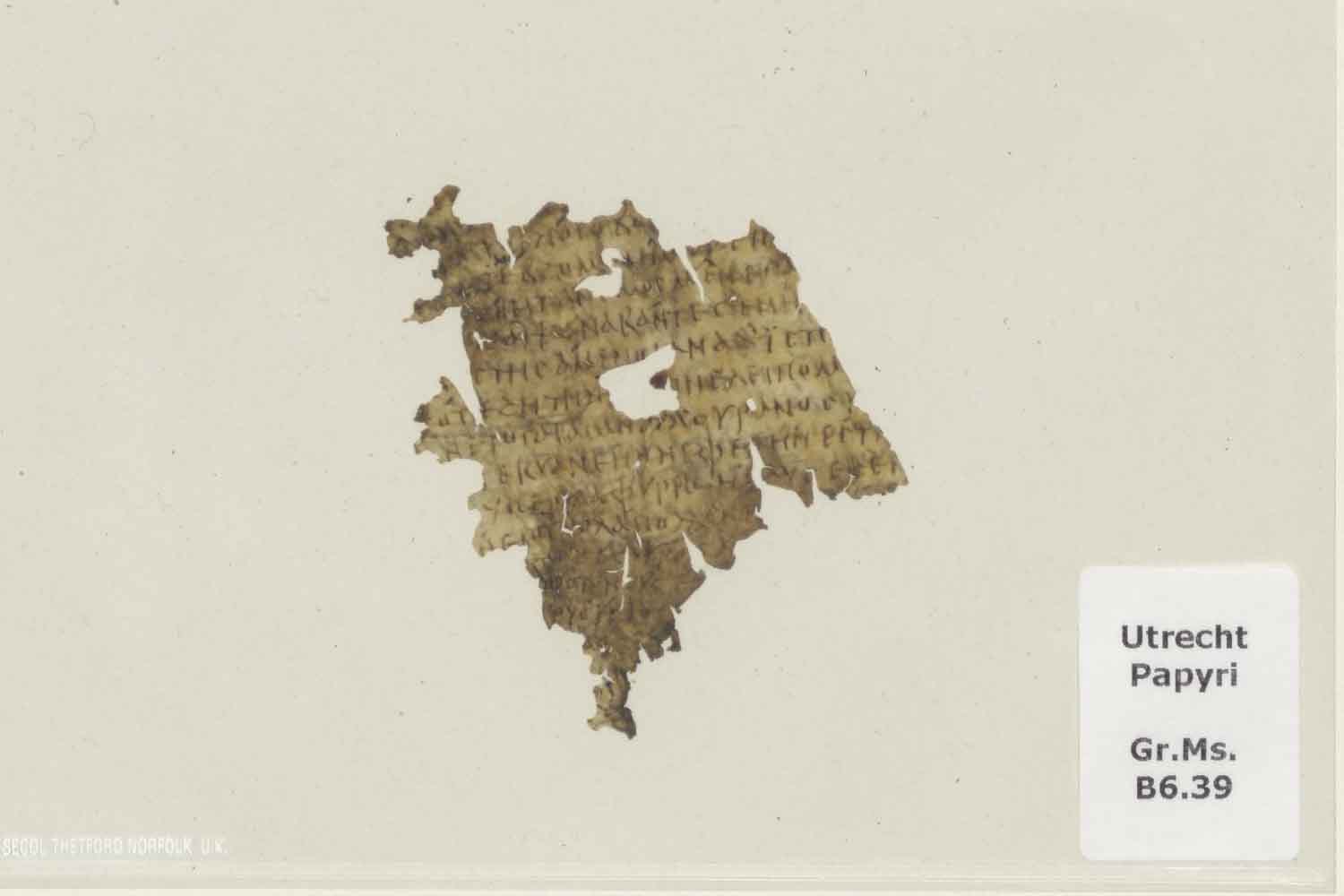
For decades it had sat there, damaged, discolored and cataloged as a modest 7th-century fragment. Then Mark de Kreij took a closer look at those tiny Greek letters and recognized something much more familiar: Homer. The artifact preserved in the library of Utrecht University, in the Netherlands, is a fragment ofOdyssey dating back to the 3rd or 4th century ADtherefore approximately 1,700 years old.
And the material is parchment. The small sheet belonged to a codex, that is, a book made up of bound pages, and preserves some verses from canto XII on both sides. Utrecht University estimates that only about thirty comparable fragments are known worldwide. A little piece of book that had survived for seventeen centuries, in short, had spent a good part of its modern life discreetly minding its own business in the library.
The fragment recounts the moment in which Helios discovers what Ulysses’ men have done
The scene chosen by chance is one of the worst days of Ulysses’ entire journey. After surviving Scylla and Charybdis, his companions arrive on the island of the Sun god, Helium. They have received a specific ban: his sacred cows must be left alone. Starving and stranded on the island, the men do exactly what was forbidden and kill animals for food.
The verses preserved in Utrecht record precisely the moment Elio learns of the sacrilege. From there the story takes a turn for the worse. The god asks Zeus for revenge and the ship is destroyed: Ulysses’ companions die, while he remains alone. It is the lowest point of the journey told by the hero to the court of the Phaeacians and is found, almost perfectly, in the middle of the 24 books of theOdyssey.
That detail makes the fragment interesting even beyond the content of the verses. It does not preserve a marginal episode that miraculously happened under the eyes of a papyrologist: it preserves a narrative point that readers of antiquity knew well, within a work that continued to be copied centuries after its composition.
It was probably a small Odyssey to take with you
The parchment was likely part of something much less monumental than the word “manuscript” suggests. According to the reconstruction of Utrecht University, it belonged to one complete and compact edition ofOdysseyabout the size of a modern e-reader. It would have been produced around 300 AD and probably used by a reader living in the Egyptian oasis of the Fayyum.
A sort of paperback Homer, several centuries ahead of the paperback format.
Even the most recent history of the fragment has something fortuitous about it. In the mid-twentieth century, Utrecht University purchased a collection of early Christian manuscripts from the heirs of the German scholar Carl Schmidt. Most were Coptic texts on parchment, along with some Egyptian and Greek documents. Among that material also ended up the sheet now cataloged as Utrecht Gr. Ms. B6.39a. The letters were small, the support in poor condition and the original identification placed it centuries later.
De Kreij, now a professor of ancient Greek and papyrology at Radboud University in Nijmegen, works on the recovery and study of papyrological collections that have remained little explored for a long time. The fragment ofOdyssey it is part of a larger project on the texts of Greco-Roman Egypt preserved in Utrecht, intended to be published in the volume Hieratic, Demotic, Greek, and Coptic Texts in the Utrecht University Collection (P.Utr.).
The library announced the identification on September 14, 2026. A few lines remain of the code. They were enough, however, to bring to light one of the most well-known passages of the poem: the one in which Ulysses’ men ignore a very clear prohibition and pay the bill in full. 1,700 years later, that terrible decision can still be read.
