
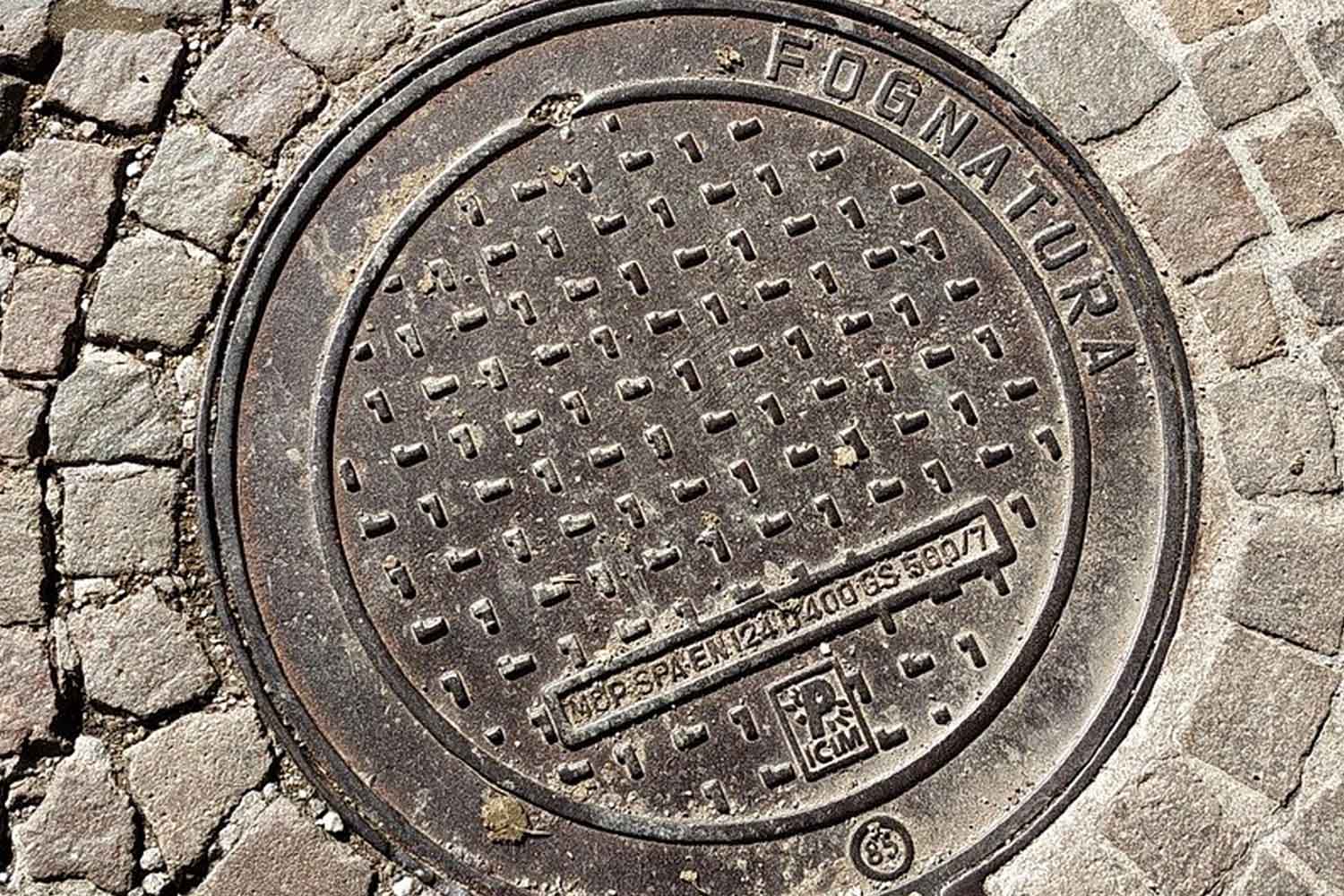
Under the streets, where very practical thoughts and very little imagination usually end up, there also passes a part of the climate that we struggle to see. Manholes, pipes, concrete curves, waste water flowing in the dark: everything seems to belong to the ordinary maintenance of cities, to that world that is only noticed when something breaks, rises, stinks, floods. And instead right there, in the urban sewerage networks, there could be a much more concrete share of methane than the official accounts have considered so far.
Methane, after carbon dioxide, is one of the most important greenhouse gases for global warming: it remains in the atmosphere less long than CO₂, however it traps a lot of heat and weighs heavily in the short term. NASA indicates it as the second largest contributor to global warming after CO₂, while the EPA points out that it is the second most abundant anthropogenic greenhouse gas after carbon dioxide and that its concentrations have more than doubled in the last two centuries. International summaries on methane attribute a share close to 45% of current net warming to anthropogenic emissions, and the United Nations Environment Program has already indicated cutting methane as one of the fastest levers to slow down warming in the coming decades.
Where dirty water remains long enough, pipes become little reactors without oxygen
For years, sewers have remained in a gray area of climate inventories. The initial idea seemed reasonable: the wastewater passes through the pipes for a limited time, so the formation of methane should be marginal. Added to this was a very practical problem, because measuring what happens inside extensive, irregular underground networks, which differ from city to city, is complicated. Thus urban sewer systems have been treated as a negligible source, often assumed to be zero in inventories linked to Intergovernmental Panel on Climate Change guidelines.
The study published on Nature Water turns this accounting convenience on its head. The authors speak of now solid evidence on CH₄ emissions from sewer systems, in contrast to the “zero emissions” hypothesis, and propose a set of equations designed to estimate methane from sewer networks using relatively easily available data: pipe geometry, design flow rates, real average flow rates in dry weather and wastewater temperature.
The material, after all, is all there. Urban wastewater is loaded with biodegradable organic matter. Inside many pipelines, oxygen is in short supply. In these anaerobic conditions, microorganisms find the right environment to produce methane. The sewer stops being just a pipe that takes away what the city expels and becomes a chemical, biological place, alive in the least poetic way possible.
The international group, coordinated by Yuan Zhiguo of the City University of Hong Kong, has been working on these processes for about twenty years, together with researchers from the University of Queensland, the Hong Kong Polytechnic University, Tianjin University and Tongji University. Already in 2008 the group had developed the SeweX model, created to simulate the physical, chemical and biological processes that occur in sewers, including the production of hydrogen sulphide, the gas responsible for many odor and corrosion problems, and that of methane.
The crux was calibration. To make the methane part of the model more reliable, the researchers collected field data in Australian sewer networks using online sensors designed to track what happens inside the pipes. Once the model was calibrated, they simulated nearly 3,000 piping scenarios, changing structure and operating conditions. From there a very concrete element emerged: the production of methane is closely linked to the wetted surface of the pipeline, i.e. the internal portion of the pipe actually in contact with the waste water.
The global estimate is millions of tons per year
The decisive step comes when a complex model is transformed into a more manageable tool. The new estimate allows emissions to be calculated starting from information that many water authorities already have or can reconstruct: pipe diameter, slope, average flows, temperature, designed flow rate and actual flow rate. The tool was then tested with real data from 21 cities in Australia, the United States, China and Belgium.
The result has the weight of inconvenient numbers: global sewage systems would emit between 1.18 and 1.95 million tons of methane every year, i.e. 1.18–1.95 teragrams of CH₄. According to the study, this share would add between 1.7% and 3.3% to global methane emissions today attributed to the waste sector and between 15.7% and 37.6% to the estimated climate footprint of wastewater management.
For once the climate problem has an unspectacular form. No visible flames, no smokestacks, no large satellite images. Just pipes, dirty water, organic matter, no oxygen and an urban network that grows along with the cities. It is precisely this normality that makes the data important: if sewerage is counted as zero sources, a part of the emissions remains outside the picture. If they enter the inventories, they become a measurable and therefore manageable item.
Yuan Zhiguo and his team insist on this: sewers represent a quantifiable source of methane, with global climate implications. The growth of urban networks, especially in areas where the expansion of cities is faster than environmental planning, can also increase the emission potential. Including these emissions in national greenhouse gas accounting systems would help make inventories more realistic and open up new space for intervention for reducing emissions.
Without a measure, that methane remains invisible maintenance. With an estimate, it enters the budgets. Climate policies also live on what they can count. A leak from a gas pipeline, a landfill, a farm, an industrial plant: everything enters the debate more easily when it leaves a clear trace in the data. Sewers have long enjoyed a kind of technical anonymity. They were underneath, they worked, they disappeared from the conversation. This new tool takes away that alibi from them.
For cities, it means looking at wastewater with a broader lens. Managing a sewer system concerns hygiene, safety, maintenance, odors, corrosion, flooding, public health. From now on, with more force, it also concerns the climate. Methane from sewers becomes a small item compared to the giants of global emissions, yet large enough to deserve a line in national budgets. The asphalt remains above. Below, the count continues.
You might also be interested in:
