
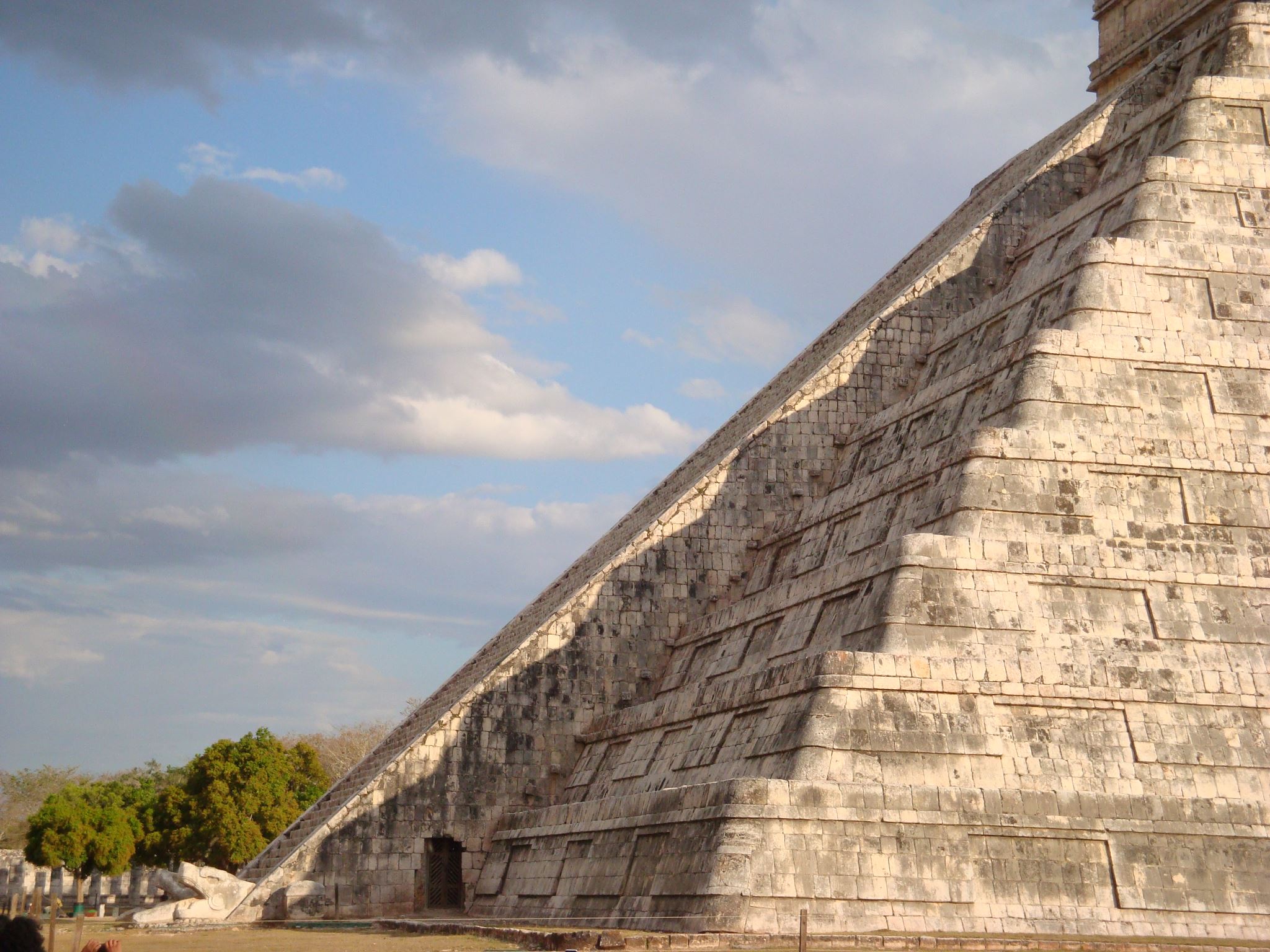
In the heart of the Yucatán Peninsula, the archaeological site of Chichén Itzá stands as one of the most fascinating and mysterious in the world. This ancient Mayan complex, recognized among the seven wonders of the modern world, attracts thousands of visitors every year, curious to discover its majestic structures and the secrets that are hidden there. Among these, one of the most extraordinary events is linked to the pyramid of Kukulkán, also known as El Castillo, where a breathtaking phenomenon occurs: the appearance of a serpent-shaped shadow that seems to descend along the steps of the pyramid during the spring and autumn equinoxes.
In reality, the play of light and shadow is created by the sun, which gives life to a suggestive optical illusion: a snake-shaped silhouette along the 91-step staircase of the pyramid, which descends to the earth during the first light of dawn and then rises towards the sky during sunset.
How the serpent of light is born (scientific explanation)
The famous “Descent of Kukulkán” is the result of a careful play of light and shadow designed by the ancient Mayan builders. When the Sun is in the right position, the corners of the pyramid’s terraces project a series of luminous triangles onto the northern stairway, creating the impression of the sinuous body of a serpent descending towards the head carved at the base of the structure.
Although today the phenomenon is explained by science, its ability to arouse wonder remains intact. It is precisely this fusion of astronomical knowledge, architectural skill and religious symbolism that makes Chichén Itzá one of the most fascinating places left by ancient American civilizations.
A surreal sight to see once in a lifetime
According to Mayan legend, in fact, twice a year the serpent god visits the pyramid dedicated to him to get in touch with his worshipers and bring his blessings to ward off drought so that the harvest is good. But not only that. Near this pyramid it is possible to experience a particular sound effect. According to some scholars and observers, the echo produced by the pyramid recalls the cry of the quetzal, the bird sacred to the Maya, symbol of freedom and divine power. Scholars have discovered that this acoustic marvel is due to the particular architecture of the pyramid, which creates a system of echoes and resonances unique in the world. It is another example of Mayan ingenuity, which managed to combine architecture and nature to create extraordinary sensory experiences.
The Pyramid of Kukulkàn, also known as El Castillo, is the center of Chich’en Itza and was built by the pre-Columbian Maya civilization between the 9th and 12th centuries. In 1988 the archaeological site was declared a UNESCO World Heritage Site. The descent of the god Kukulkàn represents a very important moment for the Mayan tradition, to be witnessed at least once in a lifetime. The event is artificially recreated during a light show projected onto the pyramid.
The symbolic importance of the feathered serpent
Kukulkán is not just a deity, but a complex symbol that represents the union of opposites: earth and sky, body and spirit. The descent of the serpent god onto the pyramid is not just a visual spectacle, but a moment full of spiritual and religious meaning. According to legend, the god descends to earth twice a year to bless his faithful and ensure the fertility of the land, averting drought and ensuring abundant harvests. This ritual, which has its roots in a distant past, continues to exert an irresistible fascination on anyone lucky enough to witness it.
The show, scheduled every evening from Tuesday to Sunday, lasts about half an hour and is accompanied by sounds and stories about the extraordinary Mayan civilisation.
A masterpiece of Mayan astronomy and architecture
The Kukulkán pyramid is also a sophisticated stone calendar. The structure is in fact linked to the astronomical cycles observed by the Mayan civilization, which studied the movements of the Sun, Moon and stars with great precision. Its four sides are oriented towards the cardinal points and the 91 stairs on each side, added to the upper platform, symbolically form the 365 days of the solar year.
This link between architecture and astronomy demonstrates how fundamental the observation of the sky was for the Maya not only for measuring time, but also for organizing agricultural and religious life. The equinoxes, moments in which day and night have almost equal duration, therefore represented particularly important passages in their system of knowledge.
Chichén Itzá, a city at the center of the Mayan world
Chichén Itzá was not just a ceremonial place, but a real city with buildings dedicated to religion, astronomical observation and public life. In addition to the pyramid of Kukulkán, the site includes the Great Ball Court, the Temple of the Warriors and the astronomical observatory known as El Caracol.
The presence of such different buildings testifies to the central role that the city had in the Yucatán region between the terminal classic and postclassic periods of the Maya civilization. Even today the site represents one of the most important testimonies of the ingenuity, scientific knowledge and culture of this ancient people.
Even today, in front of the pyramid of Kukulkán, science and myth seem to meet: a play of light created by stone and the Sun which continues, after centuries, to tell the extraordinary vision of the Mayan world.
Sources: Chichen Itza
