
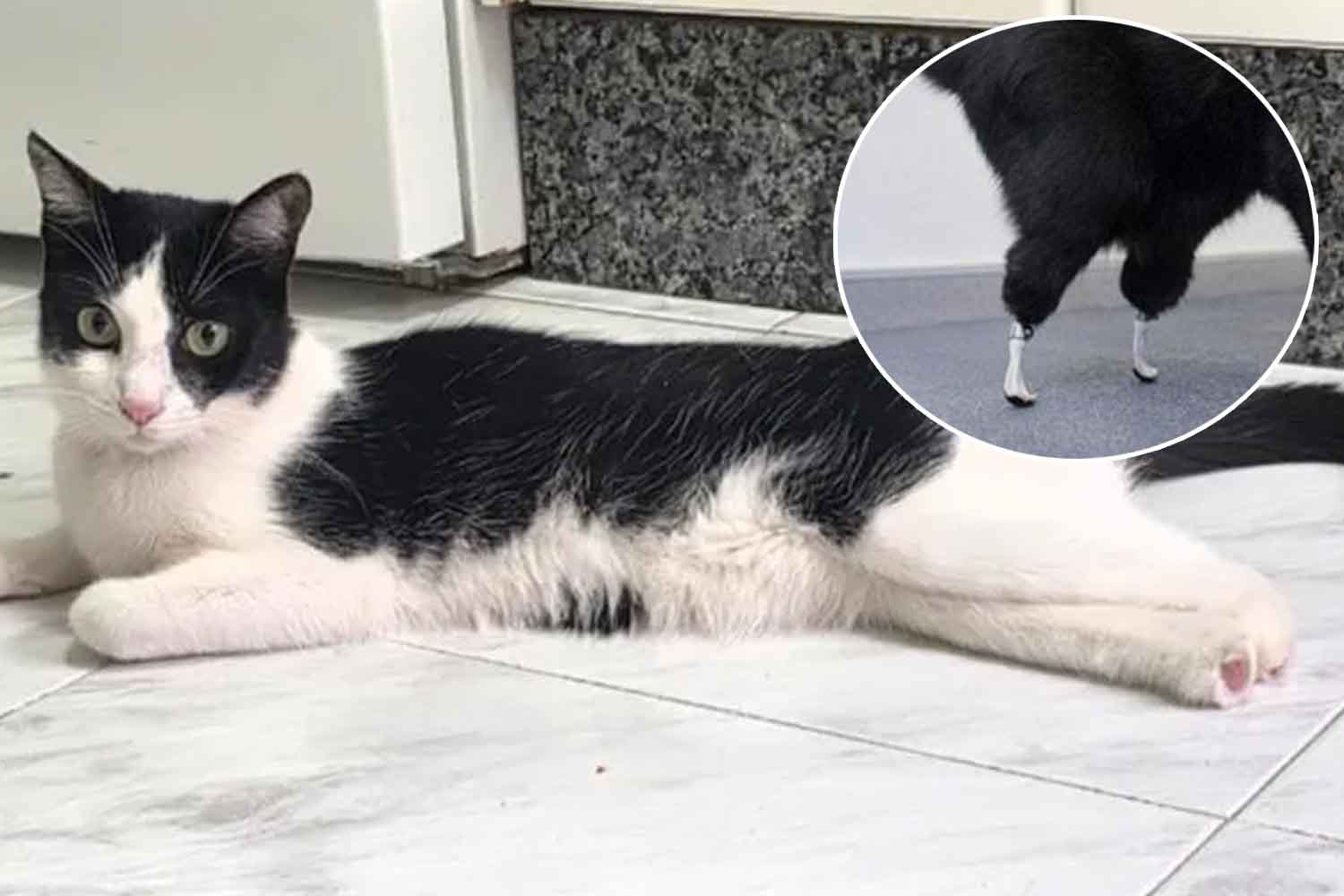
For two years Venus did what cats do quite well: adapt. She was born with one malformation of the hind legs and, having no terminal part of his limbs, he learned to move by placing his stumps directly on the ground. He ran, played, climbed as best he could. Except that, as she grew up, that constant rubbing began to cause injuries and pain.
Now one of its legs ends in something completely different: a custom designed titanium implantfixed to the bone and intended to support a real prosthesis. The second surgery should also arrive in about a month. This is how Venus, just two years old, became the first “bionic cat” in Spain.
Its story begins in Foios, near Valencia. Venus was just a month old when Vanesa learned of a litter born near a factory and of that kitten with hind legs different from the others. It was supposed to be a temporary shelter. It went as these things often go with cats: Venus stayed.
Two prostheses built especially for her
As the months passed, the problem became more evident. Walking directly on the stumps exposed the skin to constant rubbing, irritation and lesions. The family then began looking for a solution that would allow Venus to unload the weight on two new supports and move without continuing to traumatize the tissues.
Thus the project of the two osseointegrated prostheses was born. The fundraiser dedicated to Venus tells of a rather challenging journey: the implants must be built to the precise measurements of her bones and surgically inserted into the tibias. The first operation lasted about four hours. The team of orthopedic veterinarian Antonio Cañadillas, specialized in traumatology and orthopedic surgery of small animals, took care of it.
“Bionics,” in this case, does not mean that Venus has suddenly acquired motors, sensors and intentions to conquer the living room. The internal part of the implant is made of titanium and is anchored directly to the bone; the external one will instead serve to connect the prosthesis on which the cat can rest.
Now he has to learn to use his new paw
The surgery is just the beginning. Venus must go through the healing phase, allow the tissues to stabilize around the implant and then learn to redistribute the weight on a paw that until a few weeks ago ended much earlier.
Osseointegrated prostheses in animals remain a specialized and still uncommon procedure. The available veterinary studies describe animals that, after surgery and rehabilitation, have managed to return to using the limb, even if the process requires careful checks precisely because the implant passes through skin and bone. A clinical series published in Veterinary Surgeryfor example, documented the use of transcutaneous intraosseous implants in amputated dogs and their subsequent functional recovery. For Venus all this means several visits, medications and patience. Then it will be the second paw’s turn.
A fundraiser of almost 10 thousand euros
There’s also a less sophisticated obstacle than titanium: cost. The initial estimate reported in the campaign organized for her exceeded 7 thousand euros only for customized prostheses. Considering interventions and veterinary treatment, the family spoke of a total expense close to 10 thousand euros. To raise the necessary amount, donations and initiatives dedicated to the cat arrived. And the first piece of the project has now become a real paw to learn how to use.
If everything goes as planned, after the second surgery Venus will finally be able to walk without placing the stumps directly on the ground. And maybe go back to dealing with decidedly more feline things: running, jumping and reaching places where no one had any particular interest in letting her get to.
