
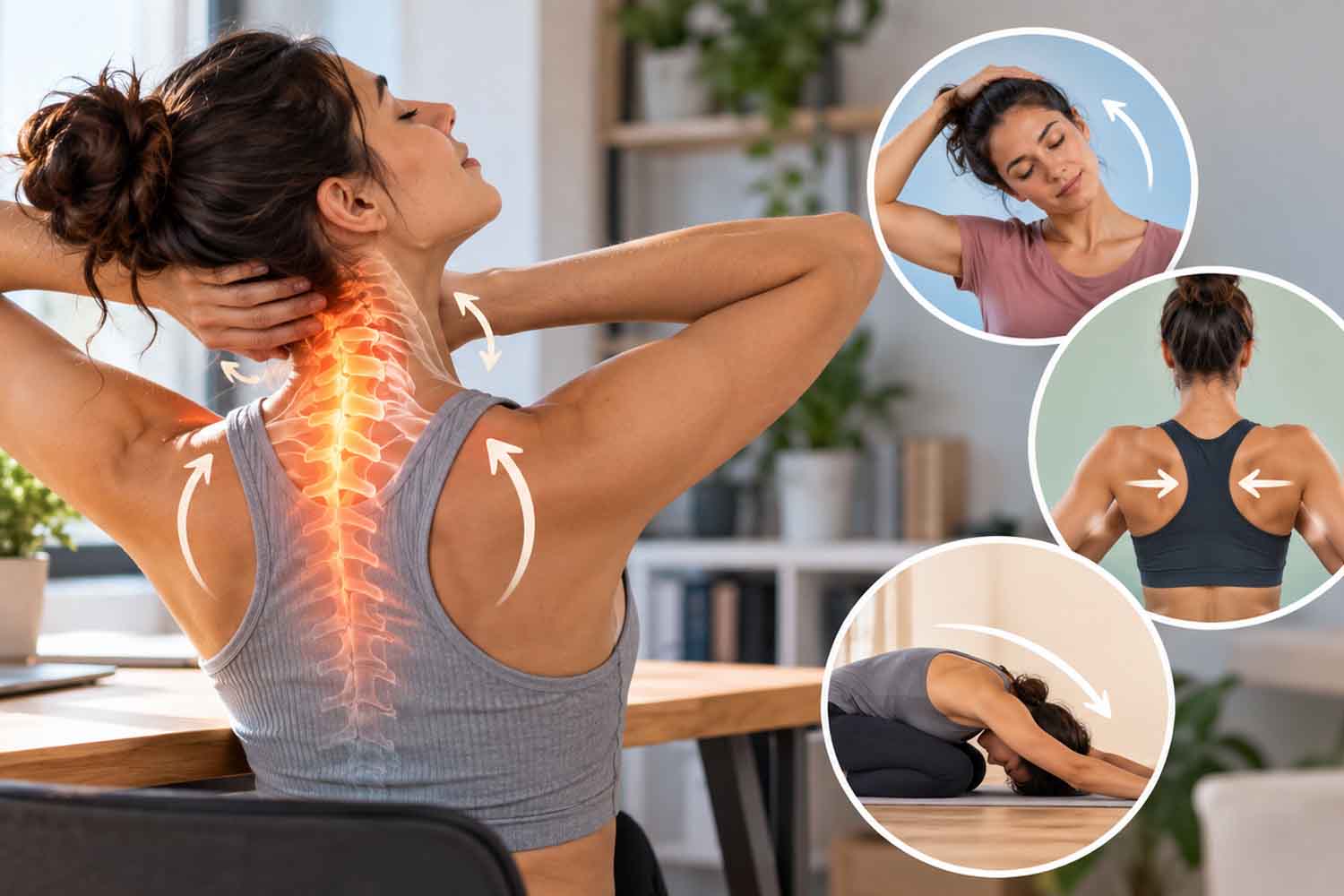
Spending hours in front of a computer, driving for a long time or simply spending half a day with your smartphone a few centimeters under your nose can leave a rather precise memory: a stiff neck, shoulders that seem to have moved close to the ears and that tension between the shoulder blades that we continue to try in vain to “crack”.
However, there is no need to transform the living room into a gym. To keep the neck, shoulders and thoracic tract moving, even very simple exercises may be enough, some of which are done sitting on the same chair on which we probably built the problem.
In fact, NHS physiotherapy services remind us that, in the presence of the most common cervical problems, the aim of the exercises is above all to maintain or recover movement and limit stiffness and weakness linked to immobility. This is explained, among others, by the NHS Dynamic Health service.
Here are 15 movements to try, without chasing maximum amplitude at all costs: the neck is not a bottle cap.
1. Tuck your chin in
He’s the famous one chin tuckdecidedly less elegant than the English name once you discover that it essentially consists of voluntarily getting a double chin. Sit or stand with your back straight and your gaze straight ahead. Gently bring your head back, without lowering it, as if you wanted to align your ears with your shoulders. Hold for a few seconds and relax. It is one of the exercises also suggested by NHS physiotherapy services to work on cervical movement.
2. Bring your shoulder blades back
Sit with your hands resting on your thighs. Without arching your lower back, gently bring your shoulder blades together, then release them. There’s no need to squeeze them until they meet. The movement must be small and controlled. Scapular retraction appears among the exercises recommended by Dynamic Health for those suffering from neck stiffness and pain.
3. Use the back of the chair to open your chest
Choose a chair with a fairly high backrest, place your feet well on the ground and place your hands behind your head or cross your arms over your chest. At this point, slowly lean back, letting the upper part of the backrest support the thoracic area. The movement must mainly involve the central and upper part of the back, not turning into a competition to see who can look at the wall behind them. Cambridge University Hospitals NHS Trust includes the chair thoracic extension among the exercises to improve the mobility of the central part of the spine.
4. Slowly rotate your neck
Keep your torso still and slowly turn your head to the right until the movement is comfortable. Return to center and repeat to the left. No impulses and above all no attempts to gain a few degrees by also rotating the shoulders and chest: in that case it is the torso that is doing the work instead of the neck. Cervical rotations are part of the mobility exercises offered by NHS physiotherapy services.
5. Do a few shoulder turns
Raise your shoulders slightly towards your ears, bring them back, then down and finally forward again, drawing a large circle. You can also repeat the movement in the opposite direction. It almost seems too easy to deserve the name exercise, but the shoulder rolls they are used in physiotherapy programs to keep the shoulder girdle moving.
6. Rotate your torso while remaining seated
Sit up straight and place one hand on the outside of your opposite thigh, while the other can rest behind you on the chair. Slowly rotate your chest without moving your pelvis, return to center and repeat on the other side. It’s an easy way to work the thoracic spine after many hours spent in virtually the same position.
7. Bring your chin towards your chest
This time the movement is different from chin tuck. Slowly lower your head, bringing your chin towards your chest until you feel a slight stretch in the back of your neck. Hold for a few seconds and return to the starting position. Cervical flexion is also one of the simple mobility exercises indicated in physiotherapy programs dedicated to the neck.
8. Stretch the side of your neck
Sit up straight, leave one shoulder relaxed and slowly tilt your head towards the opposite shoulder. You can hold the position for a few seconds, without pulling your head with your hand. A variant proposed by Cambridge University Hospitals works in particular on the upper trapezius and sternocleidomastoid and recommends not forcing the head with the hand.
9. Rounds your upper back
Sit with your feet on the ground. Bring your chin towards your chest and let your upper torso gently round forward, keeping your head and shoulders relaxed. Then return to the starting position.
10. Switch to cat-cow
Get on all fours with hands under your shoulders and knees under your pelvis. Exhaling, slowly round your back and let your head drop. Then reverse the movement, opening your chest and letting your spine gradually return in the opposite direction. There is no need to push the extension to the maximum: it is much more important to move slowly. This alternation between flexion and extension also appears in the Cambridge University Hospitals thoracic mobility exercises.
11. Rotate your chest on all fours
Still on all fours, bring one hand behind your head and open your elbow outward while slowly rotating your chest. Return to the center and repeat on the other side. The head follows the movement without being dragged by the hand. Quadrupedia thoracic rotations are used to work on the mobility of the upper back.
12. Slide your arms forward
Start on all fours again and slowly slide your hands forward on the floor while bringing your pelvis back. The chest gradually approaches the ground, but without forcing the shoulders. Cambridge University Hospitals offers a similar movement between exercises to increase mobility of the thoracic spine.
13. Test the extension with a rolled towel
Lie on your back and place a rolled towel lengthwise in the middle of your back, between your shoulder blades. Place your hands behind your head with your elbows initially pointing upwards. Inhaling deeply, then slowly let your elbows open outwards.
14. Tilt your chest sideways on the chair
Sit sideways in a chair with a back and, if necessary, place a small pillow between your hip and the back. Bring your hands behind your head or cross your arms over your chest and gently tilt your torso to the side. Then change positions and work on the other side. In this case we are not just tilting the neck: the movement mainly affects the thoracic spine.
15. Do an unweighted row
Sit with your back straight and bring your arms forward. From here, bend your elbows and pull them back, imagining bringing your shoulder blades together. Then extend your arms again and repeat with a slow movement. Dynamic Health offers a version of this seated row without equipment among the exercises dedicated to the cervical and scapular area.
How many exercises do you need to do?
You don’t have to go through all 15 every time, as if there were a physical education exam at the end. A more realistic solution may be to choose some of the most suitable ones at the moment: a couple to do sitting during a break, some movements for the shoulders and one or two exercises for the thoracic area when you have more space. The Dynamic Health service suggests starting with a few exercises and adapting the movement and number of repetitions if the pain increases.
And above all: an exercise should not be a test of pain resistance. Abrupt, forced movements or movements that cause a marked worsening of symptoms do not become more effective just because we grit our teeth.
In case of sudden and intense neck pain, rapid worsening, weakness in the limbs, coordination problems, changes in sensitivity or pain that appeared after a trauma, it is advisable to contact a doctor. The NHS also recommends an assessment if pain or stiffness persists for several weeks.
The rest of the time we can at least remind ourselves that the body, unlike the computer, was not designed to remain in exactly the same position for eight hours.
