
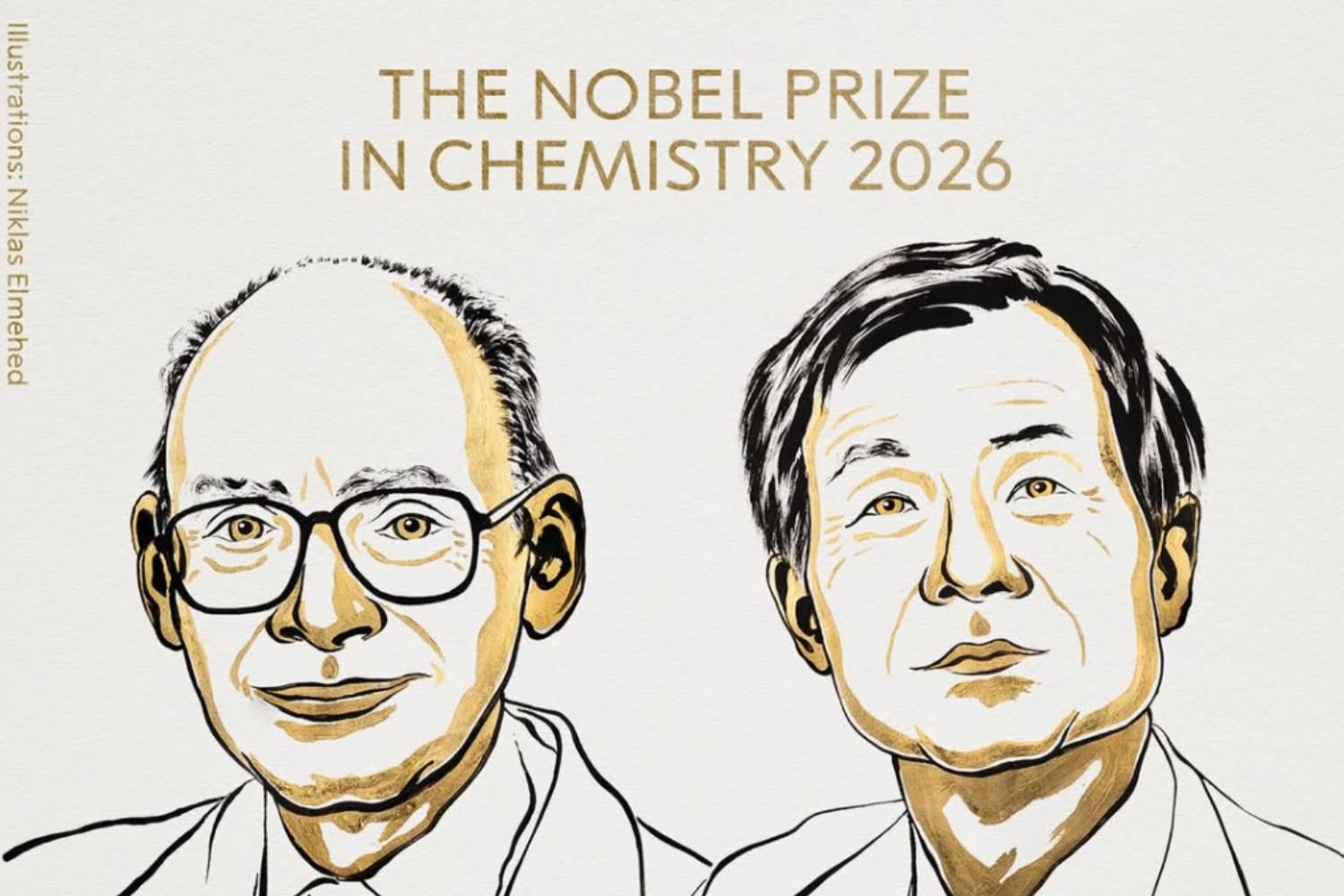
The Royal Swedish Academy of Sciences awarded the Nobel Prize in Chemistry 2026 to Henri B. Kagan And Kenzo Soai “for the discovery of nonlinear effects and autocatalysis in asymmetric organic synthesis“At the heart of the prestigious recognition is an extraordinary property of living matter that chemists define homochirality. Many biological molecules, including the amino acids that make up our proteins, do in fact exist in the form of two mirror-image variants of each otherexactly like the right hand and the left hand.
Although in the laboratory chemists historically obtained perfectly balanced mixtures of both forms, living organisms they selectively use only one of these mirror imagesleaving the other almost completely absent in nature. For over a century, understand how this chemical asymmetry could have emerged spontaneously has remained one of the biggest questions in science. The discoveries awarded this year offered the key to understand and replicate this extraordinary selective mechanism.
View this post on Instagram
From Kagan and Soai’s theory to the pharmaceutical applications of the future
The contribution of the two scientists revolutionized the way of conceiving chemical reactions, overcoming the limits of traditional methods. In the development of molecules intended to interact with biological systems – as in the fundamental case of drugs – the distinction between the two mirrored forms is vital, since only one of them has the desired therapeutic effect, while the other can be ineffective or even harmful.
Pioneering research conducted by Henri B. Kagan and Kenso Soai made it possible to drive the asymmetric synthesisexploiting complex phenomena such asautocatalysis they non-linear effects. This scientific triumph, included in the prestigious history of the Nobel awarded continuously since 1901, not only reveals the chemical origins of life on Earth, but opens the doors to industrial and pharmaceutical synthesis methodologies of inestimable value for the future.
