
A square of white fabric exposed to the sun managed to stay between 3 and 6 °C below the air temperature. In the same material, the movement also generates a small amount of electricity, enough to detect a gesture and command the turning on of a heating system. All inside a flexible structure that can be printed.
The material was developed by a group at the University of Illinois Urbana-Champaign and described in a study published in Advanced Science. The base is a nanocomposite of polydimethylsiloxane, or PDMS, and zirconium oxide (ZrO₂)worked through a printing technique called direct ink writing, a sort of 3D printing in which the ink is deposited forming a network of fibres.
The result has two characteristics that usually end up in different materials: it reflects much of the sun’s energy and uses contact and movement to generate electrical charges.
It reflects 96% of solar radiation
In tests the fabric achieved a 96% solar reflectance and a mid-infrared emissivity of 97%. In practice it absorbs little energy from the Sun and, at the same time, manages to disperse part of the heat outwards in the form of infrared radiation.
To verify how much this translated into cooling, the researchers carried out outdoor tests in Urbana, Illinois, under direct sunlight. The more immediate numbers, however, require a clarification: those 3-6 °C below room temperature was not measured on the skin of a person wearing a t-shirt.
The quantitative experiment used a skin simulator. With the heat source turned off, under the conditions normally adopted to measure passive radiative cooling, the material remained between 3 and 6 °C below the surrounding air. With the simulator heated to mimic human metabolic heat, the tissue instead recorded temperatures lower than 6-10 °C compared to white cotton6-14 °C compared to the surface left uncovered and 10-15 °C compared to a silver-coated fabric.
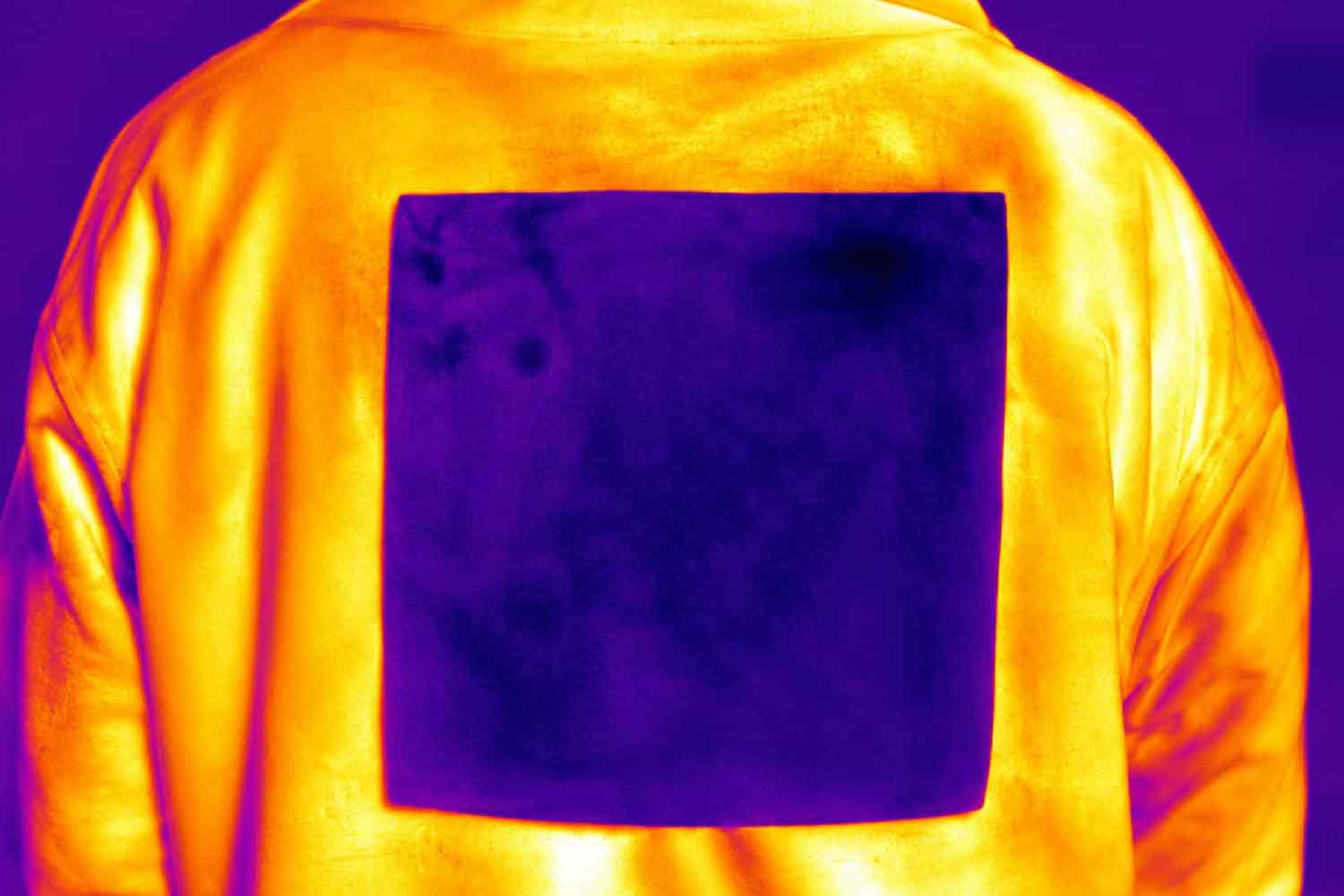
The University of Illinois Urbana-Champaign also showed a larger version applied to the back of a shirt: in the thermal image the area covered by the new material appears significantly colder than the surrounding fabric. It’s a promising visual demonstration, still far from a clinical test on people spent hours in the sun.
By moving it also produces electricity
Zirconium oxide also serves a second job. When the material comes into contact with the skin and then separates, it produces a charge through thetriboelectric effectthe same physical phenomenon behind the small shock that can occur after walking on carpet.
With the optimized composition, the researchers achieved a maximum power density of 47 milliwatts per square meter. The signal remained stable after 30,000 operating cycles. These are interesting numbers for wearable sensors, decidedly less so for turning your sweatshirt into an electrical socket. In short, for the phone you still need the charger.
The team used material on the elbow to track the movements of the joint and on the fingers to distinguish different configurations of the hand. The electrical signals produced by the movement can therefore function directly as sensors, without requiring a separate continuously powered sensor.
Movement can control the heating, but the energy comes from outside
The most curious part of the experiment comes when cooling and movement are put together. The researchers printed the nanocomposite on top of a silver-coated conductive fabric, capable of heating by the Joule effect.
When the system detects strong enough movement, the triboelectric signal activates a circuit that turns on the heat. In the tests, increasing the frequency and duration of the touches also increased the thermal response: at a frequency of one touch per second an increase of approximately 10°C in 3.8 minutes.
Here the detail is important: the electricity produced by movement alone does not provide the energy needed to heat the tissue. It works as a command. In the experimental setup, a microcontroller and a relay received the signal, while the heating energy came from an external power supply.
The idea is therefore that of a material that remains passively cool under the Sun and can use the movement of the wearer to decide when to activate a separately powered thermal system.
For now it has survived ten washes, not a season in the wardrobe
The printed structure showed a vapor permeability close to that of commercial cotton, and the optical properties remained essentially stable after ten wash cycles at 30°C with detergent. A good start, difficult to assimilate to the months or years of washing, sweat, rubbing and drying that await a real garment.
The same authors indicate better sweat management and longer checks on the aging of the material among the subsequent steps. There is also a commercial interest to declare: research coordinator Lili Cai is co-founder of SolarMantle and inventor of patents related to radiative cooling technologies, a circumstance reported in the study.
The material nevertheless brings together into a single structure passive cooling, energy harvesting and motion sensingavoiding some of the multi-layered architectures used so far. There isn’t a t-shirt ready to put in the backpack yet. First it has to survive something far less elegant than a laboratory: people, sweat and many more than ten washing machines.
