
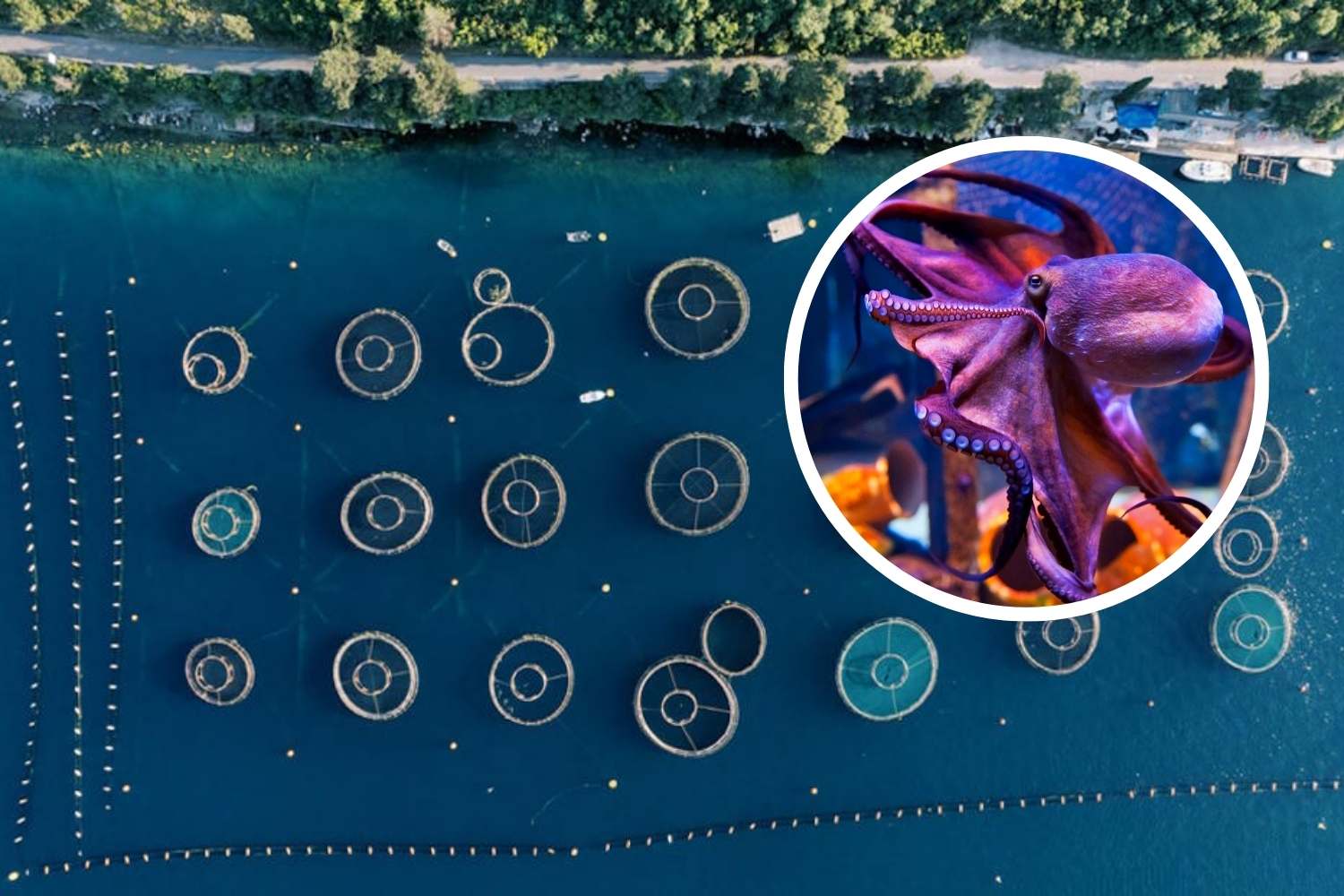
Raising octopuses in large tanks, transforming them into animals for intensive production, as already happens with chickens and pigs. This is one of the new frontiers of the food industry. And as research seeks to make commercial breeding and breeding of these animals possible, questions are growing about the consequences for their well-being and the health of the oceans.
A legislative initiative has just been presented to the Chamber of Deputies to prevent the development of intensive farming of octopus and bluefin tuna and limit the expansion of aquaculture of carnivorous species.
The deputy illustrated it Devis Dori by Alleanza Verdi e Sinistra, together with Compassion in World Farming (CIWF) Italia, and should be formally filed by the end of October.
What does the proposal against octopus and tuna farming include?
The initiative illustrated to the Chamber focuses on two closely related issues: the welfare of farmed animals and the environmental impact of carnivorous aquaculture. The aim is to introduce rules capable of preventing the creation of intensive farming of octopus and bluefin tuna and counteract the expansion of production systems that require large quantities of fish to feed other fish species.
An octopus is not just any animal. He is capable of learning, solving problems, exploring complex environments and modifying his behavior based on experiences. It has a particularly developed nervous system which is also largely distributed in the tentacles. Furthermore, in nature, many species lead a predominantly solitary life and use dens and shelters, continuously interacting with the surrounding environment.
These are all characteristics that make it particularly problematic to imagine their breeding in industrial tanks, where space, environmental stimuli and the possibility of expressing natural behaviors would inevitably be limited.
In captivity it cannot express its natural behaviors, and today there is no method to kill it without suffering. We don’t have to breed it, we have to protect it, explains biologist and researcher Andrea Spinelli.
One of the main concerns concerns slaughter: currently there is no scientifically validated and universally recognized as humane method for killing octopuses on an industrial scale. Added to this are the problems linked to the density of animals, the conditions of confinement and the possible appearance of aggression and cannibalism, behaviors that can emerge when normally solitary individuals are forced to live together in confined spaces.
@CIWF
The environmental problem
Not everyone realizes that octopuses and tuna are predators and that, to grow, they need to feed on other marine organisms. In industrial aquaculture this can translate into a significant demand for fish and fish derivatives to be used as feed. It is one of the main paradoxes of carnivorous aquaculture: to produce a certain quantity of meat for human consumption it may be necessary to use a greater quantity of other fish resources.
The pressure on wild populations naturally depends on the species farmed, the composition of the feed and the origin of the raw materials. Not all forms of aquaculture have the same impact, but the farming of large marine predators poses specific critical issues.
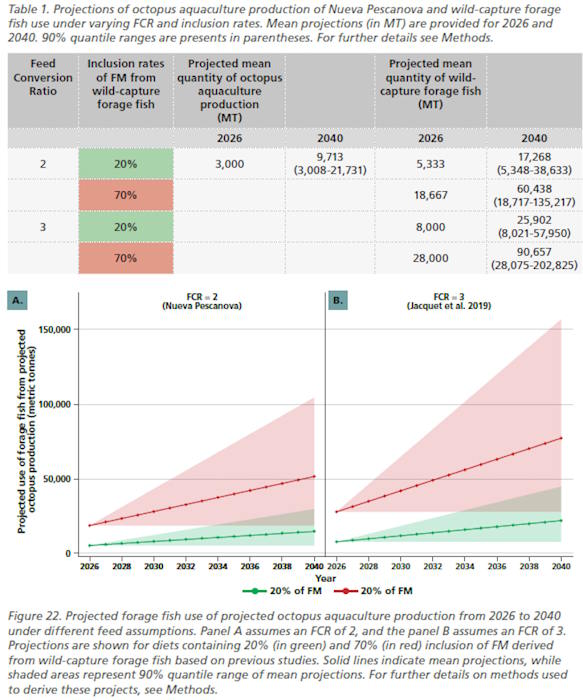
In the case of the octopus farming project in the Canary Islands, for example, which was then abandoned, CIWF had estimated that around 28,000 tonnes of wild-caught fish would be needed to produce 3,000 tonnes of octopus meat in the first year of operation.
@CIWF
An amount that, according to the organization, would have increased pressure on fish stocks and coastal communities that depend on fishing for their food and subsistence.
Added to these problems are wastewater management, the release of nutrients into the water and the possible consequences on the surrounding ecosystems. It is precisely for these reasons that the associations ask not to automatically consider the expansion of aquaculture as a sustainable solution to the growing global demand for seafood.
The project in the Canary Islands
The Italian proposal comes a few months after an important decision: in July 2026, the Spanish company Nueva Pescanova officially gave up the project to build in the port of Las Palmas, in Gran Canaria, what was supposed to become the first large commercial octopus farm in the world.
The structure could have hosted around a million specimens each year, destined for food production. But the project then encountered strong opposition from animal rights associations, scientists and environmental organizations, and the company then formally communicated its renunciation to the Port Authority of Las Palmas in July 2026, after a complex authorization process and the request for further environmental investigations.
Bluefin tuna is also at the center of the debate
Alongside octopus, the proposal draws attention to the farming of bluefin tuna, one of the symbolic species of the Mediterranean. In this case the sector is already active, especially through fattening systems in marine cages, where specimens captured in the wild are kept and fed until commercialization. A practice different from closed-cycle farming, but which still raises questions about the sustainability of the supply chain.
In addition to the conditions of the confined animals, one of the issues concerns the use of other fish species as food.
The management of bluefin tuna fisheries in the eastern Atlantic and Mediterranean has allowed stocks to recover in recent decades, after a period of serious overexploitation. However, this result does not eliminate the need to control catches, monitor farms and evaluate the environmental impacts of fattening activities.
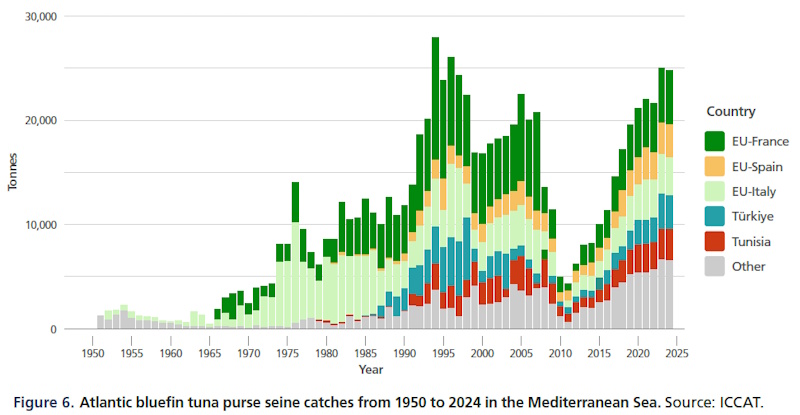
CIWF’s initiative aims precisely to prevent the increase in commercial production from compromising the conservation objectives and health of marine ecosystems.
The petition
On the occasion of the presentation of the legislative initiative, Compassion in World Farming Italia also launched a petition addressed to the Italian Government.
The request is to prevent the opening of octopus farms and intervene on the expansion of carnivorous aquaculture, in line with the international commitments made to halt the loss of biodiversity by 2030.
Sources: Chamber of Deputies, conference of 13 October 2026
