
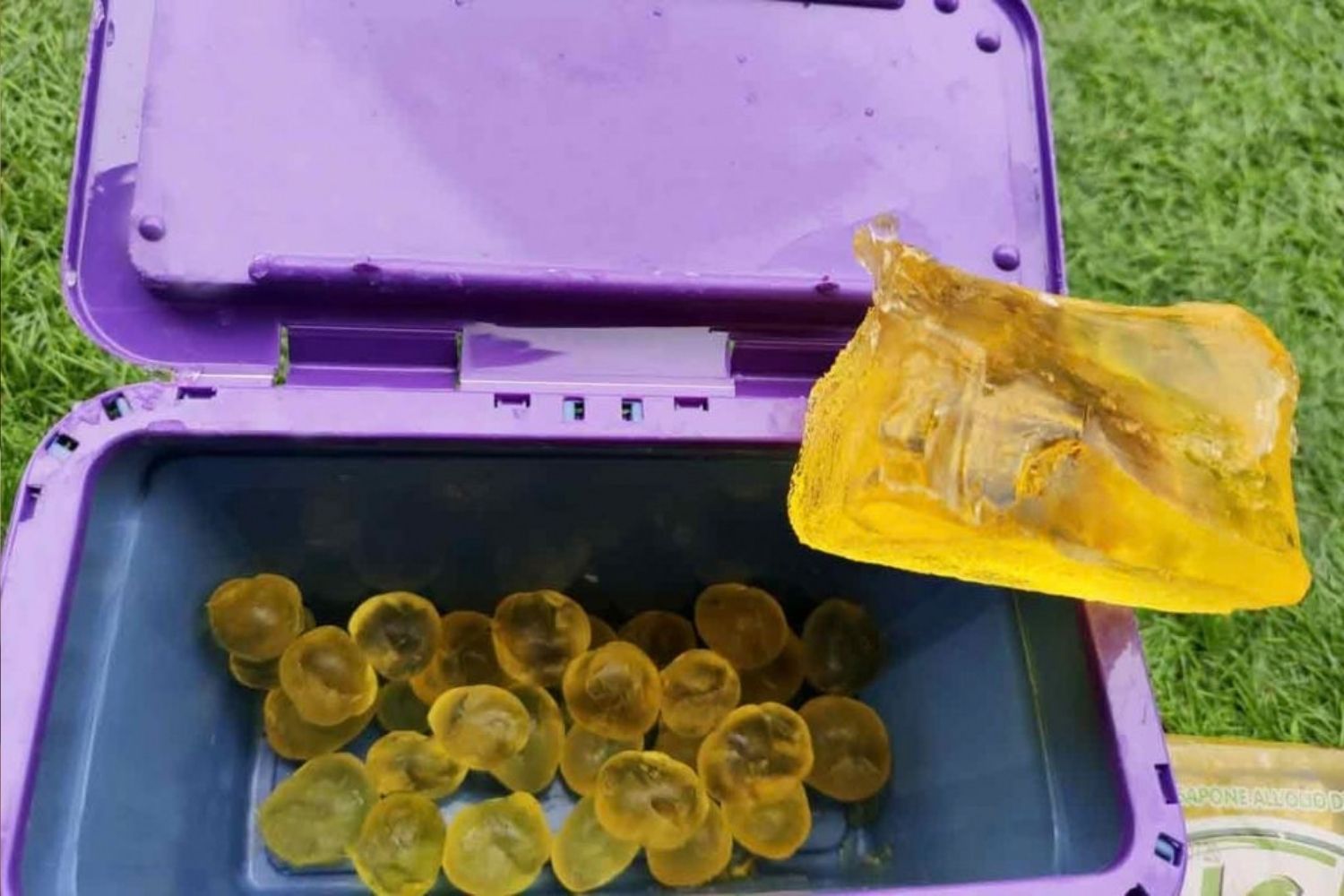
Anyone who has ever used Alga soap at least once knows this well: as soon as you open the package and try to handle it, you find yourself faced with a very different stick from normal solid soaps. It is soft, malleable and above all extremely sticky. Cutting it with a knife can become inconvenient, storing it incorrectly means risking finding it stuck to the container and, if it is divided into small portions, these can easily stick together. But why does this happen? The answer is linked precisely to the nature of the product.
Because Alga soap is so soft and sticky
@greenme
Alga soap belongs to the category of soft potassium soaps, from which it inherits its characteristic pasty consistency.
Unlike traditional hard soaps, generally obtained using sodium hydroxide during the saponification process, potassium hydroxide is used for soft soaps. It is precisely this difference that contributes to the soft, elastic and easily mouldable consistency that characterizes the classic yellow brick. Furthermore, in the case of Alga soap, the formulation is traditionally linked to coconut oil. The result is a soap that can be easily divided, molded with the hands or dissolved in water, but which inevitably tends to adhere to the surfaces it comes into contact with.
The knife is not always the best solution
The problem becomes evident especially when you try to divide the dough, because being very soft, the soap will tend to stick to the knife blade and deform as it is cut. In the end you may end up with a knife covered in product and portions that are anything but regular. A much more practical system consists of using a simple thread: just pass it through the dough and it will be possible to separate the different portions, without dragging the soap along knives and other tools. It’s a little trick that also allows you to obtain more regular and easier to store pieces.
Single-dose balls are convenient, be careful how you store them
Thanks to its consistency, Alga soap can be easily shaped with your hands and for this reason many people prefer to divide it into small balls to use when necessary, for example for laundry. The problem with this type of arrangement concerns the conservation of the balls, because if they were all placed together, without any care, they could stick together and transform back into a single sticky block. To avoid this, it is better to store them separately in a container, trying to limit contact between one portion and another. If you choose a jar, make sure it is clean and avoid exposing it to heat sources.
Better not to leave it out in the open
Leaving the dough open on the sink, or in a piece of furniture without protection, is also not a good idea. Like all cleaning products, it should be stored in its packaging, or in a suitable container, away from dirt, water and heat sources and out of the reach of children.
Being sticky is still a strong point
That annoying consistency that emerges when cutting is actually one of the characteristics that make Alga soap so versatile: it can be molded into small doses, rubbed locally and dissolved in water with ease.
The secret, therefore, is not to try to make it similar to classic solid soap, but to learn to manage its consistency: dividing it in the right way and storing it with a few small precautions can make its use decidedly more practical and functional.
