
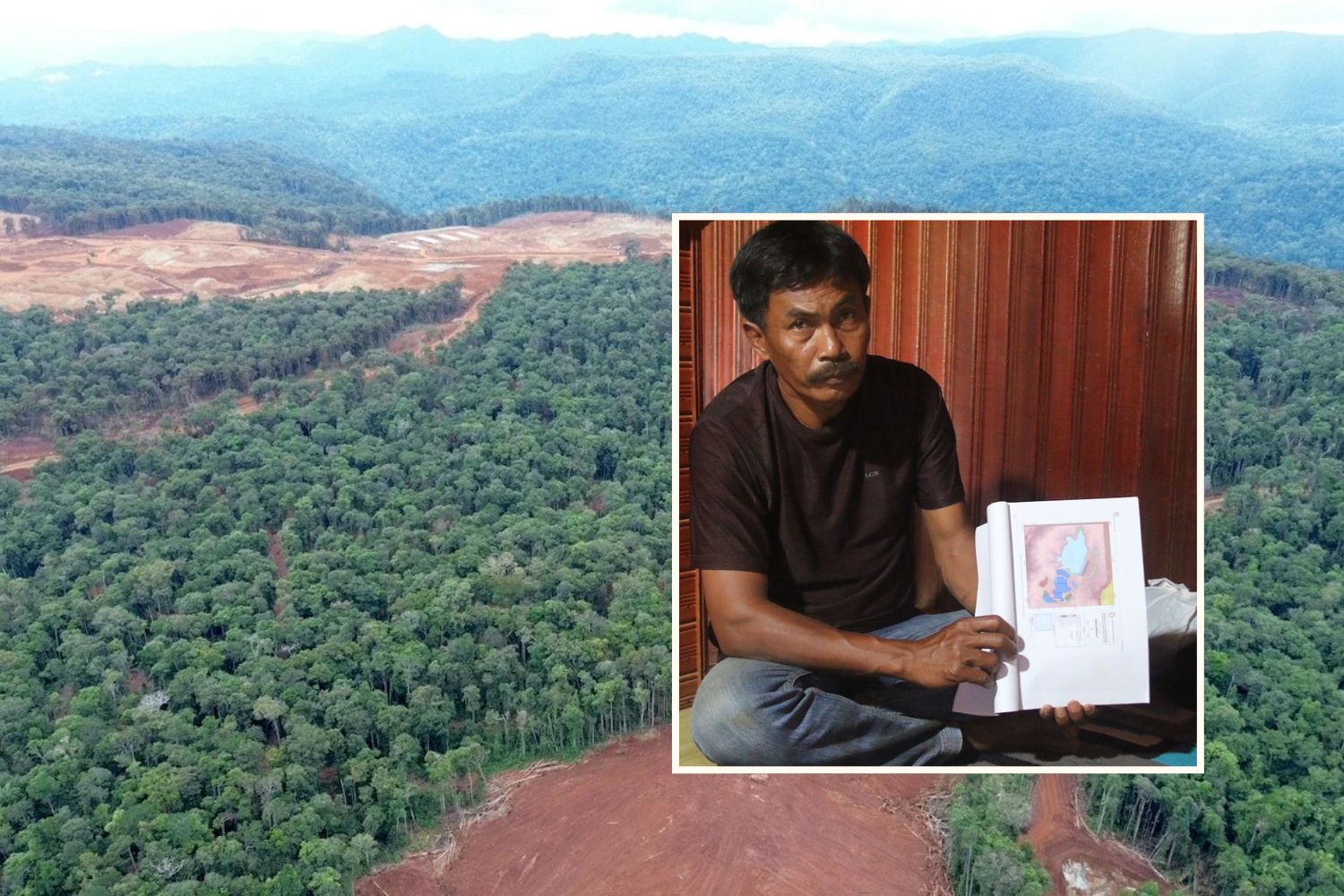
Is the electric car really sustainable? If it is true that it does not produce exhaust emissions, it is equally true that behind its production there are environmental contradictions that are anything but negligible. And those who pay the price, more often than not, are the forests and indigenous communities on the other side of the world.
This is what emerges from a new investigation published by The Guardian, conducted in collaboration with Voxeurope and other European media, which reconstructs possible links between the batteries used by some of the world’s largest car manufacturers and the deforestation of Indonesia’s tropical forests.
Names involved in rebuilding supply chains include Volkswagen, Ford, Tesla, BMW, Volvo, Stellantis, Hyundai and General Motors. Different companies, united by a material that has become fundamental for part of the battery industry: nickel.
Be careful, though: the investigation does not prove that a specific battery fitted to a Tesla or Volkswagen necessarily contains nickel from disputed mines. Rather, it documents trade links between those mines, battery materials producers and suppliers to automakers.
Indonesian forests destroyed to extract nickel
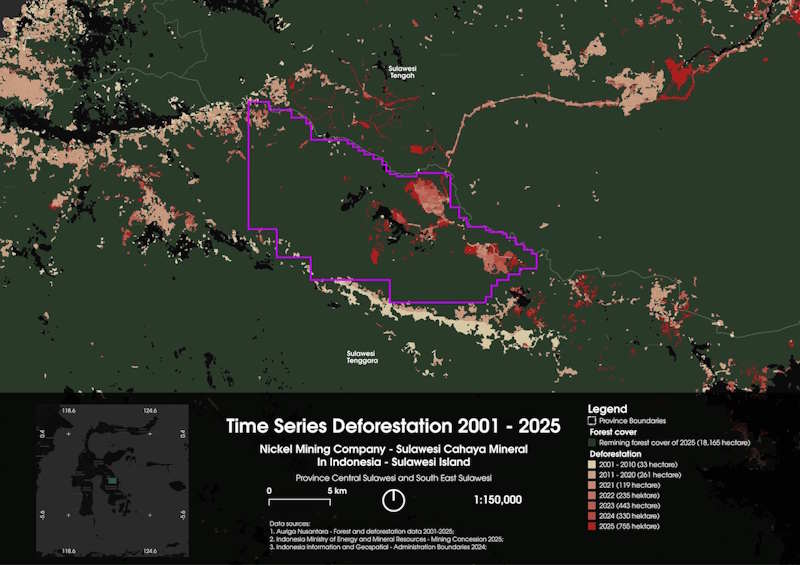
On the island of Sulawesiin an Indonesia already devastated by fires, the Cahaya and Hengjaya mines are transforming the tropical forests inhabited by the indigenous Tolaki people into extractive areas. According to satellite analyzes by the company The TreeMap, nickel mining could be responsible for about two-thirds of the deforestation recorded since 2001 in the Cahaya concession and more than half of that of Hengjaya.
View this post on Instagram
In 2024 alone, according to the environmental NGO Auriga, the Sulawesi Cahaya Mineral (SCM) company, which manages Cahaya, contributed to the destruction of another 330 hectares of forest. In 2025 it also received two administrative sanctions for illegally deforesting over 450 hectares outside authorized areas.
For Tolaki communities, however, it is not just an environmental issue. The forest represents an essential resource for survival, as well as a place of profound cultural and spiritual value. Destroying it means destroying their very lives.
@Charioteer
From mines to Volkswagen, Ford and Tesla batteries
The nickel mined in Cahaya and Hengjaya is transported to the Morowali industrial plant, managed by a subsidiary of the Chinese group Zhejiang Huayou Cobaltwhere it is transformed into a material intended for the production of battery cathodes. From here it reaches the Chinese factories Huayouwhich has commercial relationships with CATL, one of the world’s largest battery manufacturers, and with the South Korean LG group, suppliers of numerous car manufacturers. In 2024, the Morowali plant exported material worth 606 million dollars to China, followed by a further 470 million in 2025.
The investigation thus identified commercial links with the supply chains of Volkswagen, Ford, Tesla, BMW, Volvo, Stellantis, Hyundai and General Motors. However, it has not been possible to demonstrate that the nickel from the two mines is actually present in specific batteries: the traceability of individual supplies remains the main critical point.
What do car manufacturers respond to?
From the same lines as the Guardian, Volkswagen admitted that it could not exclude the presence of the companies involved in its supply chain, while Ford announced checks on the accusations. Renault confirmed that it had identified a mining site in Sulawesi among its indirect suppliers and that it had started investigations.
Volvo has reported carrying out checks on Indonesian suppliers, while Mercedes-Benz, General Motors, Stellantis and Hyundai have acknowledged environmental and social risks linked to nickel mining. However, none of the companies made the detailed results of the audits public. Tesla, CATL, Huayou and SCM had not responded to requests for comment by the time the investigation was published.
The hidden environmental cost of batteries
A study published in Nature Communications in 2025 found that the impact of nickel mining on land use may be, at some sites, up to more than 500 times greater than estimates used in previous assessments. The main burden is the destruction of forests, which also involves the loss of carbon stored in vegetation.
Meanwhile, according to projections from the International Energy Agency, global demand for nickel could reach around 5.7 million tonnes by 2040. A pressure also fueled by the spread of increasingly larger electric cars, although there are batteries, such as lithium-iron-phosphate (LFP) batteries, which do not require nickel.
Reducing the size of vehicles, improving battery recycling and investing in public transport could help contain demand for new raw materials.
Do electric cars pollute less or not?
The investigation does not question the climate advantage of electric cars compared to combustion ones. According to a 2025 ICCT study, an electric car sold in the European Union can produce around 73% fewer greenhouse gas emissions over its life cycle than a comparable petrol car.
But lower emissions do not mean absence of environmental consequences. The destruction of forests, the loss of biodiversity and the repercussions on indigenous communities remain real problems. The challenge, therefore, is not only to replace combustion engines with electric ones, but to ensure transparent supply chains, responsibly extracted raw materials and less resource-intensive batteries.
Sources: Voxeurop / Nature / ICCT
