
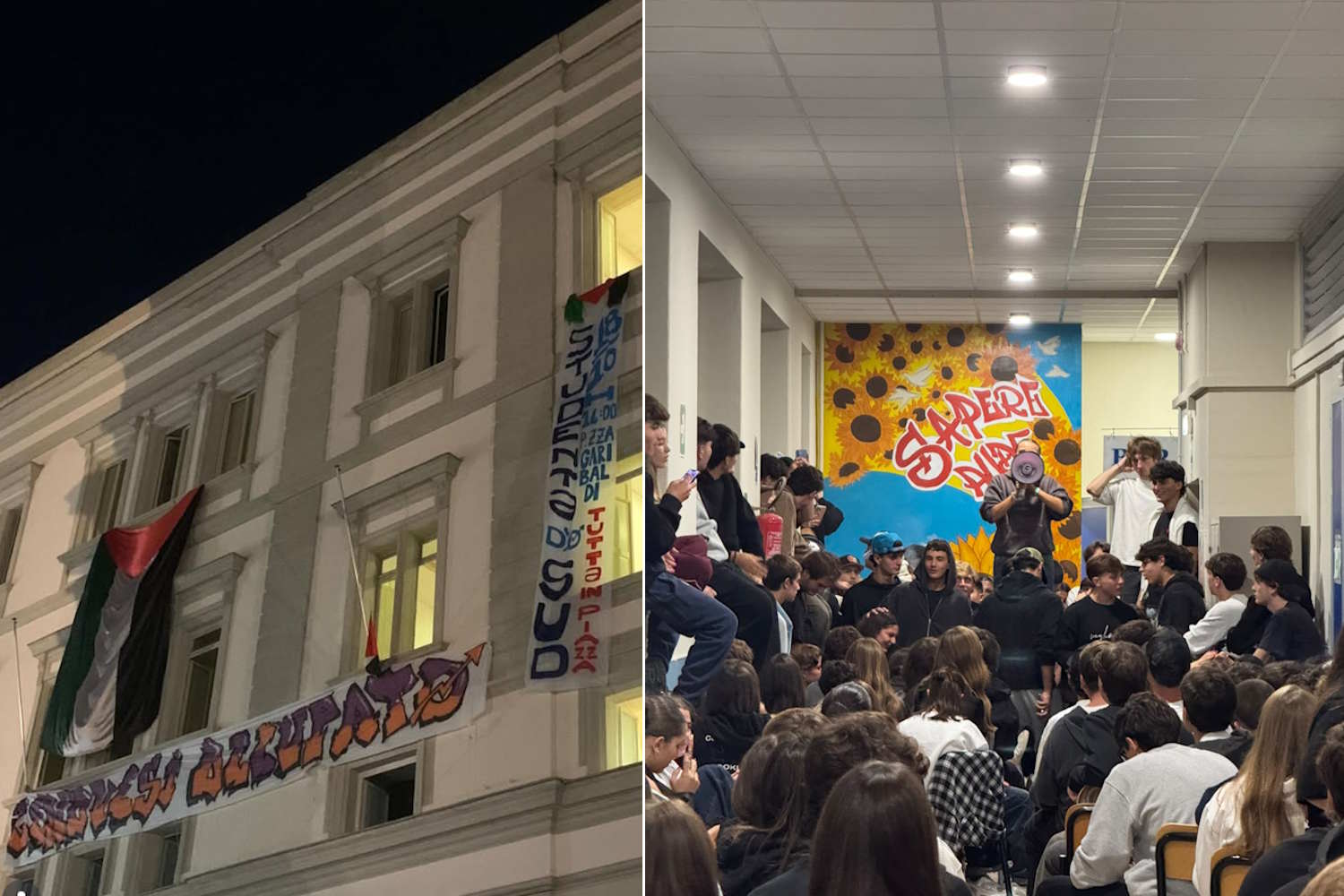
First we call them wimps, then, when they speak up, we silence them. First we judge them as slackers with an easy life, then, when they want to show us that this is not the case, we put our heads in the sand. Assuming that every form of violence must always be condemned (including spoken violence), regardless of any colour, at what point will we start to reflect on what our boys and girls want to tell us by taking to the streets and occupying the schools?
When we call “daddy’s boys” kids who we consider spoiled, irresponsible, ungrateful, when we call those who go on the Flotilla a glorious head, when we label the children of immigrants who are worth less than nothing as “maranza”, exactly who are we doing a favor for? What idea of civil society do we want to give them? What idea of community do we want to build? What inclusive language do we ever want to build if the words we address to them are only invectives?
View this post on Instagram
Why don’t we like these guys here? They irritate us and we only define them as ignorant provocateurs incapable of documenting themselves. Oops, Bruno Vespa come on, but do you really think that making paternalistic sermons solves anything?
View this post on Instagram
The point is always that. In recent years, Italy has literally gone to the bottom, with a frightening division between wealth and poverty, wages have decreased, no purchasing power, and there remain a thousand and more prehistoric problems such as the housing crisis and rising rents.
We are one of the few Western countries that destroys the most important capital it possesses: them, the young people. According to ISTAT data, 67.7% of young people between 15 and 34 who enter employment do so with a fixed-term relationship.
We are surprised if these kids occupy schools (schools, among other things, which are falling apart and in which not a cent has been invested for years), if they hang banners on the windows, if they interrupt lessons, if they ask to be listened to. We are surprised if in Turin, Rome, Naples, Bologna and other cities they decide that the time has come to say enough. They protest against the high cost of living, the difficulties of public schools, rearmament, the proposal to limit the presence of foreign students in classes to 30% and an increasingly uncertain future. But look, we are surprised, just because we are handing over to an entire generation a future that increasingly resembles a door slammed in their face. What a pain in the ass.
View this post on Instagram
A generation to which we ask to have children, but to which we deny the possibility of raising them
For years we have been talking about the birth rate emergency. No more children are born, Italy is getting older, the cradles are empty. We launch appeals for motherhood, we celebrate the traditional family, we promise incentives. But, instead, let’s try to put ourselves in the shoes of a 28-year-old girl who works with an expiring contract, perhaps still lives with her parents because a studio apartment costs half her salary, and doesn’t even know if she’ll have the same job in six months. Or a 30-year-old boy who goes from an internship to a collaboration, from one low-paid job to another, and who should find the courage to take out a mortgage and build a family.
With what money? With what certainties? It’s not that young people don’t want to take on responsibility. It is precisely that we have transformed even the most beautiful responsibilities of life into an economic privilege.
According to Istat, just 355,772 children were born in Italy in 2025, 3.8% less than the previous year. The average number of children per woman fell to an all-time low of 1.14. The average age at the birth of the first child has reached 32 years. And Istat itself recalls job insecurity, the difficulty of finding a home and obstacles in reconciling work and family among the factors that hinder parenting plans.
Yet, we continue to talk about the birth rate decline as if it were a generational whim.
View this post on Instagram
“Study, work hard, be excellent”
Then there is that other wonderful, all-Italian contradiction. We ask our boys and girls to study, to graduate on time, to learn languages (in private institutions, let it be clear, because in public curricular cycles English is relegated to three scant hours a week), to gain experience, to be competitive. We want them prepared, brilliant, possibly with master’s degrees and internships under their belt before they even turn 25.
And when they become researchers, engineers, doctors, teachers, professionals, they discover that their country has no place for them. Or, worse, that there would also be a place, but under conditions that no one else would dream of proposing. So they leave. In 2025, according to Istat, there were 109 thousand expatriations of Italian citizens. More than a third involved people between 25 and 34 years old. And between 2019 and 2025, the South lost, through transfers to other regions and expatriations, 150 thousand young Italian graduates of that same age group.
Numbers that should make us jump out of our seats, because at least behind every departure there is a city that loses skills and a territory that becomes impoverished.
We have stopped imagining the future or, at least, we have stopped imagining it for those who are 16, 20 or 25 years old today. There is no vision of the country that truly puts the new generations at the centre. There is no sufficiently ambitious project that brings together public school, university, decent work, housing rights, equal opportunities and ecological transition. There are continuous emergencies, measures, bonuses, announcements, slogans and no long-term perspective.
Furthermore, in the meantime, the kids find themselves having to deal with a climate crisis that they did not cause, with wars that seem to be multiplying. They are the same kids to whom we taught the importance of the environment, human rights, active citizenship, democratic participation. The same ones to whom we told that we must defend what we believe in and not remain indifferent to injustices.
Then, when they try to do it, they annoy us. When they ask for more funding for public schools and fewer resources for rearmament, when they talk about Palestine, about climate changeof inequalities, of rights, suddenly become too politicized.
But what exactly should a school that trains aware citizens be? A place where you learn the Constitution by heart, as long as it doesn’t occur to anyone to take it seriously? That’s right: in this scenario, the Meloni Government’s response to the protests focuses only on control and discipline. End. It defends public order as the supreme objective and restricts the spaces for dissent.
What if they understood everything before us?
The thing that probably irritates us most about occupations is that kids force us to look at ourselves in the mirror. They remind us that we have left enormous issues unresolved, that we have consumed resources without worrying about who would come next, that we continue to talk about merit in a country in which the social and economic starting point still weighs heavily on the possibility of arriving.
They remind us that it is not enough to say we are committed if the commitment is not then recognised. That it’s not enough to invite them to have children if they can’t afford a house. That it is not enough to ask them to love Italy if they are forced to look elsewhere to work with dignity.
View this post on Instagram
And they also remind us of a very simple thing: the future we discuss every day on television, in political buildings and in adults’ living rooms is theirs. Not ours.
We can argue endlessly about the usefulness of the occupations, the methods, the contradictions of the student movements. We can criticize a slogan, contest a position, ask that the rights of those who want to continue attending lessons be respected. But we cannot continue to dismiss everything with the usual caricature of kids who don’t want to study. By asking them to lower their voices, we risk not even hearing the noise when they leave.
