
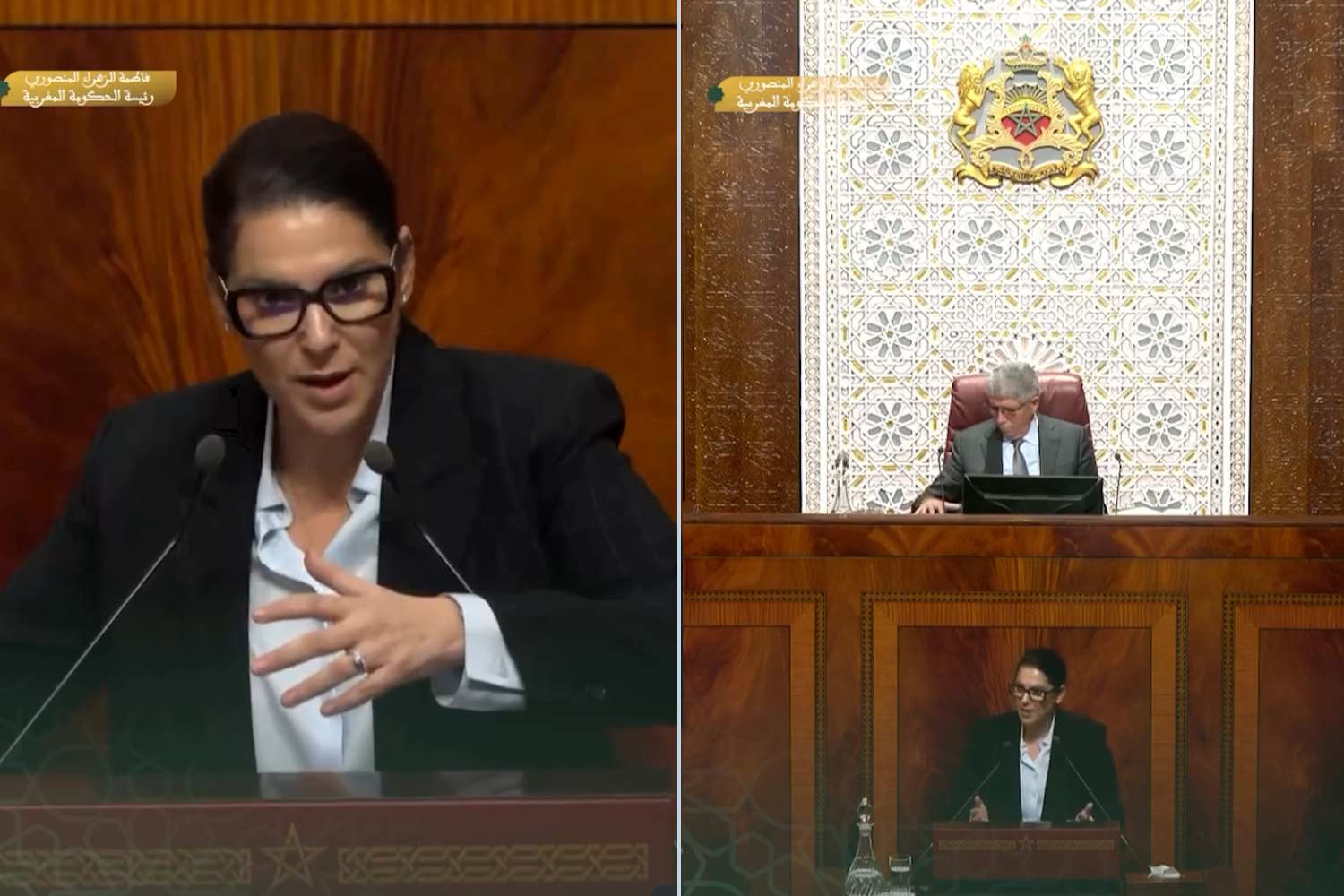
“This is the second time you have called me Mr Prime Minister. I am the Prime Minister and you will have to get used to itA few words, firmly spoken in front of the deputies of the Moroccan Parliament, were enough for Fatima Ezzahra El Mansouri, the first woman in the history of Morocco to lead the government, to transform a parliamentary discussion into a much broader issue: that of the recognition of women in places of power.
It happened a few days ago, when the prime minister responded to the interventions of the parliamentary groups on her government’s program. Also in front of her were the representatives of the Justice and Development Party (PJD), a conservative Islamist formation currently in opposition.
One of them continues to address the new head of government using the masculine language. El Mansouri interrupts and corrects him: for the Moroccan prime minister it is the moment to remind those in front of her that a woman can occupy the highest position in the executive without having to be linguistically transformed into a man.
And so, in his speech, El Mansouri immediately brought to mind a 2014 statement by the former head of the Moroccan government Abdelilah Benkirane, now general secretary of the PJD. During a parliamentary speech, Benkirane compared women to chandeliers that light up the house, an image used to highlight the female role within the family. Twelve years later, that metaphor returned to Parliament thanks to her. But this time reversing it:
I’m not a chandelier. They are reason, conscience, convictions and struggle, declared El Mansouri, amid applause from the room. Here is the woman in front of you.
Words that sound like a response to a conception of women confined to the domestic dimension, whose value is linked above all to the ability to take care of others.
The Prime Minister recalled that she was also present in Parliament in 2014, when Benkirane uttered that phrase, and explained why that representation does not correspond to the reality of many Moroccan women.
There are widows who, after the death of their husband, have to work to support the family. There are divorced women who raise their children without receiving maintenance payments from their ex-spouses. Women for whom work is not a concession, nor an alternative to the family, but a daily necessity.
And then there is that contradiction that El Mansouri wanted to openly denounce: the same politicians who encourage their daughters to study and build a career would like to reserve a different destiny for other women, limited to the home. The question is not whether a woman can choose to dedicate herself to her family, but recognizing that that choice cannot be imposed as the only possible model.
Who are you to decide who is Muslim?
The Prime Minister’s speech also touched on another delicate issue in Moroccan politics: the relationship between religion and power. As the Moroccan weekly reconstructs TelQuelthe clash also arose from a controversy relating to the request to suspend a parliamentary session to allow prayers.
Addressing PJD representatives, El Mansouri contested the claim of being able to judge the religious faith of political opponents.
Do you decide who is Muslim and who is not?, he asked the deputies.
And then he added that Islam was passed down to Moroccans from their ancestors, certainly not introduced by the Justice and Development Party. A significant passage in a country in which religion occupies a central place in public life and in which the debate on the role of women is inevitably intertwined with the different interpretations of religious traditions.
El Mansouri certainly does not contest the Islamic faith, but rather the idea that a political formation can claim its monopoly and use it to establish what the place of women in society should be.
View this post on Instagram
When Giorgia Meloni chose “the President”
The Moroccan affair inevitably recalls what happened in our area in October 2022, when Giorgia Meloni became the first woman as Prime Minister. In that case, the choice was the opposite.
From the first official communications, Meloni adopted the masculine formula “the Prime Minister” and immediately, on 28 October, a communication signed by the general secretary of Palazzo Chigi, Carlo Deodato, indicated the name to the ministries “Mr President of the Council of Ministers, Hon. Giorgia Meloni”.
The note was corrected a few hours later: Meloni herself asked to simply use “the President of the Council of Ministers“, eliminating the word “Mr” but keeping the masculine article.
Two women, therefore, who were the first to lead their respective governments and two different ways of relating to the language of power.
And, let’s notice, El Mansouri’s claim does not only concern the right to be called “Madam Prime Minister”, but also and above all the possibility of being recognized for what it is, for the responsibilities it exercises and for the ideas it represents, without having to adhere to a model built by others.
The metaphor of the chandelier, after all, tells a lot about a certain idea of women: figures capable of illuminating the lives of others, as long as they remain hanging in the place assigned to them. And Fatima El Mansouri has chosen to overturn it by launching her challenge, that of ensuring that that freedom to choose, study, work and decide does not remain the privilege of women who manage to get to power, but becomes a concrete right for all the others.
