
He taught us to travel among the stars, but above all to never lose sight of what really matters on Earth: respect, solidarity and the defense of those who have no voice. Patrick Stewart was not only the unforgettable Captain Picard of Star Trek or Professor Xavier of the X-Men. Behind those characters there was a man who had made empathy a life choice, taking a stand against violence against women and cruelty towards animals.
The world of cinema and theater mourns the passing of the British actor, who died on 28 October 2026, at the age of 86, at his home in Los Angeles. As confirmed by his family, Stewart passed away alongside his wife Sunny Ozell, after dealing with Alzheimer’s disease and Lewy body dementia, two neurodegenerative diseases whose diagnosis had not previously been made public.
For millions of spectators he will remain Captain Jean-Luc Picard from Star Trek: The Next Generation, the commander of the Enterprise who preferred dialogue to violence, knowledge to fear and respect for differences to oppression. For others he will be Professor Charles Xavier from the X-Men saga, the mentor capable of imagining a world in which humans and mutants could coexist.
But reducing Patrick Stewart to these two roles would only tell part of his story. Behind the unmistakable voice, the Shakespearean career and the elegance that had made him an international icon there was a man deeply marked by what he had experienced as a child. A man who had chosen to use his notoriety to talk about domestic violence, defend women and children and combat cruelty towards animals.
From a childhood marked by violence to the battle to protect women and children
Patrick Stewart was born in 1940 in Mirfield, Yorkshire, into a working-class family. His father Alfred, a veteran of the Second World War, was a man his son would remember as authoritative and charismatic, but also capable of terrible outbursts of violence. As a child, Patrick repeatedly witnessed his father attack his mother Gladys. He had learned to recognize the signs that preceded an outburst of anger, to distinguish the sounds of footsteps and even to understand when it was time to physically intervene to try to protect her.
In an intense autobiographical article published in the Guardian in November 2009, Stewart recounted that daily fear and sense of helplessness that had accompanied him for years. But above all he had denounced the silence of adults and institutions. She recalled that even some people who intervened in her home tried to attribute part of the responsibility to her mother, rather than recognizing the seriousness of the abuse. A conviction had accompanied him throughout his life: violence is never the responsibility of those who suffer it, but of those who choose to exercise it. It was also for this reason that in 2007 he became an official supporter of Refuge, a British organization that offers protection and assistance to women and children victims of domestic violence. He didn’t just lend his face to the campaigns. He participated in public meetings, supported awareness initiatives and spoke about his experience several times, even when recalling those memories meant reopening personal wounds.
In 2004 he also supported an international campaign by Amnesty International against violence against women. For Stewart, the problem could not be confined to the private sphere. It was a collective responsibility, which required men to take a stand and institutions to guarantee concrete protection to the victims. And he also explained why he had accepted the role of testimonial for Refuge: he had done so thinking of his mother, who as a child he had not been able to defend as he would have liked.
The theatre, meanwhile, had been his first refuge. Acting had allowed him to find a safe space, away from the tension of home. From that escape an extraordinary career would be born, passing through the Royal Shakespeare Company, the Broadway stages and finally Hollywood.
The love for animals and the battle against illegal dog fighting
There is another aspect of Patrick Stewart’s life that deserves to be remembered: his commitment to animals, in particular to Pitbulls, often victims of prejudice, abandonment and exploitation in clandestine fights. The actor had long collaborated with the ASPCA, one of the main US organizations involved in the prevention of cruelty to animals.
In 2017 and 2018 he became one of the faces of the National Dogfighting Awareness Day campaigns, dedicated to raising public awareness against dog fighting, an illegal practice that subjects animals to violence and terrible suffering. Stewart had not hesitated to use his popularity to denounce this phenomenon and, above all, to fight the stigma surrounding pit bulls, too often described as aggressive animals by nature.
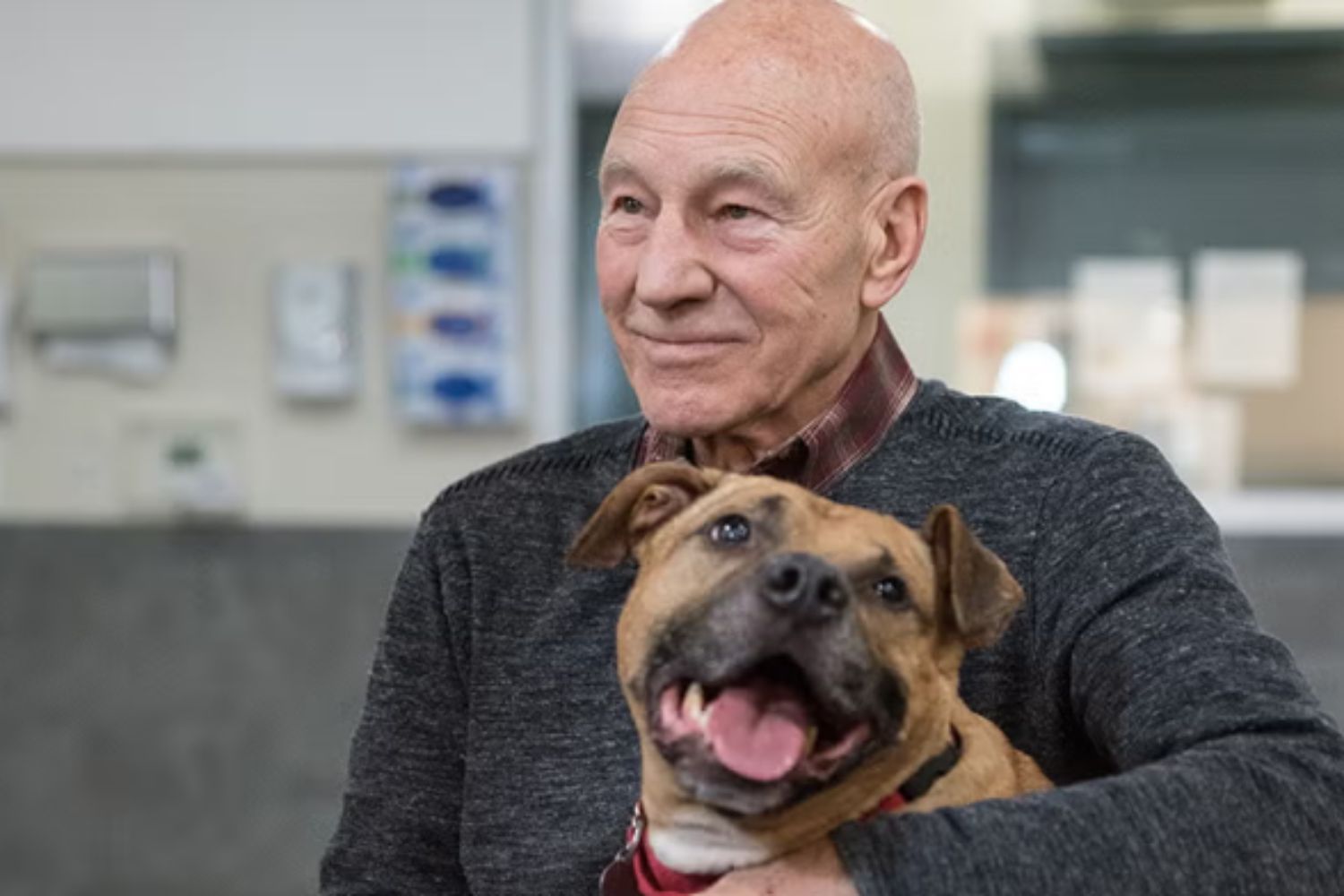
His personal experience had led him to change his mind about these dogs. In 2017, together with his wife Sunny Ozell, he temporarily welcomed Ginger into their home, a pitbull rescued from a shelter in Los Angeles thanks to the Wags and Walks organization.
The videos showing the famous Captain Picard cuddling Ginger, playing with her and taking care of her needs had won over thousands of people on social media. It was a simple but important image: one of the most recognizable actors in the world who demonstrated, through everyday life, how an often feared and discriminated dog could be affectionate and capable of creating a deep bond with human beings.
From that experience was born an even stronger commitment. Stewart and his wife temporarily took in other pit bulls, helping to spread their stories and encourage adoption. The actor even wanted a pit bull to appear in the Star Trek: Picard series, alongside his character. In 2021 the ASPCA awarded him the Pit Bull Advocate & Protector Award, recognizing his contribution to the protection of these animals and the fight against prejudice. An award that Stewart welcomed with gratitude, explaining that the real privilege was already being able to contribute to their defense.
The family’s final farewell and request: support Alzheimer’s research
In recent years Stewart had continued to work and meet his audiences. In 2023 he published his autobiography, Making It So: A Memoir, tracing his childhood in Yorkshire, his career and the experiences that transformed him into the man we knew. The news of his death, announced on October 29, sparked a great wave of emotion.
In the message released by the family, his loved ones recounted the actor’s last moments, surrounded by affection, music and loved ones. In lieu of flowers, they ask that any donations be made to the Johns Hopkins Alzheimer’s Disease Research Center Fund and the Alzheimer’s Foundation of America’s caregiver support programs. A way to transform the memory of Patrick Stewart into concrete help for research and for people living with these diseases. Sir Patrick Stewart leaves a legacy that goes far beyond cinema. He leaves us with the image of a child who had experienced fear at home and who, having become an adult, had decided not to turn away in the face of violence. Of a man who had put his voice at the service of the most vulnerable women, children and animals. Safe travels, Captain. And thank you for reminding us, on and off the screen, that true greatness is also measured by the ability to protect those who need it.
