
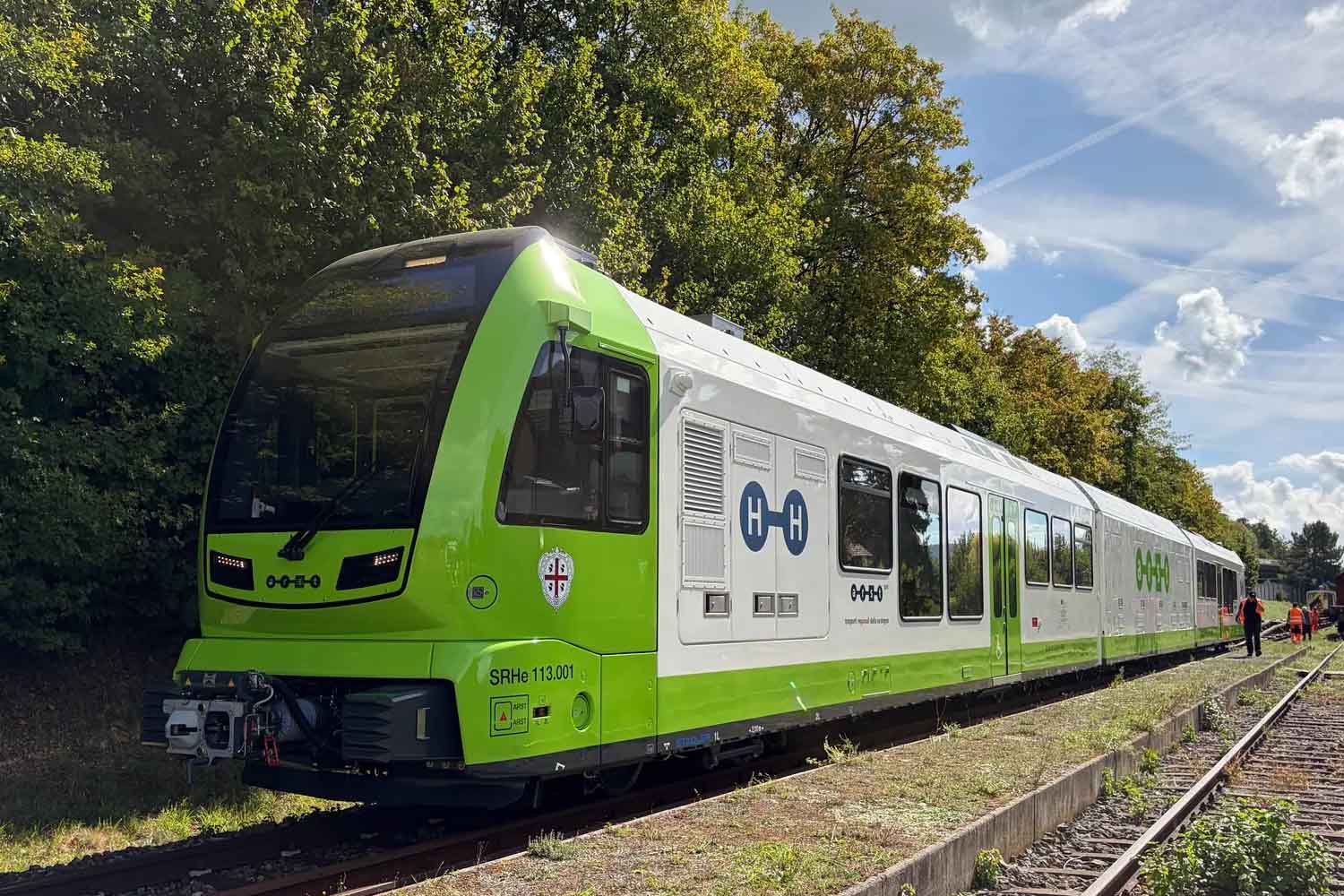
To test the world’s first hydrogen train designed for narrow-gauge railways, Stadler had to add a third rail along almost four kilometers of track in Switzerland. The convoy is destined for Sardinia and has been undergoing tests prior to its arrival on the island since mid-October 2026. For passengers we will have to wait until at least 2028.
The project includes ten hydrogen trains for ARST, the regional transport company of Sardinia. The world record concerns a precise characteristic: the trains are designed for tracks 950 millimeters wide, narrower than those of ordinary railways. Hydrogen trains already exist, but it is the first time that this technology has been adapted to such a gauge.
Why are Sardinian trains tested in Switzerland?
The tests take place between Hemishofen and Ramsen, in the canton of Schaffhausen. As Stadler explains, the third rail was added to an already existing line to allow the new trains to travel on the same gauge that they will find in Sardinia. A solution that avoids having to immediately transfer the trains to Italy to test them. In Switzerland, however, they can be checked near the manufacturer’s factory, checking for any problems before delivery.
The tests cover the operation of the hydrogen engine, speed, acceleration and braking. These are necessary steps to obtain traffic authorizations. And Sardinia will not be the only one to use these trains: Stadler is building a total of 21 trains also destined for Calabria and Sicily.
How do hydrogen trains work and how much do they pollute?
The fuel system is located in the central part of the train. Here fuel cells use hydrogen to produce electricity, which powers the batteries and allows the train to move without needing electrical cables above the tracks. It is a solution designed especially for non-electrified railways, where many diesel trains still run today.
During operation, fuel cells do not directly emit carbon dioxide. However, the overall environmental benefit also depends on how the hydrogen is produced. For this reason, the Sardinian project plans to use renewable energy, including through photovoltaic systems, to produce fuel directly on the island.
Interventions were carried out for three production centers in Alghero, Macomer and Mandas. According to the Sardinia Region, work on the power plant for the Sassari–Alghero–Airport line was completed in June 2026. The plant, financed with approximately 30 million euros from the PNRR, should produce up to 1,500 kilograms of hydrogen per day. THE
According to Stadler’s estimates, the ten trains will save over 2,100 tonnes of CO₂ per year compared to diesel trains. A forecast that will have to be verified when the vehicles actually enter service and the hydrogen necessary to fuel them is available.
From 2028 the first passengers on the Sardinian lines
The calendar announced by the manufacturer foresees the start of passenger service from 2028. Among the connections indicated are Sassari–Alghero, Sassari–Sorso and the route between Mamuntanas and Alghero airport. The Sardinia Region has also included the Cagliari–Mandas and Nuoro–Macomer lines in the overall program. The actual distribution of the new vehicles will depend on the completion of the infrastructure and the organization of the service.
Before carrying passengers, however, the convoys will have to pass all the checks required by ANSFISA, the National Agency for the safety of railways and road and motorway infrastructures. After the tests in Switzerland, further tests are planned directly on the Sardinian network. The first narrow-gauge hydrogen train is therefore already a reality and its arrival represents an opportunity to replace part of the old diesel vehicles and improve regional connections.
For passengers, however, the world record matters up to a certain point. The frequency of trips, reliability and travel times will make the difference. The train began to move in Switzerland. It should arrive in Sardinia from 2028. Punctuality will have to be verified in service.
