
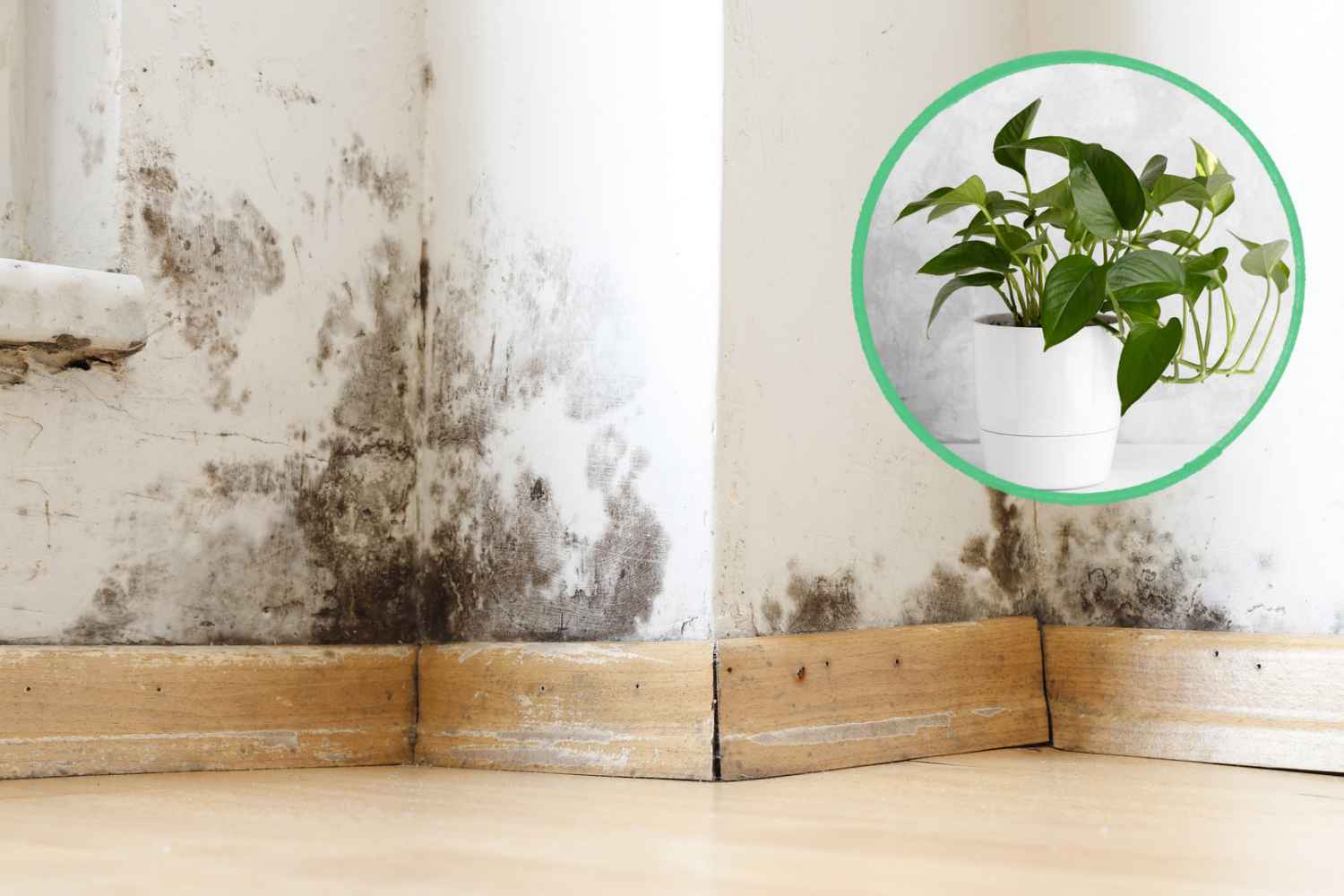
With the arrival of autumn, mold appears again in the corners of rooms, behind furniture and around windows. Temperatures drop, we keep the windows closed longer and the humidity produced by daily activities ends up accumulating in the house. Just think of the laundry hanging in the bedroom, the steam from the shower or the condensation that forms on the windows during the night.
Among the natural remedies that are often talked about there is a rather curious one: common ivy (Hedera helix), the climbing plant that we are used to seeing on walls and in gardens, but which can also be grown in apartments. According to a scientific experiment, it would be capable of reducing the concentration of mold spores suspended in the air.
The news is interesting, especially for those looking for simple solutions to improve the home environment. Before filling your bathroom or bedroom with pots of ivy, however, it is worth understanding what the researchers really discovered and what the limitations of these results are.
Common ivy: why it is thought to help against mold
Easy to recognize for its green and shiny leaves, ivy is a resistant plant, capable of adapting even to pot cultivation. At home it can grow on a shelf, fall from a hanging container or climb along a support.
It has long been cited among the plants that could help improve air quality. The reason concerns the ability of some plant species to interact with pollutants present in the environment, through processes that involve leaves, roots and soil microorganisms.
This phenomenon is part of the so-called phytoremediation, a set of processes through which plants can absorb, retain or contribute to the transformation of certain contaminating substances.
A systematic review published in 2020, which examined 95 scientific studies on the effects of indoor plants, found interesting results especially regarding some volatile organic compounds, such as formaldehyde, benzene and toluene. The effects observed, however, vary greatly depending on the species, environmental conditions and type of experiment.
In fact, it is one thing to measure the ability of a plant to retain certain substances in the laboratory. Another is to demonstrate that that same plant can significantly improve the air of an inhabited room, where doors and windows are opened, people move and pollutants continue to be produced.
What about mold? The research that made ivy famous dates back more than twenty years.
The ivy study: up to 78% less mold in the air
In November 2005, during a meeting of the American College of Allergy, Asthma and Immunology, the results of a small experiment on the ability of ivy to reduce the presence of biological particles suspended in the air were presented.
The researchers used experimental containers in which moldy bread and dog faecal material were placed. After measuring the particles present in the air, they introduced an ivy plant, repeating the measurements six and twelve hours later.
The results, reported at the time by HealthDay, attracted a lot of attention: after twelve hours, mold particles suspended in the air had decreased by 78.5%, while those associated with fecal material had decreased by 94.25%.
Remarkable percentages, which explain why even today ivy is often described as a sort of natural air purifier.
There is a problem, however. The study was conducted in closed containers and in experimental conditions very different from those of a normal home. Furthermore, the results were presented at a scientific conference and we have not found a subsequent comprehensive peer-reviewed publication that allows us to evaluate the method used in detail.
We therefore do not know whether the same effect could occur in a bedroom, nor how many plants would be needed to achieve a significant reduction in spores in the air.
Above all, reducing the spores suspended in the air is not the same as eliminating the mold growing on the walls. As long as there is moisture and surfaces favorable to its proliferation, the problem can recur.
Do plants really purify the air in your home? What the research says
A study published in the Journal of Exposure Science & Environmental Epidemiology also reduced expectations, in which researchers from Drexel University analyzed 12 previous studies and 196 experimental results on the ability of potted plants to eliminate volatile organic compounds.
The conclusion was quite clear: in normal homes, the purifying capacity of plants is too limited to compete with air exchange.
According to the authors’ estimates, to obtain an effect comparable to that of ordinary ventilation, depending on the conditions, from 10 to 1,000 plants per square meter of surface would be needed. Numbers that make clear how difficult it is to transfer laboratory results to daily life.
It should be noted that this research concerned volatile organic compounds, not mold spores directly. However, it offers an important indication: the properties observed in the laboratory are not enough to demonstrate that a plant can work as a domestic air purifier.
The US Environmental Protection Agency (EPA) also advises against considering houseplants as an alternative to ventilation and control of pollution sources.
This doesn’t mean giving up greenery at home. It simply means recognizing that a plant can make an environment more pleasant without necessarily solving its air quality problems.
Where to put ivy in the house and what to pay attention to
Those who want to grow ivy in an apartment can place it in a bright position, avoiding prolonged exposure to direct sun. It lends itself well to hanging pots and shelves, as long as it has enough space to develop its branches.
The bathroom can also be a suitable environment, especially if it has a window and good air exchange. Instead, it is better to avoid constantly dark corners or areas where the soil struggles to dry.
Watering deserves some attention. The soil should remain slightly moist during growth, but without waterlogging. A continuously wet substrate can encourage the growth of mold in the pot, adding an additional source of humidity and biological material to the environment.
Then there is an important aspect for those who live with pets. Ivy is toxic to dogs and cats: as the ASPCA explains in its sheet dedicated to Hedera helix, ingesting the leaves can cause vomiting, abdominal pain, diarrhea and excessive salivation. Contact with the plant can also cause skin irritation in sensitive people.
If there are small children or animals in the house that tend to nibble the plants, it is therefore advisable to choose a truly inaccessible location or move towards other species.
How to really prevent mold in the bathroom and bedroom
If the goal is to prevent mold from forming on the walls, the priority is not choosing the right plant, but keeping the humidity under control.
The EPA’s guidance on preventing household mold recommends keeping relative humidity below 60%, preferably between 30% and 50%. A small hygrometer can help you understand when the air in your home becomes too humid, especially in rooms most exposed to condensation.
Some habits can significantly reduce the risk:
When the mold is already visible, however, it is necessary to intervene on the affected surfaces and above all to identify the cause that allows its growth. Covering the stains with a new coat of paint or relying on a natural remedy without solving the humidity problem only risks postponing their reappearance. In extensive or recurring cases, professional intervention may be necessary.
Ivy therefore remains an interesting plant, also from a scientific point of view, but we do not have sufficient evidence to consider it an effective remedy against mold in homes. We can grow it for its beauty, without expecting it to do the job of a dehumidifier or an open window.
