
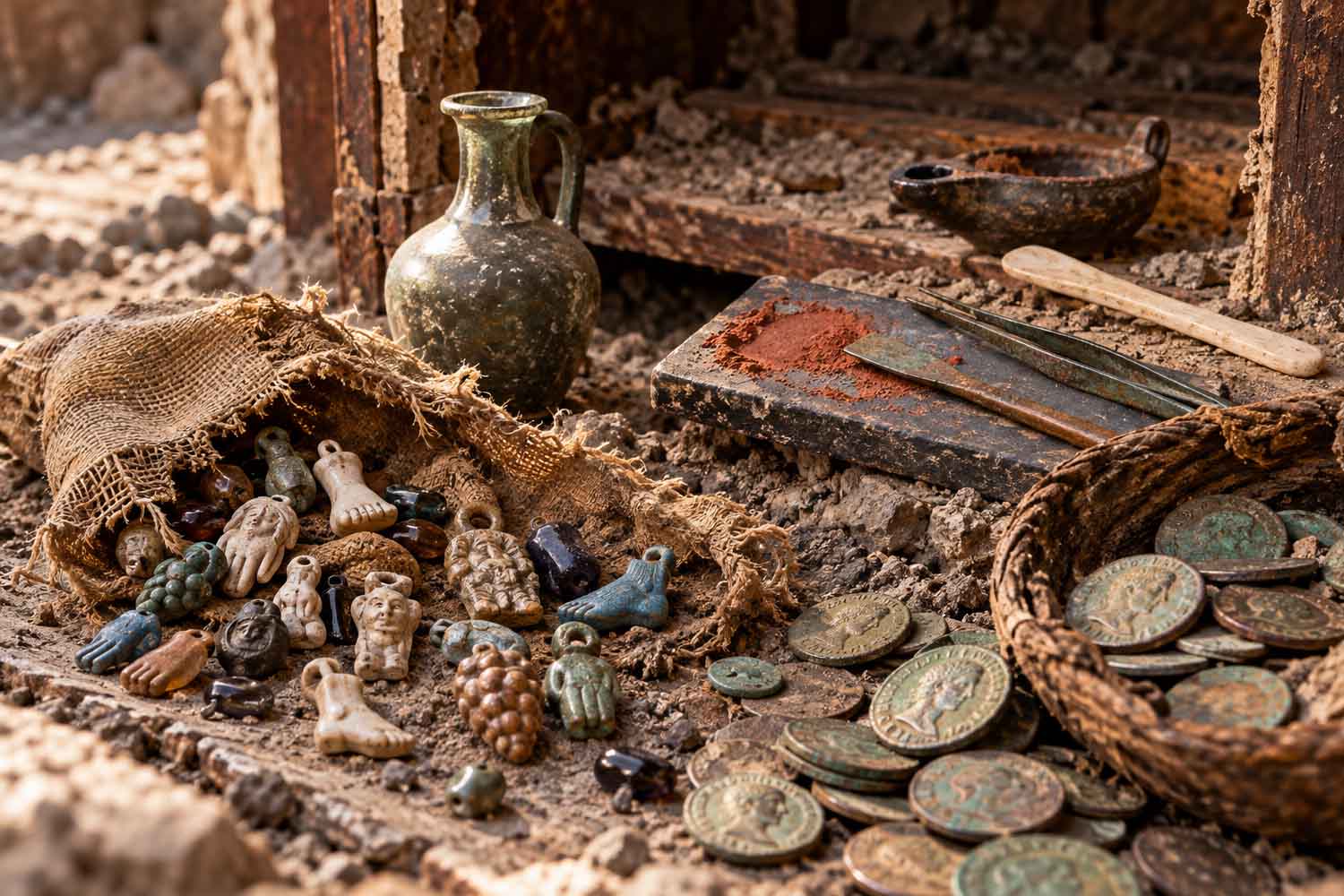
A make-up tweezers, a perfume container, 38 bronze coins and a cloth bag full of small amulets. In Pompeii archaeologists have found what remained of a wardrobe buried by the eruption of Vesuvius in 79 AD. Among the objects kept inside there are some that may have been preserved since childhood, perhaps due to their sentimental value.
The discovery comes from a house overlooking Via dell’Abbondanza, one of the main streets of the ancient Roman city. The building is traditionally known as the House of Cornelius Maximus, although the attribution remains uncertain. The finding was described in the latest study published by Pompeii Archaeological Park.
The cabinet was made of wood and much of the structure has been lost, but footprints left in the volcanic deposits have allowed archaeologists to reconstruct its shape, the position of the shelves and even how they collapsed. A sort of photograph of destruction, which remained underground for almost two thousand years.
Those little amulets that tell of a distant childhood
Among the objects recovered there are 24 particularly interesting ones. They are tiny pendants made of different materials, from bone to rock crystal, through glass paste and faïence, a decorative material with a surface similar to that of glazed ceramic.
They depict hands, feet, pine cones, bunches of grapes and deities. Archaeologists have also recognized Bes, a deity of Egyptian origin associated with protection, and Mercury, the Roman god of trade and travel. There is even a small winged shoe, one of the attributes with which Mercury was represented.
They all have a hole that allowed them to be hung. They were probably part of a series of crepundiasmall ornaments that in the Roman world could accompany children from the first years of life. The name comes from Latin diethat is, to resonate, to make noise. These objects could serve as ornaments, have a protective function and accompany the games of the little ones. In some cases they also became signs of personal recognition.
©Archaeological Park of Pompeii
Anyone who has studied Plautus may remember something similar. In comedy Rudenssome objects preserved by a young woman allow us to reconstruct her identity and recognize the links with her family of origin. In the case of Pompeii, scholars hypothesize that those twenty-four pendants may have been kept even in adulthood, as a memory of childhood. A habit that is understandable even today: keeping an object received from children, perhaps now devoid of any use, just because it belongs to one’s history.
And we also know where they were. The amulets were collected in a small cloth bag, probably placed on an intermediate shelf in the wardrobe. When the roof of the house collapsed, part of the structure hit the furniture, causing the shelf to tilt. The bag slipped, broke and the pendants were dispersed among the materials dragged by the volcanic flows. Traces of the tissue were recovered and studied under the microscope. Archaeologists were able to recognize part of the weave, with a regular weave of about a millimetre.
Make-up, perfume and coins: what the wardrobe kept
Alongside the personal mementos there were decidedly more practical objects for personal care: bronze tweezers, a small slab of slate that can be used to prepare pigments, two bone spatulas and a glass balsam container, i.e. a container intended to contain perfumed or cosmetic substances. They are tools that allow us to imagine some “skincare” gestures in ancient Pompeii.
The find also includes an incense burner, a bronze lamp, pots, glass and ceramic containers and a refined mouthpiece decorated with motifs in the shape of pine cone flakes. Some of these objects recall the female practices of the time, but do not allow us to establish with certainty who was the person who used them.
Then there is a detail that suggests a possible work activity. On the bottom of the piece of furniture, archaeologists have identified a wooden box, with a bronze closure, containing eight lead weights. They could have been used to weigh goods during trade, although their precise function remains to be clarified.
Not far away there was a small basket made of woven vegetable fibres. Inside they were preserved 38 bronze coinsmostly minted during the reign of the emperor Nero, especially between 64 and 67 AD. A small reserve of money which, according to archaeologists, could have been used for daily expenses. Something much closer to money kept aside for everyday purchases than to a great treasure.
An abandoned house during the eruption of Vesuvius
The wardrobe was located in a house which, at the time of the eruption, was undergoing a phase of works and renovations. Some rooms had walls decorated with refined paintings, while others retained the signs of building interventions still in progress.
On a mezzanine, inside an amphora, the remains of at least two young mice were also found, probably belonging to the wild mouse species. A presence that tells of another aspect of Roman domestic life: even the houses of Pompeii had to deal with rodents.
The presence of the coins and personal objects in the wardrobe suggests that no one was able to recover them before the destruction of the house. The inhabitants may have fled during the eruption without being able to return. Or they could have died in the catastrophe. The available information does not allow this to be established.
We don’t even know who had kept those little amulets, nor if they really belonged to his childhood. However, archaeologists have found comparisons with other similar objects, kept in Pompeian homes and tombs, which demonstrate how these ornaments could accompany people even into adulthood. In that wardrobe we now know the position of the shelves, the contents of some boxes and even how the cloth bag broke. The name of the person who chose to keep it, however, is still unknown.
