
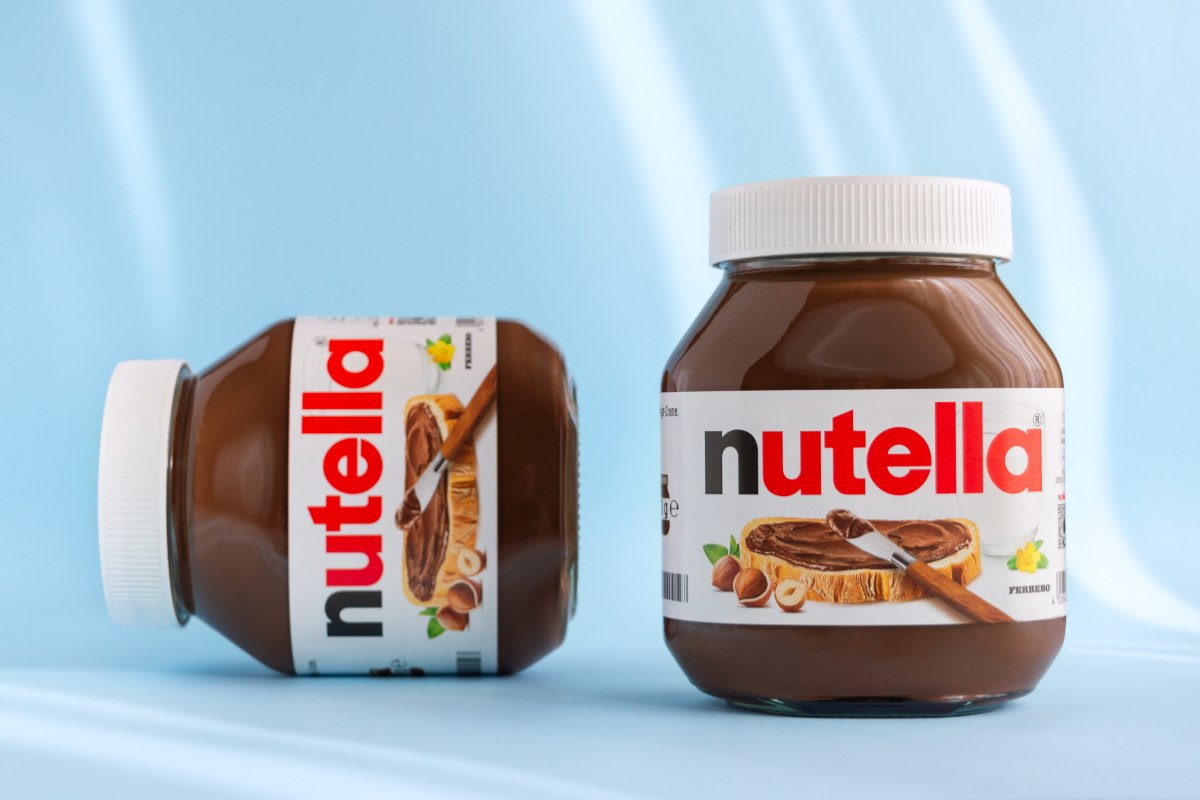
Today just open a jar and spread a little Nutella on the bread. A very simple gesture, which unites entire generations and hides a rather curious story. Because the most famous hazelnut cream in the world, at the beginning, had a completely different shape: it was a solid block, wrapped in foil, to be cut into slices.
And according to a legend that has accompanied the history of Ferrero for decades, the transformation into cream was even suggested by a small accident, during a particularly hot summer.
To understand how we arrived at the jar we know today, we need to go back to post-war Italy, when cocoa was a luxury and Piedmontese hazelnuts represented a precious resource.
When cocoa cost too much, Giandujot arrived
We are in Alba, in 1946. Italy is trying to recover from the consequences of the Second World War and obtaining some raw materials, including cocoa, is particularly difficult.
Pietro Ferrero, a Piedmontese pastry chef, then decides to enhance one of the most abundant ingredients in the area: hazelnuts from the Langhe. This is how Giandujot was born, a sweet paste prepared with hazelnuts, sugar and a limited quantity of cocoa. The name recalls Gianduja, the famous Piedmontese Carnival mask, already associated with the tradition of gianduia chocolate.
The product is packaged in blocks, which families can cut into slices and place on bread. A delicious, but above all economical, snack.
According to Ferrero’s historical reconstruction, a kilo of Giandujot cost around 600 lire, compared to the 3,000 lire that a kilo of chocolate could reach. A huge difference, capable of making that dessert accessible to many more people. Success came quickly and the small pastry shop in Alba began to transform into an industrial business.
The very hot summer that would change everything
The most curious part of the story comes in 1949, according to a very common story, during a particularly hot summer some blocks of Giandujot softened to the point of taking on a creamy consistency.
The versions change depending on the reconstructions: for some the product melted during transport, for others while it was in the warehouse.
What seemed like a conservation difficulty would however have suggested an interesting idea: transforming the block into a cream to spread directly on the bread.
The episode belongs above all to company legend and its historical reliability remains uncertain. What we know is that in those years Ferrero worked on a softer version of its hazelnut specialty.
In March 1949 Pietro Ferrero died at just 50 years old. The business continued thanks to the family, with an increasingly important role played by his son Michele, who would lead the subsequent expansion of the company.
From SuperCrema to the birth of Nutella
In 1951 SuperCrema arrived, the spreadable evolution of Giandujot. The new consistency made the product much more practical: it was enough to open the container and remove the desired quantity.
The cream quickly conquered Italian families, so much so that it pushed Michele Ferrero to further refine the recipe and prepare it for international markets. A new name was also needed, short and easily recognizable abroad.
The choice fell on Nutella, from the union of the English word nut, which recalls nuts, and the Italian suffix -ella. On 20 April 1964, the first jar of Nutella left the Alba factory. It was the beginning of a new phase for the Piedmontese company.
The jar of Nutella that became a glass
The packaging also contributed to the success of the product. For years Nutella was sold in glass containers which, once emptied, could be reused as glasses. A habit that many Italian families still remember today and which reflected a domestic culture attentive to the recovery of objects.
In 1965, with the arrival on the German market, the famous Pelikan jar also appeared, with a shape inspired by an inkwell. After Germany came France, in 1966, and subsequently numerous other markets. The cream born in the Langhe thus became one of the most recognizable Italian products in the world.
Today Nutella is a symbol of the confectionery industry, but its origins above all tell a story of ingenuity and ability to adapt. It all started from the need to use less cocoa and enhance a local ingredient.
The legend of the loaf melted by the heat adds a curious detail, while the real turning point was the ability to transform a simple hazelnut paste into a product destined to enter the homes of millions of people.
