
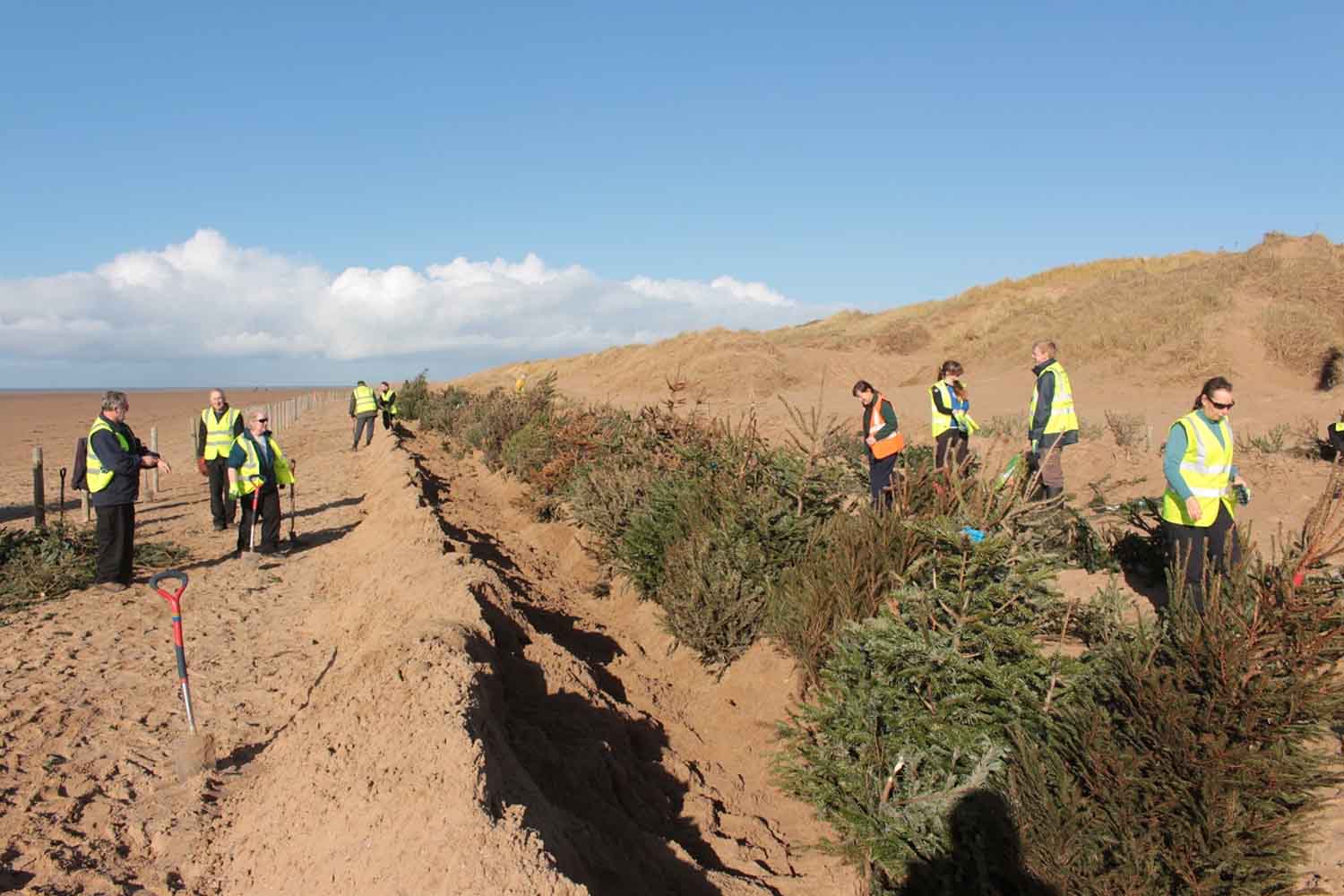
Over 2,000 Christmas trees buried along three kilometers of beach. In St Annes, on the Lancashire coast of England, around 650 volunteers spent three days burying fir trees discarded after the holidays. The trunks ended up under the sand, the branches remained exposed. And no, this is not a particularly imaginative disposal: those trees serve to retain the sand and rebuild the dunes that protect homes from storm surges.
The operation took place from 10 to 12 February 2026, as part of the Fylde Sand Dunes Project, a recovery program launched over ten years ago on a coast which, over a century and a half, has lost around 80% of its dunes. In some places, since 2013, the sand has already regained tens of meters. Christmas trees are one of the tools used, along with wooden barriers and native vegetation.
To rebuild the dunes, trees, wind and a little patience are enough
The procedure exploits a rather elementary natural phenomenon. When the wind blows, the sand moves along the beach until it hits an obstacle. In St Annes that obstacle is a Christmas fir which has already exhausted its career in the living room.
The volunteers dig trenches in front of the existing dunes, arrange the trees with their tips facing the sea and cover the trunks. The branches remain exposed, intercept the grains transported by the wind and favor their accumulation. Over time, small mounds can become new dunes.
Of course, trees need to be placed in the right places, far enough away from the direct action of the tides to prevent them from being washed away. The work then continues with chestnut wood fences and ammophilous sandstone plantings (Ammophila arenaria), a grass that grows on dunes and stabilizes them through its roots. The vegetation thus helps to retain the accumulated sand. The fir trees do the first work, the plants help to preserve the results.
A coast that has lost 80% of its dunes
Along the Lancashire coast, dunes have lost ground largely due to urban sprawl and erosion. More than 80% have disappeared in the last 150 years, according to the Lancashire Wildlife Trust. A loss that also directly affects those who live nearby. The dunes in fact constitute a natural barrier against storm surges: they absorb part of the energy of the waves and reduce the exposure of the areas behind them to the action of the sea.
To recover them, the project involves Fylde Council, Blackpool Council and Lancashire Wildlife Trust, with funding from the Environment Agency, the English public agency for environmental protection. Every January, residents can deliver their natural trees to collection points. A portion is also recovered through Trinity Hospice, a local charity that organizes the collection of fir trees in exchange for donations.
In the 2026 campaign, according to Fylde Council, this collaboration has raised over £37,000 for the charity. The trees end up on the beach, the donations finance care for sick people. A system that allows you to recover materials and simultaneously support a community service.
The dunes have already regained over 90 meters in some places
The most interesting results are measured directly on the coast. Already in 2022, according to a budget from Blackpool Council, some stretches of the dunes had gained between 60 and 90 meters since 2013. Updated data from the Lancashire Wildlife Trust indicates growth of more than 90 meters in some areas compared to 2012.
These are localized advances, of course. It doesn’t mean that the entire coast has grown in the same way, nor that the credit goes exclusively to the Christmas trees. Recovery results from a combination of interventions, including windbreaks, vegetation management and repair of damaged dunes. The program has now reached considerable dimensions: according to the Lancashire Wildlife Trust, a total of around 20,000 Christmas trees have been planted and six hectares of dune habitat recovered since 2008.
And then there are the homes. In the 2022 budget, local administrations attributed to the dune system a protective function for 493 properties exposed to coastal erosion and another eight to the risk of flooding. Around 400 further properties could have benefited from subsequent interventions. These are assessments referring to the dunes as a whole and their ability to attenuate the effects of the sea. No natural barrier guarantees absolute protection, especially in the face of the most violent storms and rising sea levels.
Sand lizards have also returned to the dunes
The recovery of the coast has also brought benefits to the animals. The dunes are home to over 280 recorded species of vascular plants, numerous insects and birds that depend on these habitats. Among the most interesting interventions is the reintroduction of the sand lizard (Lacerta agilis), one of the rarest reptiles in the United Kingdom, which has disappeared from many areas of the country due to the destruction of natural environments.
According to the Lancashire Wildlife Trust, the reintroduction program has resulted in the release of hundreds of captive-bred young specimens. The monitoring also identified hatched eggs and young born in the wild, encouraging signs for the formation of a stable population. The work also includes the removal of invasive plant species and the creation of small wet depressions in the dunes, which are useful for various organisms.
Of course, maintenance must continue. Storm surges can also erode reconstructed dunes and the rising sea makes the work progressively more challenging. In St Annes, meanwhile, Christmas trees have already found a use that lasts well beyond the holidays. Three days and a few hundred volunteers are enough to bury them. It takes years to rebuild the dunes.
