
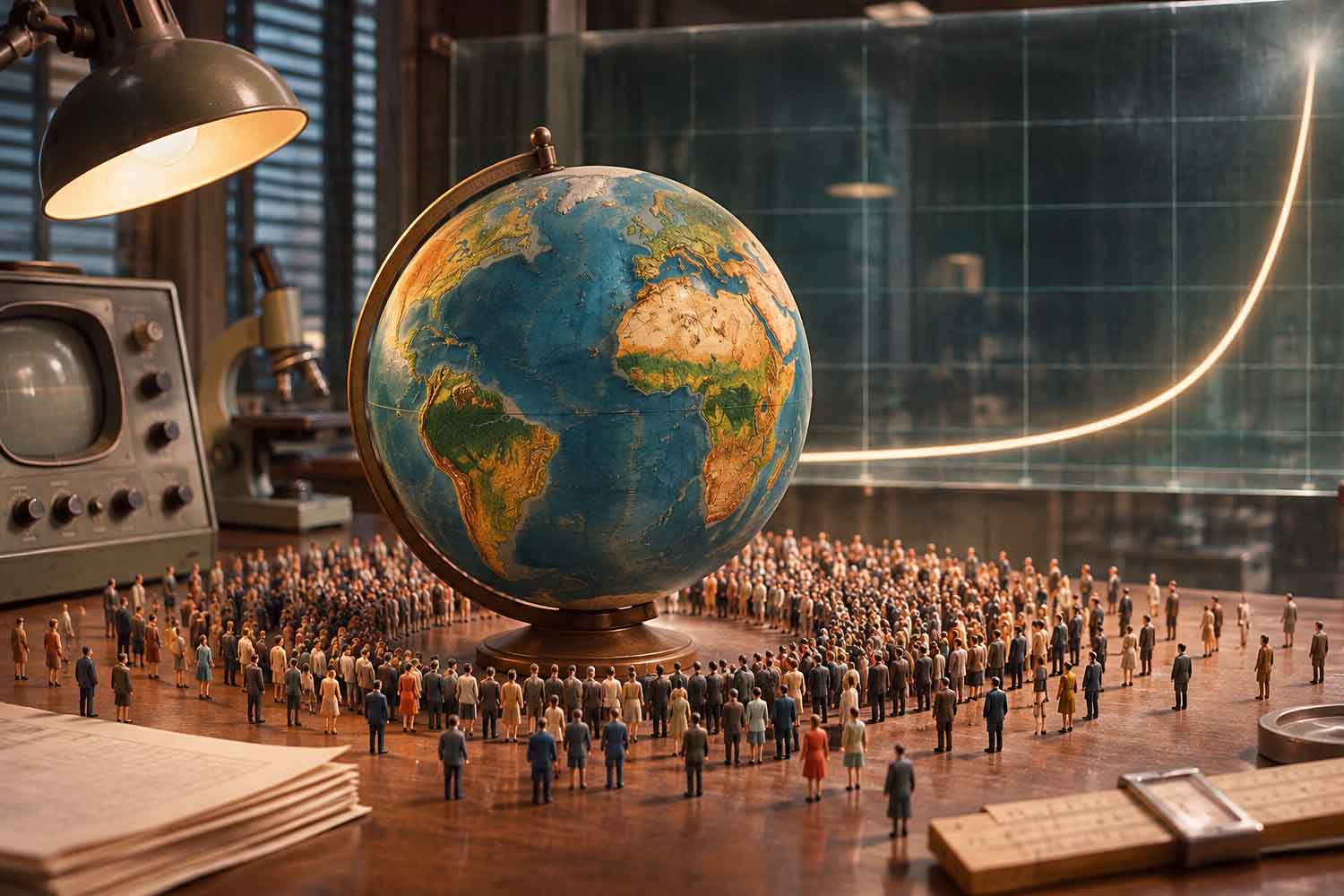
November 13, 2026 will be Friday. So far, the calculations add up. According to a study published in the prestigious scientific journal Science in 1960, however, that date should have marked something decidedly less ordinary: the day on which the world population would have reached, at least mathematically, infinity. An impossible number of human beings crammed onto a planet of rather limited dimensions.
The prediction bore the signature of three researchers from the University of Illinois, Heinz von Foerster, Patricia M. Mora and Lawrence W. Amiot, authors of a study published on November 4, 1960 with a title that left little to the imagination: Doomsday: Friday, 13 November, AD 2026. Judgment Day, Friday 13 November 2026.
Sixty-six years later, as that date approaches, Science itself has returned to the topic. On October 8, 2026, a new analysis by economist Javier A. Birchenall of the University of California at Santa Barbara was published, dedicated precisely to that forecast. The conclusion is rather reassuring: the world population has taken a very different direction than imagined in 1960.
How three scientists came to predict the end of the world
At the time, population growth seemed unstoppable. The world population had reached approximately three billion people and continued to increase rapidly, also supported by advances in medicine, agriculture and hygienic conditions. Von Foerster and his colleagues decided to analyze this growth using a mathematical model. They collected 24 estimates of the world population distributed over approximately two thousand years of history, up to 1958, looking for a relationship capable of describing the trend.
The results suggested growth hyperboliceven faster than the exponential one. According to the model, as the population increased, its ability to grow also increased, thanks to cooperation, communication and technological development. The problem came with extending this curve into the future.
The calculations led to a so-called mathematical singularity: a time when the theoretical population would become infinite. The central estimate fell towards the end of 2026, with a margin of about five and a half years. Friday 13 November therefore represented a much more precise, and decidedly more suggestive, choice than the results allowed. The authors, moreover, had accompanied the work with a good dose of irony. In the text they wrote that our descendants would not die of hunger, but rather crushed by the presence of too many people.
A rather macabre joke, inserted into a serious scientific discussion on population growth and available resources. There was also a fundamental condition, already declared in the subtitle of the study: all this would happen only if the population continued to grow as in the previous two millennia.
The prediction worked for decades, then reality arrived
For a time, the model seemed to work surprisingly well. The world population continued to grow rapidly throughout the 1960s, 1970s, and 1980s, following the curve researchers had developed fairly closely. Then the trajectory began to drift away from the calculations.
Demographic growth progressively slowed, while in many areas of the world the average number of children per woman decreased. Access to contraception, social changes, female education and economic transformations contributed to changing behaviors that the 1960 model was unable to anticipate.
Today the planet is home to approx 8.3 billion peopleaccording to United Nations estimates for 2026. A huge number, certainly, but rather far from infinite. United Nations projections also point to a slowdown in growth in the coming decades. According to the report World Population Prospects 2024the world population is expected to reach a maximum of approximately 10.3 billion people in the mid-1980sand then gradually begins to decrease.
These are naturally projections, subject to uncertainty and revisions over time. The difference compared to the 1960 model, however, is substantial: today demographic analyzes take into account the evolution of fertility, mortality and differences between countries, rather than indefinitely prolonging a single historical curve.
Because Science has returned to its prediction in 2026
The new article published in Science on October 8 bears a rather eloquent title: Demographic “doomsday” misses the markthat is, the demographic doomsday prediction misses the mark. Economist Javier A. Birchenall takes up the case to reflect on the limits of mathematical predictions. A relationship capable of accurately describing the past can lose its predictive capacity when the conditions that produced it change.
It is an important distinction, especially when talking about complex phenomena such as demography. The human population responds to economic, cultural, political and health transformations. A model built on a specific historical period can identify a real trend without being able to predict how long that trend will continue.
And of course the failure of the 1960 prediction does not mean that population growth is without consequences. The consumption of resources, the availability of water, food production and the pressures on ecosystems remain concrete issues, which also depend on how much and how we consume, as well as on the number of inhabitants. On the other hand, the demographic slowdown also opens up different problems, from the aging of the population to the sustainability of social security systems.
For the three researchers of 1960, the risk was endless growth. Today, many countries are already faced with the opposite problem: an aging and decreasing population. November 13th will actually fall on a Friday, exactly as indicated in the title of the study. On this, von Foerster and colleagues were right. As for infinity, the world’s population seems to have decided not to cooperate with the formula.
