
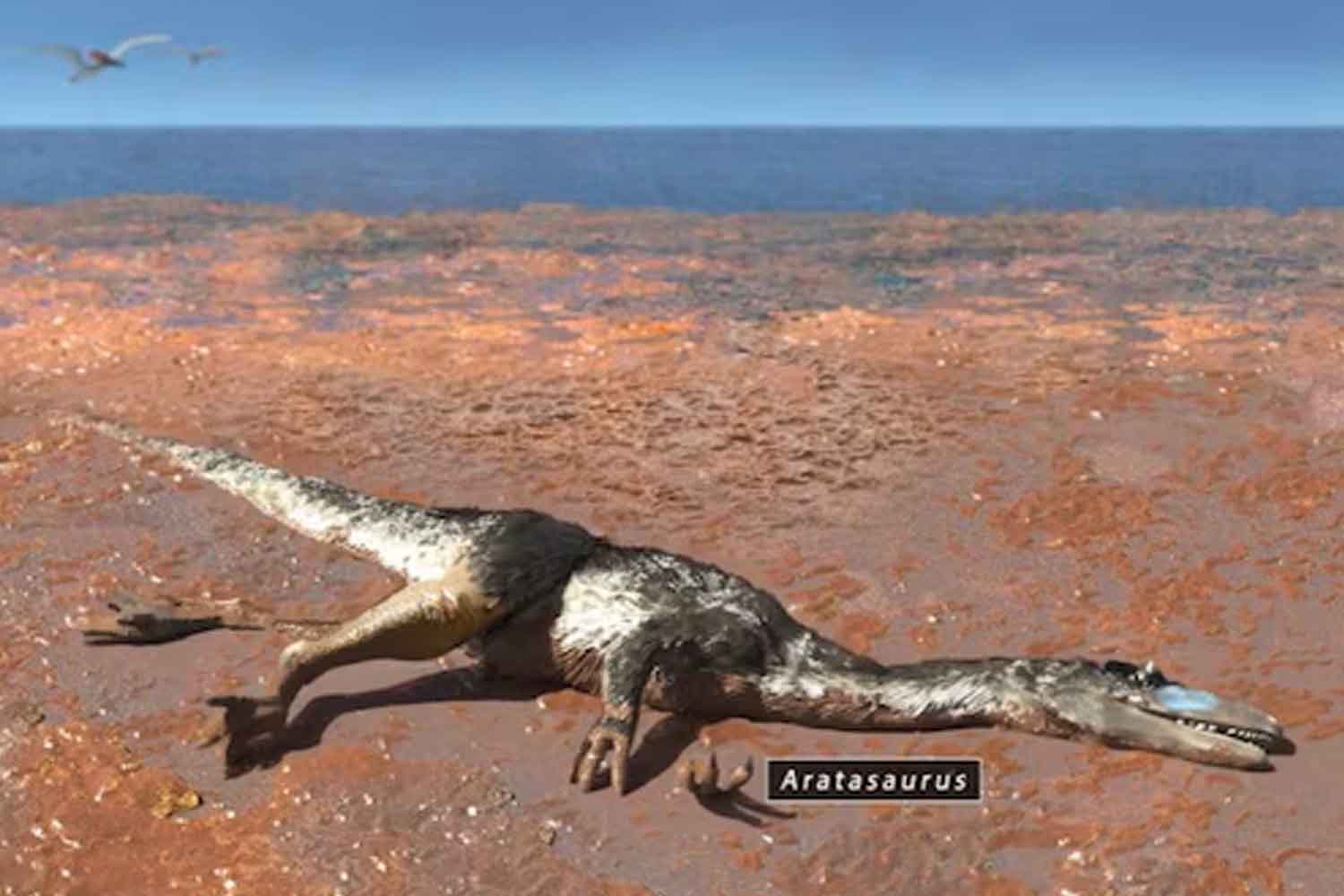
A dinosaur that died 115 million years ago left tiny oval structures in its leg bones, preserved in the very channels where blood once flowed. By analyzing them, an international group of researchers has identified traces of heme, the component of hemoglobin that allows it to bind oxygen. The structures resemble red blood cells and, according to the authors, represent some of the strongest evidence ever obtained for the preservation of material attributable to dinosaur blood.
The result comes from a study published in PNAScoordinated by Curtin University, Australia. The protagonist is Aratasaurus museunacionalia carnivorous dinosaur that lived in what is now northeastern Brazil during the Early Cretaceous. The novelty mainly concerns the combination of evidence: structures similar to blood cells, molecules attributable to heme and a position compatible with that of the red blood cells when the animal was alive. All this in a fossil that, at first glance, had very little that was spectacular.
An incomplete leg and a fossil discovered almost twenty years ago
The fossil was recovered in 2008 in a chalk quarry near Santana do Cariri, in the Brazilian state of Ceará. It belonged to a young theropod about 3.1 meters long, probably dead around four years of age. When the species was first described in 2020 in Scientific Reports, paleontologists only had part of the right hind limb, including fragments of the femur, tibia and foot.
Sufficient material to identify a new species and reconstruct some characteristics, including its approximate age and size. Six years later, those same bones yielded something that no one could have recognized by just looking at their surface. In the vascular channels, the tiny cavities through which blood vessels passed, scientists found numerous ellipsoidal microstructures. In shape and position they resembled red blood cells. But bacteria, fungi and particular mineralization processes can also produce structures that, under the microscope, resemble cells. Something more convincing than form was therefore needed.
The team led by geochemist Kliti Grice subjected the samples to several analyses, using Raman spectroscopy, transmission electron microscopy and chromatography and mass spectrometry techniques. Different tools, used to understand what substances those tiny structures were made of and whether they could really belong to the animal.
The analyzes have identified heme B and heme-derived molecules, some modified during fossilization processes. The chemical signals were associated with oval structures present in the vascular channels. Contamination by microorganisms that entered the fossil after the death of the dinosaur still had to be ruled out.
Comparison with the surrounding sediments provided another clue. Compounds attributable to chlorophyll and bacteriochlorophyll prevailed in the rock, while molecules characteristic of heme were present in the bone. Two different chemical signatures, which according to the authors support the origin of the blood traces from the animal itself.
The mineral that may have preserved blood for 115 million years
It remains to be explained how traces of such delicate biological material managed to cross 115 million years. The answer may lie where theAratasaurus is dead. The researchers hypothesize that the body was rapidly buried in an oxygen-poor environment characterized by the presence of microbial communities. Particular conditions, which may have favored the conservation of some organic components during decomposition and subsequent fossilization.
An important role would have been played byhausmannite, a mineral composed of manganese oxidepresent in the analyzed microstructures. The mineralization may have stabilized or reproduced the shape of the cells, also helping to preserve some of their chemical traces. In the press release published by Curtin University, Kliti Grice described the possibility of recognizing molecules derived from heme after such a long period of time as surprising.
The researcher believes that this information can help reconstruct some aspects of dinosaur physiology, from metabolism to oxygen transport, to differences in activity levels between extinct species. For the moment, however, the result mainly concerns the preservation of chemical traces. From these it is not yet possible to reconstruct the functioning of the circulatory system of theAratasaurus or establish how active he was.
Is this the first time dinosaur blood has been found?
The discovery is important, but the fossil blood had already left some clues to paleontologists. In 1997 Mary Schweitzer and her group published a study in PNAS in which they reported compounds compatible with heme and products of hemoglobin degradation in the bones of a Tyrannosaurus rex.
In 2005, on the pages of Science, the same paleontologist had documented structures similar to blood vessels and cells in another tyrannosaur fossil. The Brazilian discovery, therefore, does not represent the first ever report of traces attributable to dinosaur blood.
The novelty is to have associated chemical signals of heme with mineralized microstructures interpreted as red blood cells, located within the vascular channels of the bones. A set of clues that makes the researchers’ hypothesis particularly interesting.
However, the identification of the structures as authentic red blood cells remains the subject of scientific evaluation: their shape and size, although compatible with a cellular origin according to the authors, are not sufficient in themselves to establish their nature. Further checks on other fossils will be useful.
And above all, no one has recovered liquid blood, viable cells or dinosaur DNA. The identified heme molecules have also undergone chemical transformations over millions of years. This is not complete, functioning hemoglobin. However, the discovery has an interesting implication even outside paleontology.
Understanding how some biological residues can be preserved in particular geological conditions could help astrobiology researchers to recognize possible traces of ancient life on other planets. For now this is a possible future application, linked to the need to better understand these conservation processes.
Then there is a much closer and decidedly more practical consequence: museums hold thousands of fossils collected and studied when such sophisticated analysis tools were not yet available. Some may contain information you have never searched for before.
THE’Aratasaurus it had already been discovered in 2008 and received a scientific name in 2020. In 2026, a new examination of its bones made it possible to recognize chemical traces that had remained there for 115 million years. And the paleontologists only had part of the right leg available.
