
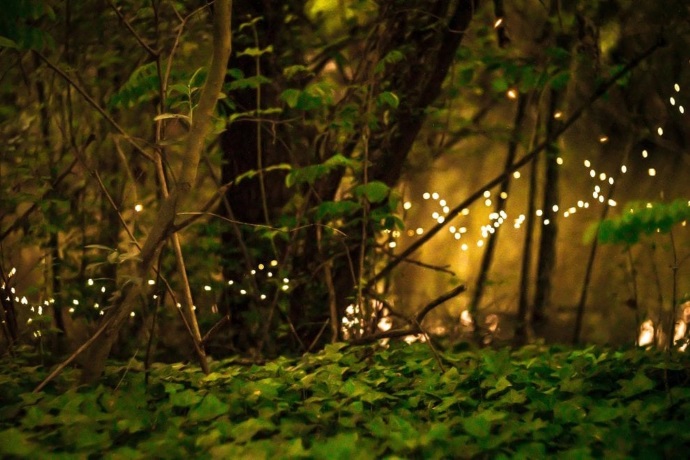
On May 15, 2026, in a meadow in Virginia, in the United States, Aljoscha Nern observed some fireflies and decided to share the sighting on iNaturalista platform that allows anyone to document nature. So far, one of the many reports that arrive every day from enthusiasts and naturalists. Too bad that those insects belonged to a species that had not been documented since 1983: the Pyractomena similisa firefly that disappeared from scientific records for 43 years.
The spring of 2026 brought two more surprises. A second population was also identified in Virginia and, on June 3, entomologist Christopher Heckscher of Delaware State University recognized the same species by its characteristic amber flashes, this time in a Delaware meadow. Three sightings in a few weeks, after more than four decades of silence. The discovery, reported in a study published in Journal of Lost Speciesbrings with it a rather surprising fact: in the United States and Canada there are still 28 firefly species considered lost to science, about 16% of the 178 known native species in the region.
Lost, in fact. Because a species can continue to live even when no one can find it anymore. And this little firefly evidently still had something to show.
Illustration ©Mauricio Alvarez
A sequence of flashes made it possible to recognize it after 43 years
Christopher Heckscher was looking for exactly that Pyractomena similis. He had already explored two natural areas between Maryland and Delaware, without finding any trace of the insect. Then he arrived at Brandywine Creek State Park, where he spotted a particularly interesting environment: a mature meadow, with shrubs, bushes and low vegetation, left to grow spontaneously. As evening fell, the fireflies had begun to light up. And among the most familiar light signals those amber flashes appeared, emitted in rapid succession, as Heckscher recounted in the press release published by Re:wild, an international organization committed to the conservation of biodiversity:
I was sure I had found the species the moment I saw the light sequence.
For the males of the Pyractomena similisthose flashes are a kind of love language: they generally produce ten to twenty closely spaced light pulses, take a short pause and start again. A system to be recognized by the females of your species.
The definitive confirmation came on July 2, through the microscopic examination of a specimen. Four days later, the report published on iNaturalist by Nern was also confirmed. The story therefore has two protagonists who arrived at the same discovery through independent paths: an observer who shared what he had found and an entomologist engaged in targeted research. Both helped bring the species back into the scientific records.
The 28 fireflies that no one can find anymore
The history of Pyractomena similis it is only one part of a much larger research. The group of scholars coordinated by Candace Fallon, biologist at the Xerces Society for Invertebrate Conservation, examined the information available on fireflies in the United States and Canada, identifying 28 species for which confirmed reports have been missing for at least ten years. Some have been absent from the records for much longer. The curious fact is that many could continue to live undisturbed. Simply, no one looked for them enough, or they did it in the wrong place, in the wrong season or when the insects had already gone back into hiding.
After all, observing fireflies requires a certain amount of patience. Some adult species are active for only a few weeks a year, others live in particular environments that are difficult to reach. Many look so similar that recognizing them without observing their behavior can become complicated. And even the most conspicuous insects, it seems, can go unnoticed.
However, there is one fact that gives rise to hope. Nine species included in a preliminary list of lost fireflies, compiled in 2024 for Re:wild, have already been found. Some thanks to the research of entomologists, others through the observations of ordinary people, subsequently examined by experts. In July 2024, for example, a participant in the Firefly Atlas project found a population of the so-called in Arkansas Ozark sparka firefly that had not been documented since 1964. Sixty years of absence from the records, then a new observation. And subsequently two other populations identified nearby.
Even in Italy fireflies still hide some surprises
American history has something in common with what is also happening in our country. Because Italian fireflies, however familiar they are on summer evenings, are still surprisingly little studied. According to the National Research Council, which coordinated the LUCE project together with the Scuola Superiore Sant’Anna, around twenty species of fireflies live in Italy, several of which are endemic. For some, even the classification requires further investigation through genetic analysis.
And precisely in 2026, research arrived that tells how precious citizens’ observations can be. A study published in the scientific journal Biogeography reconstructed the distribution of fireflies in the Italian islands, combining researchers’ field investigations with reports collected through iNaturalist. The scholars documented ten taxa, including species and subspecies, and also identified a presence never before recorded in Italy: that of Lampyris pallida on the island of Linosa, in the Pelagie archipelago.
In this case the discovery came from scientific field investigations and was confirmed through DNA analysis. Citizens’ observations instead made it possible to broaden the geographical coverage of the research, especially in the most popular and easily accessible islands. Two different tools which, used together, allow us to learn more about animals about which we still know too little.
In short, from Virginia to Linosa, history is similar: someone observes, documents, shares. And information that seemed tiny can become useful for reconstructing the presence of a species in the area.
Fireflies need darkness, and meadows that remain meadows
There is another important detail in the Delaware discovery. Heckscher found the Pyractomena similis in an environment that today is not as common as it might seem. We think of lawns as something ordinary, present practically everywhere. Yet, many are cut regularly, used for grazing or processed for other activities. The place of discovery, however, preserved well-developed spontaneous vegetation, with grass, shrubs and bushes. According to the researcher, these characteristics could be particularly important for the species.
Fireflies have needs that go far beyond the ability to illuminate a summer evening. During larval development, many live in the soil, among fallen leaves and moist vegetation, feeding on small invertebrates such as snails and slugs. Once adults, they need conditions that allow them to reproduce. And then there is the darkness. The real one, increasingly difficult to find.
For many species, light signals are essential for identifying a partner, and artificial lighting can interfere with this communication. Added to this are habitat loss, the use of pesticides and the effects of climate change. Research published in PLOS ONE by 2021 it had already identified at least 18 species of North American fireflies threatened with extinction, out of 132 examined. For many others, there was not enough information to even determine how much danger they were in.
How to help fireflies, even in your home garden
To encourage the presence of fireflies, major interventions are not necessarily necessary. Indeed, sometimes it is precisely the excess of maintenance that makes the places in which they could live less hospitable. The Firefly Atlas, an initiative dedicated to monitoring North American fireflies, recommends conserving portions of spontaneous vegetation, reducing mowing and limiting the use of pesticides. Leaving some of the fallen leaves on the ground can also be helpful: that plant layer helps maintain humidity and provides shelter for the larvae. A garden can continue to be cared for without treating every fallen leaf as an emergency.
And when evening comes, it is better to turn off the external lights that are not needed. Fireflies use their light signals to communicate and find a mate – adding more lighting can make things a lot more complicated. Then there is another possibility, within the reach of those who love observing nature: contributing to the collection of scientific data.
There are also initiatives in Italy citizen science dedicated. The Alpi Marittime Protected Areas, for example, invite citizens to report sightings as part of the Starry Skies project, which studies the effects of light pollution on nocturnal biodiversity. For those who live elsewhere, documenting a sighting on iNaturalist, indicating the location, date and possibly accompanying it with photographs or videos, can also contribute to the knowledge of these insects.
Meanwhile, American researchers will have to return to the field to understand if the Pyractomena similis has become truly rare or has simply escaped observation for decades. We still know little about its habits, current distribution and population size. But we know that it continues to live and communicate through its little amber flashes. For 43 years no one had managed to document it. She, in the meantime, had continued to light up.
