
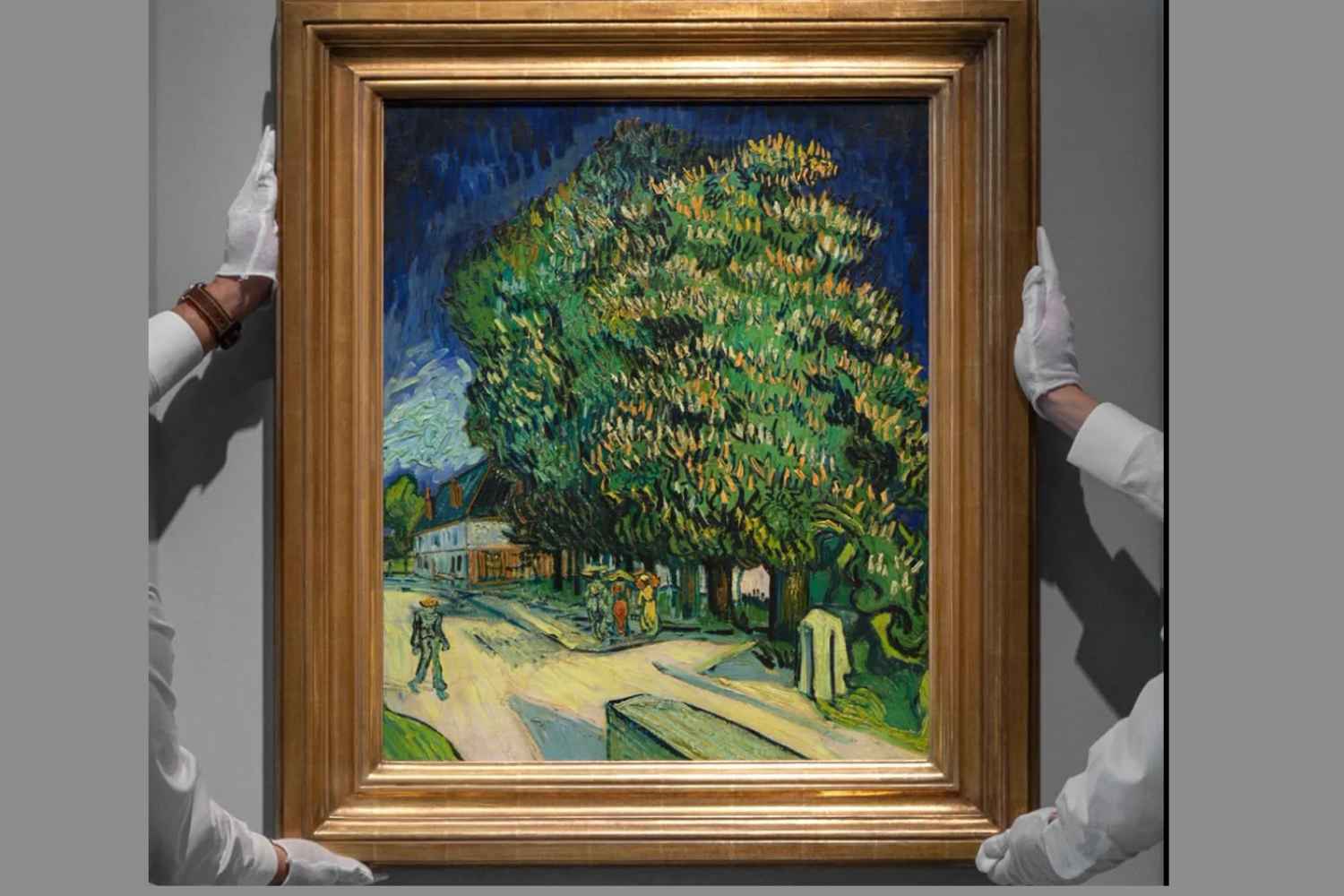
A spring landscape, with chestnut trees in bloom and a road that crosses the French countryside. Vincent van Gogh painted it in May 1890, a few weeks before his death. One hundred and thirty-six years later, that painting sold for $190.4 million, setting a new record for the Dutch painter. But the story of Châtaigniers en fleurs, known in Italian as The chestnut trees in bloom, also goes through one of the most tragic periods of the twentieth century: the Nazi persecutions against the Jews.
The work was auctioned on Wednesday 18 November 2026 by Sotheby’s in New York, after a controversy over its provenance which risked blocking the sale. The heirs of Samuel Fischer, a German Jewish publisher who had purchased the painting in 1909, claimed that the family had been forced to separate from it in 1936 due to the persecution of the Nazi regime. An agreement reached just one day before the auction allowed the award to proceed.
The painting created in the last months of Van Gogh’s life
In May 1890 Van Gogh had just left the psychiatric hospital of Saint-Rémy-de-Provence, where he had been hospitalized for about a year. He moved to Auvers-sur-Oise, a small town north of Paris, to be followed by Dr. Paul Gachet and continue painting.
It is here that he created The Chestnut Trees in Bloom, a landscape dominated by trees in full bloom, with a road that opens up through the vegetation. The brushstrokes are dense, the colors bright. The blue sky is the backdrop to the green foliage, dotted with white and pink flowers.
Van Gogh died on July 29 of the same year, aged just 37. The painting therefore belongs to the last phase of his production, that of the landscapes of Auvers-sur-Oise.
For over fifty years the work remained away from the public eye, kept in a private Argentine collection. It was brought back to the market by the descendants of Nelly Arrieta de Blaquier and her husband Carlos Pedro Blaquier, an entrepreneur who died in 2022.
The couple had purchased the painting in 1975 and kept it in their collection in Buenos Aires along with works by Cézanne, Monet, Renoir, Degas and Gauguin.
The pre-auction estimate was around $180 million. The final award, including commissions, reached 190.4 million, surpassing Van Gogh’s previous record: the 117.2 million paid in 2022 for Verger avec cyprès (Orchard with cypresses).
According to what was reported by Reuters and Artnet, the purchase of the painting was William Acquavella, a New York art dealer at the helm of the Acquavella Galleries. It has not been publicly clarified whether he purchased the work for himself or on behalf of a client.
From the Fischer family to the escape from Nazism
To understand the controversy that preceded the auction we need to go back to 1909, when Samuel Fischer and his wife Hedwig purchased the painting in Berlin. Fischer, a German publisher of Hungarian origin, was the founder of S. Fischer Verlag, one of Germany’s main publishing houses, which had published authors such as Hermann Hesse and Thomas Mann.
With the arrival of Adolf Hitler to power in 1933, the publishing house and the Fischer family were affected by the regime’s anti-Semitic policies. Some of the authors published by the publisher ended up on the Nazi blacklists and their books were destroyed during the fires organized in Germany.
Between 1932 and 1933 the painting was entrusted to the Paul Cassirer & Co. gallery in Amsterdam, where it remained in storage.
Samuel Fischer died in 1934 and ownership of the work passed to his daughter Brigitte and her husband Gottfried Bermann-Fischer, who also found themselves managing the publishing business in increasingly difficult conditions. The two left Berlin and moved to Vienna, where they opened a branch of the publishing house. In June 1936, the Amsterdam gallery sold The Chestnut Trees in Bloom to the French collectors Marcel and Henriette Kapferer, on behalf of the Fischer heirs. It is precisely this sale that has been contested, ninety years later.
The heirs’ request: was the painting sold under the pressure of Nazi persecution?
According to the heirs of Samuel and Hedwig Fischer, the sale of the painting in 1936 was not a free commercial choice. The family, forced to leave Germany and dealing with the economic consequences of Nazi persecution, would have sold the work in conditions of necessity.
Lawyer Gunnar Schnabel, specialized in disputes over works of art stolen during the Nazis, contested the circumstances of the transaction, asking Sotheby’s to demonstrate that the price was reasonable and that the family would have still decided to sell the painting in the absence of the persecutions.
This is an important aspect in requests for the restitution of works of art related to the Nazi period. Disputes can also concern formally regular sales, when it is believed that the owners have been forced to give up their goods due to discrimination and persecution. The heirs had asked to suspend the auction scheduled for November 18, raising doubts about the provenance of the work.
Sotheby’s said it had carried out extensive checks on the painting’s history. On November 17, the eve of the sale, the auction house announced that an agreement had been reached between the Blaquier-Arrieta family and all legal descendants of Samuel and Hedwig Fischer.
The terms of the agreement were not made public. The agreement allowed the auction to proceed, without a final decision on the nature of the 1936 sale being made known.
Van Gogh’s new record and the art market
The sale of The Chestnut Trees in Bloom was one of the most important results of the November auction week in New York, during which Sotheby’s, Christie’s and Phillips totaled approximately $2.44 billion, compared to $2.23 billion the previous year.
Sotheby’s reported evening sales of about $1.2 billion. Among the other auctions, Arlequin by Paul Cézanne stands out, created between 1888 and 1890, sold for 111 million dollars.
Van Gogh’s achievement also takes on particular weight for the history of the work. For half a century the painting remained in the Blaquier-Arrieta family collection, after passing through the European market in the years preceding and accompanying the Second World War.
Its return to auction has also brought attention to the Fischer affair and the issue of works of art sold by Jewish families during Nazism, a topic that continues to interest the international market and cultural institutions.
As for The Chestnut Trees in Bloom, the painting now leaves the Argentine collection after fifty years. Its final destination, and whether it will return to public display, are not yet known.
