
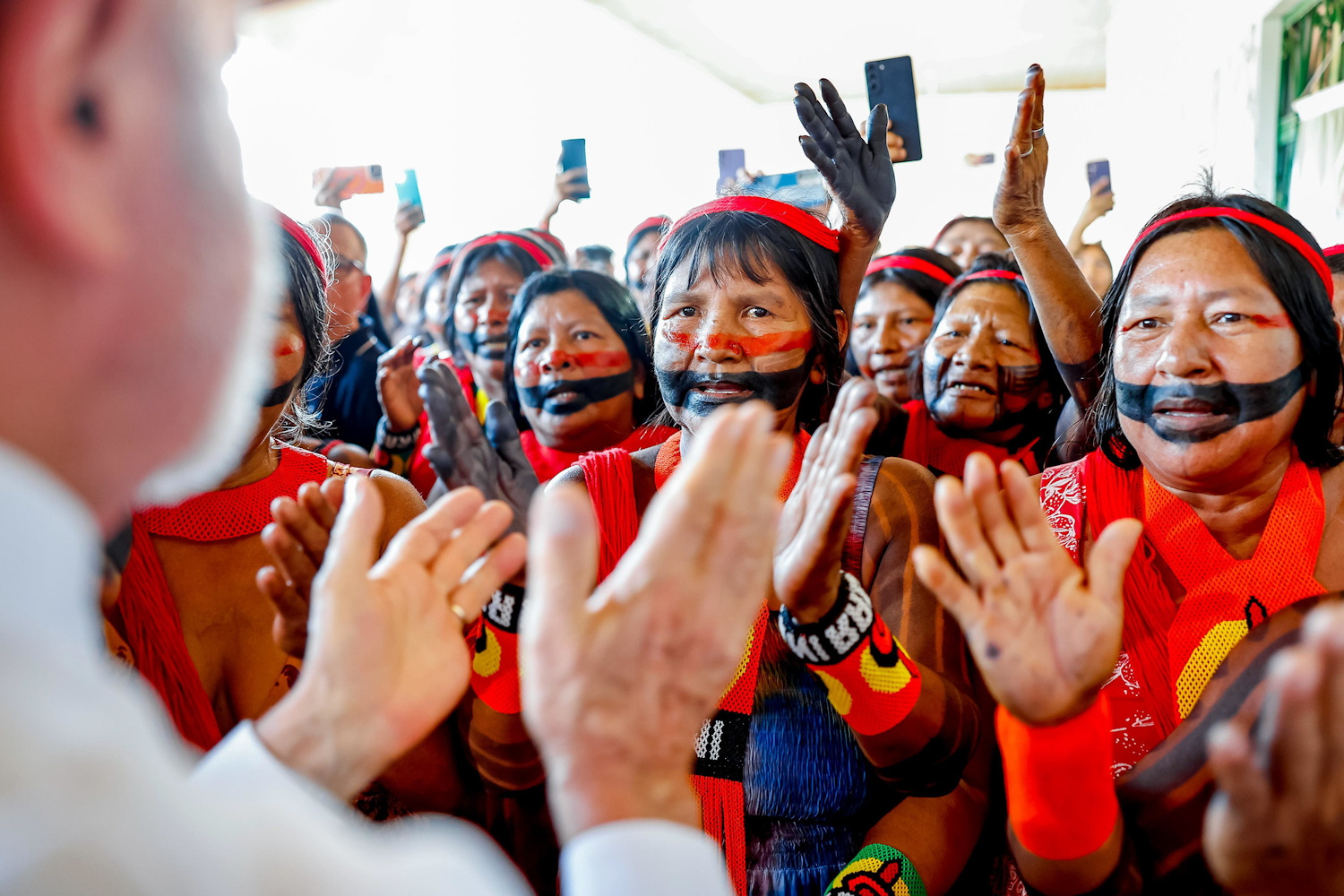
Victory! The Kapôt Nhĩnore Indigenous Territory now has legally defined borders: President of Brazil Luiz Inácio Lula da Silvarecently re-elected, signed the ordinance with which he officially recognizes the Territory. This signature, coming after decades of struggle, is a historic step towards protecting nearly 362,000 hectares of their ancestral territory in the Amazon.
As stated on the Brazilian government website, with an extension of 362,000 hectares, among the states of Mato Grosso and of Parathe borders of the territory are now officially recognized. We are talking about an area that is still 83% covered by forest which includes sacred places for the Mẽbêngôkre people, including ancient burial sites, a priceless treasure which with this signature is decidedly better preserved.
I have a commitment to life with respect to indigenous people and with a guarantee of my directions. Therefore, following the declaration of the Indigenous Land Kapôt Nhĩnore, ancestral territory of Cacique Raoni, this has a special significance.
We are making… pic.twitter.com/5TDx6tp6uK
— Lula (@LulaOficial) November 19, 2026
The Mẽbêngôkre people
The people Mẽbêngôkrealso known as Kayapó, belongs to the language family Je and preserves a rich cultural tradition passed down from generation to generation. Their connection to the forest and rivers is an integral part of their lifestyle and is reflected in a deep knowledge of plants and animals, as well as activities such as farming, gathering, hunting and fishing.
Body paint – traditionally made with natural dyes obtained from jenipapo and fromurucumconstitutes a significant expression of their identity, linked to different aspects of community life and traditional celebrations. Festivals, rituals and the great importance attributed to ancestral names also play a central role in their social organization and in the protection of their culture.
Decades of struggle
In the 1950s, the advance of colonization frontiers in the Xingu led to the displacement of indigenous populations from the region and that area was subsequently excluded from its neighbor’s borders Capoto/Jarina Indigenous Territory at the time of its official regularization, which took place in the 1990s.
The demarcation process received a new impetus in 2012, when the Federal Court ruled against the federal government for the delay in the regularization process, following a legal action brought by the Federal Public Prosecutor (MPF).
In 2015, the National Foundation for Indigenous Peoples (Funai) has established a technical working group responsible for conducting the anthropological studies and other assessments necessary for the identification and delimitation of the area, and the Detailed Identification and Delimitation Report (RCID) was approved by Funai only in July 2023.
This decision was the subject of legal appeals and objections, to which the Foundation responded by referring to the regulations governing the demarcation process. But on October 6, 2026, the 12th Section of the Federal Regional Court of the 1st Region (TRF1) unanimously confirmed the validity of the studies conducted to identify and delimit the Kapôt Nhĩnore Indigenous Territory.
For Raoni Metuktirerecognized internationally for his commitment to the rights of indigenous peoples and the conservation of forests, this is one of the last great battles of his life and he finally sees the light of victory: he is 94 years old, he is currently being cared for at his home in Peixoto de Azevedoand is an eminent leader Mẽbêngôkre who has dedicated decades to the fight for the protection of their territory and indigenous peoples.
What changes with President Lula’s signature
The signing of the declarative ordinance therefore marks a further fundamental stage in the process of official recognition of the territory – we read on the Brazilian government website – In addition to guaranteeing territorial protection and supporting the rights of the people Mẽbêngôkrethe demarcation contributes to the conservation of the environment and the protection of biodiversity
The area has been under severe pressure due to grazing expansion in the eastern Amazon. According to data presented by Funai, deforestation has gone from 4,178 hectares in 2000 to 58,000 hectares recorded in 2026.
It was no longer possible to allow this environmental disaster to continue.
Sources: Government of Brazil/Presidency of the Republic / Lula/X
