
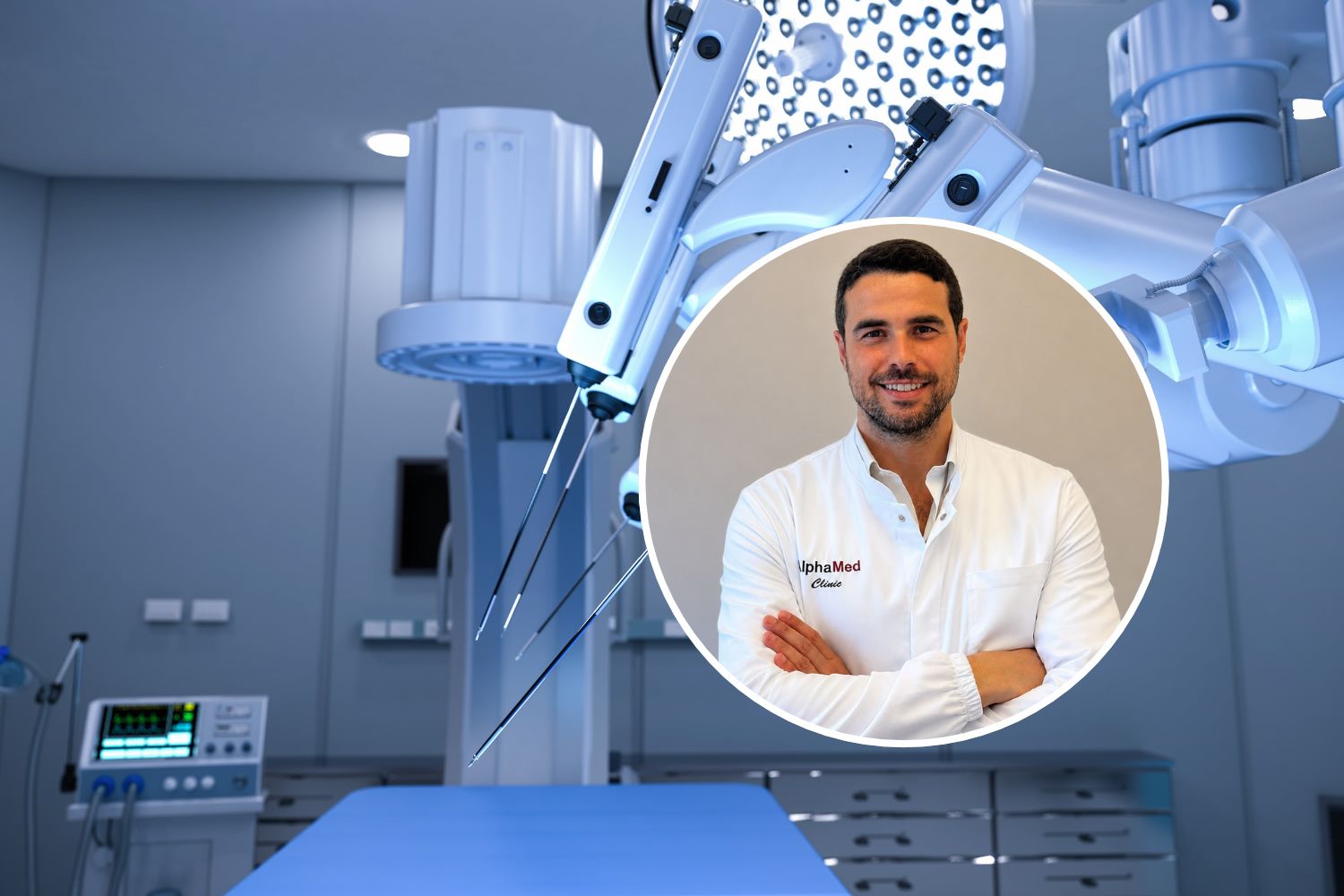
A scooter accident, a truck trailer and a finger left attached to the hand only by a flap of skin and a single digital artery. This is the dramatic situation experienced by a 21-year-old Brazilian student who lives in Rome. His story, today with a happy ending, has become a concrete example of how robotic microsurgery is entering operating rooms, without however replacing the work of human doctors, as underlined by the surgeon Alessandro Piperno who dealt with the delicate case.
An intervention on very delicate structures
When the young woman arrived at the hospital, her finger was almost amputated. Saving him meant intervening on multiple fronts at the same time. In the first operation the surgeon stabilized the fracture, repaired the tendons and nerve and reconstructed the continuity of the artery. For this last step, the Symani robotic system was used, used for vascular micro-anastomosis, i.e. the suturing of tiny blood vessels. This is one of the most complex phases of reconstructive surgery, because it requires extreme precision.
The path after the operation
Recovery was not immediate. In the following months, a second operation was necessary to treat adhesions and joint instability. Then, after over a year and a course of physiotherapy, the girl returned to normal daily activities.
The case shows well how long and complex the path is after a serious trauma: the operating room is only the first step, rehabilitation is equally decisive.
Who is the surgeon and what techniques does he use?
The case was handled by Alessandro Piperno, a specialist in Orthopedics and Traumatology, active in hand surgery and microsurgery at the Israelitico Hospital in Rome. He is among the few surgeons in the world to have used robotic systems for hand microsurgery. In addition to Symani, developed by Medical Microinstruments, it employed MUSA 3, developed by Microsure.
His training includes a fellowship in hand surgery at the University of Iowa, United States, and a period at the Microsurgery Center at Queen Victoria Hospital in East Grinstead, United Kingdom. He also performs clinical work at UPMC Salvator Mundi International Hospital and specializes in hand and wrist trauma, microsurgery and lymphedema treatment.
What a robot can really do
The most interesting point concerns the role of technology. Systems like Symani are designed to assist the surgeon’s movements, reducing physiological tremor and allowing the scale of the gesture to be modulated. In practice, a hand movement can be translated into a much smaller and more precise one.
Yet Piperno urges caution: «The use of these technologies does not make the doctor’s experience and evaluation superfluous, nor does it alone guarantee a favorable outcome. The severity of the injury, the condition of the tissues, the choice of technique and rehabilitation remain central.” The real question, he adds, is to understand “in which situations robotic assistance can offer a concrete clinical advantage and how to measure it”.
For this reason, the result obtained cannot be attributed to the robot alone: it is the combination of competence, surgical choices and recovery that makes the difference.
The comparison between specialists and a look to the future
The theme was also at the center of the SiM 2026 Symposium, «Revascularized Bone», which took place on 23 October at the Santa Maria della Scala Museum Complex in Siena. The congress explored vascularized bone reconstruction techniques and their applications in limb, hand, head and neck surgery, comparing different surgical specialties. Piperno chaired the session «New perspectives of bone reconstruction». According to Piperno, the future of microsurgery is «a constantly evolving horizon, where innovation, technology and human ingenuity meet to overcome the limits of the possible». In the coming years the challenge will be to integrate new technologies with the surgeon’s experience and the evaluation of clinical results.
The story of the young student tells precisely this balance: robotics is a precious ally, but it is always medical expertise, time and rehabilitation that restore a functioning hand.
