
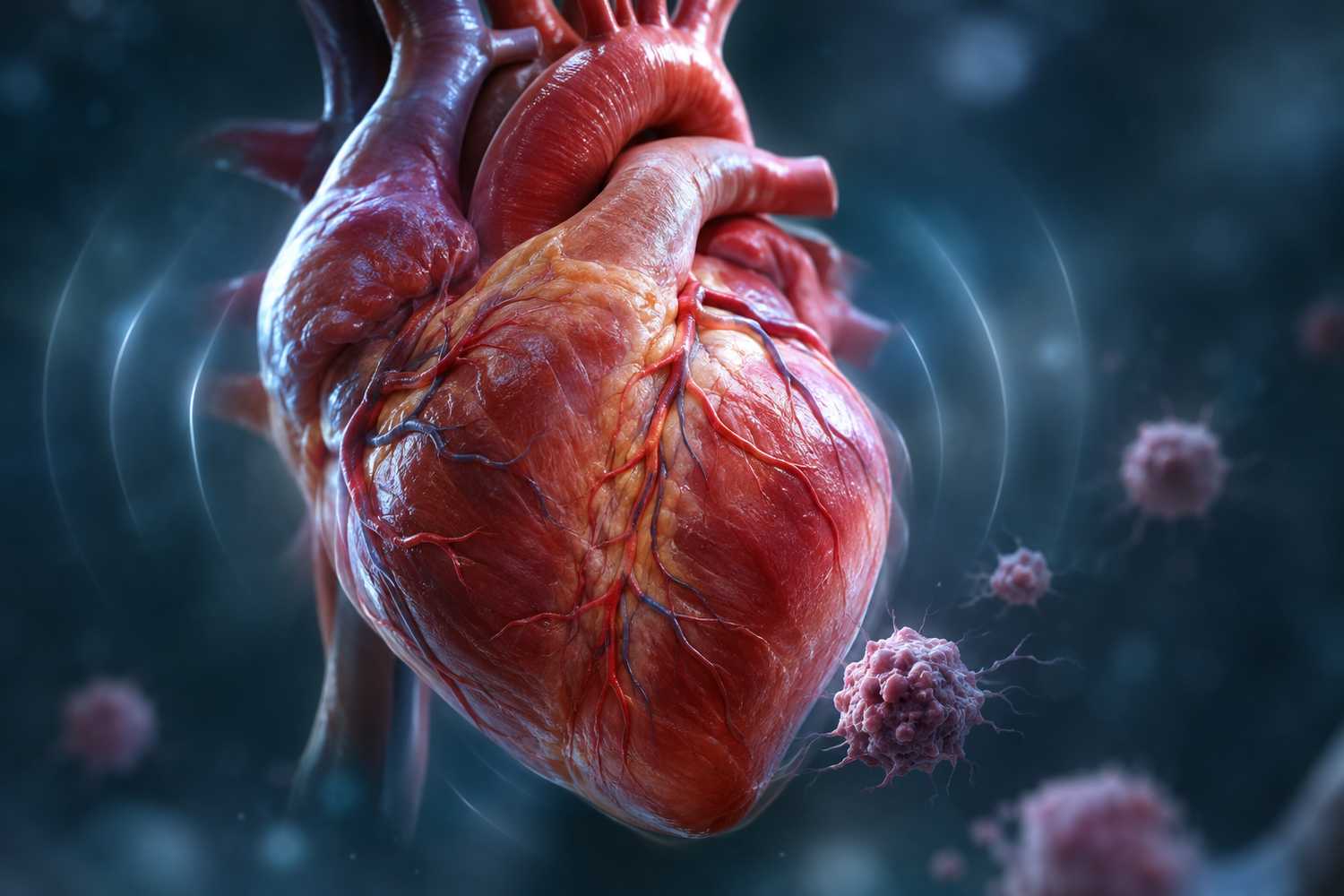
The heart receives blood continuously, yet it is one of the organs in which tumors develop most rarely. Metastases that reach the heart muscle also tend to be less extensive than those present in other tissues. A peculiarity that has intrigued doctors for some time and which could have a surprisingly simple explanation: the heart also defends itself thanks to its beating.
This is suggested by a study published in the journal Sciencecoordinated by the University of Trieste in collaboration with the International Center for Genetic Engineering and Biotechnology (ICGEB) and the Monzino Cardiology Center of Milan. Researchers have found that mechanical forces produced by heart contractions can slow the proliferation of cancer cells, even changing how they use their own DNA. In short, the heart could have a protection system incorporated into its daily activity. And it works precisely because that muscle continues to work.
The heart beats and the tumor cells slow down
Each cardiac contraction subjects the muscle to pressure, stretching and deformations. It happens dozens of times a minute, thousands of times every day, without us realizing it. This continuous movement is essential to maintain blood circulation, but according to the research group led by Giulio Ciucci and Serena Zacchigna it could also perform another function.
The scientists started from a characteristic of the adult heart: its cells almost completely lose the ability to multiply after birth. A limit that becomes particularly problematic when the muscle is damaged, for example after a heart attack, because the heart tissue struggles to regenerate.
Among the factors that contribute to slowing down this ability are the mechanical forces generated by cardiac work. Hence the researchers’ hypothesis: if movement limits the proliferation of heart cells, could it also hinder that of tumor cells?
To verify this, the group used several experimental models, comparing cardiac tissues subjected to normal mechanical loading with others in which this stimulus had been reduced. The results showed a clear difference. When the heart supported its normal work, tumor cells struggled to proliferate. By reducing the mechanical load, however, growth became much faster.
The same behavior was observed in heart tissues reconstructed in the laboratory, where researchers could directly control the intensity of the stresses. The phenomenon affected cells from various tumors, including lung, colon and melanoma. The heartbeat therefore seemed to represent a concrete obstacle to the growth of the cancer. It remained to be understood how a physical force could influence something that happens inside the cell nucleus.
The Nesprin-2 protein is the signal that reaches DNA
The answer came from a protein called Nesprin-2, which helps connect the cell’s internal structure to its nucleus, where DNA is kept. We can imagine it as part of a connection system capable of transmitting stresses coming from the outside to the nucleus. When heart tissue contracts, these forces are sensed by tumor cells and can change their behavior.
The experiments showed that mechanical load, through Nesprin-2, influences the organization of chromatin, the complex of DNA and proteins present in the nucleus. Some chemical modifications of histones, the proteins around which DNA is wrapped, change and the activity of genes involved in tumor proliferation is reduced. The movement of the heart thus comes to influence the functioning of the genes that regulate the growth of cancer cells.
To test how important Nesprin-2 was, scientists experimentally reduced its activity in lung cancer cells. Without this protein, the cells recovered the ability to multiply even when subjected to the normal mechanical load of the heart. A confirmation of the role of Nesprin-2 in the connection between physical forces and the response of tumor cells.
The same trace has been found in human metastases
The scientists also looked for confirmation in human tissues, analyzing samples of cardiac metastases from three patients with tumors originating in the lung, colon and skin.
Comparison with lesions present in other organs of the same patients showed molecular changes compatible with those observed in the experiments. In particular, tumor cells present in the heart showed changes in the organization of chromatin and in the regulation of genetic activity.
Human samples are few and experiments on the role of mechanical loading have been conducted in preclinical models and engineered tissues. The result, however, offers a possible biological mechanism to explain the particular resistance of the heart muscle to tumor growth.
As Serena Zacchigna, professor of Molecular Biology at the University of Trieste and head of the ICGEB Cardiovascular Biology laboratory, explained in the press release released by the Monzino Cardiology Centre:
Our results demonstrate that cardiac pulsation is not only a physiological function, but can act as a natural suppressor of tumor growth.
According to the researchers, therefore, the heart could be less hospitable to tumor cells also for mechanical reasons, as well as for its immunological and metabolic characteristics.
A therapy against tumors that reproduces the heartbeat
The discovery gave researchers a rather peculiar idea: to try to reproduce the forces of the heartbeat on tumors found in other parts of the body.
Zacchigna’s group already collaborates with robotics experts from the University of Siena to develop wearable devices capable of applying rhythmic mechanical stimulation to tissues. The project, presented in 2024 during the Genoa Science Festival, was also reported by the ICGEB.
The objective is to verify whether these stresses can slow down the proliferation of tumor cells even outside the heart, for example in some more superficial tumors, and whether they can be integrated with existing oncological therapies.
For now this is an experimental prospect. It will be necessary to establish which tumors are sensitive to mechanical stimuli, with what intensity and frequency to apply them and what effects they produce on the surrounding tissues.
However, the research has identified a biological mechanism that has so far received little attention. And it also contains a curious contradiction: the same forces that make it difficult for the heart to regenerate after damage could help it fight tumors.
The adult heart pays for this protection with a very limited repair capacity. Researchers are trying to understand whether it is possible to exploit its favorable side elsewhere too. For the moment, the heart muscle continues to do what it has always done: beat. With some more effects than those we knew.
