
In the Marche, egg pasta is a serious thing, it is part of the tradition of hand-rolled pastries, Sunday lunches and recipes handed down in the family.
Traditions that continue even in pasta factories, where industrial processes try to preserve some characteristics of homemade pasta.
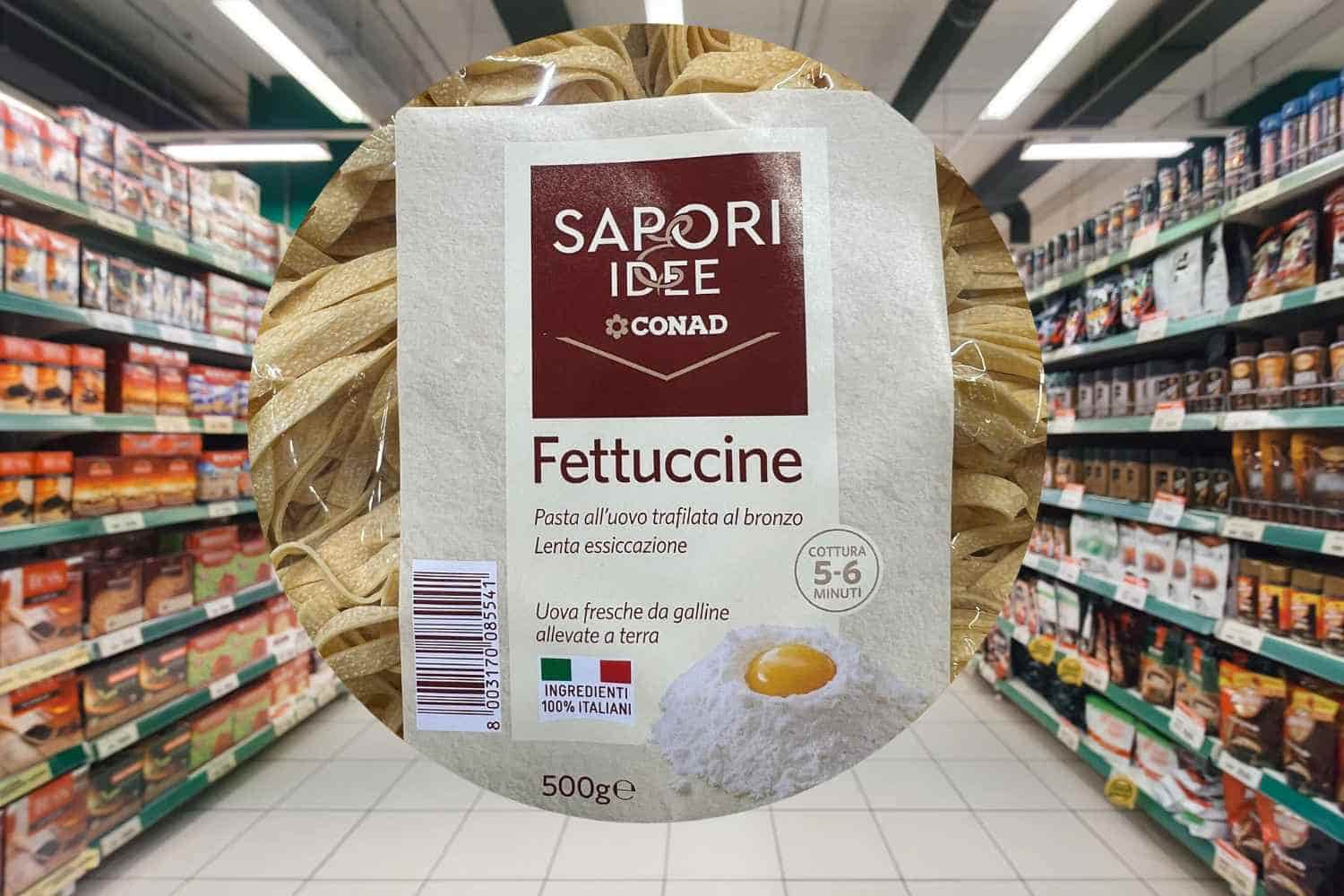
And it is precisely from this territory that Sapori & Idee Conad egg fettuccine comes from, one of the references in the supermarket’s gastronomic line.
They are produced by Entroterra SpA, a company based in Camerino, in the province of Macerata. A name that may not be familiar, at least until we discover that La Pasta di Camerino, a brand specialized in the production of egg pasta, is also behind it. A curiosity that pushed us to look more closely at the packaging. Because in addition to the manufacturer there is some interesting information about the ingredients and processing.
From Camerino to Conad shelves: who is behind these fettuccine
@Marco Crisciotti/GreenMe
Pasta di Camerino was born from the entrepreneurial history of the Maccari family, who transformed a family gastronomic tradition into a productive activity.
The brand is linked to Gaetano Maccari and the memory of the home preparation of egg pasta, described by the company as one of the inspirations behind its business.
Today the Entroterra pasta factory produces various egg specialties and markets its products through the La Pasta di Camerino brand. But it doesn’t just make products under its own name.
Among those that leave the Marche factory there are also the 500 gram Sapori & Idee Conad fettuccine, as confirmed by the indication on the back of the package:
Produced for Conad SC, Via Michelino 59, Bologna, by Entroterra SpA, Località Torre del Parco snc, Camerino (MC).
It is an example of how even supermarket gastronomic lines can rely on producers who have developed their own identity in the food sector.
The detail that struck us: 30% fresh eggs
@Marco Crisciotti/GreenMe
If the producer tells us where these fettuccine come from, the ingredients tell us something more about their composition. The declared recipe is essential: durum wheat semolina and fresh pasteurized eggs from free-range hens, present in the amount of 30%.
A percentage that deserves attention, because eggs are not simply an accessory ingredient of egg pasta: they contribute to the structure, color and organoleptic characteristics of the product.
For dry egg pasta, Italian legislation requires a minimum quantity of four whole eggs, equal to at least 200 grams of eggs per kilogram of semolina.
The percentage of 30% declared by Conad therefore represents concrete information, even if it alone is not enough to establish how good fettuccine is.
Then there is the question of breeding.
The eggs come from free-range hens. This means that the animals are not kept in conventional cages, but live inside sheds, without necessarily having access to the outside.
We must therefore not confuse this wording with free-range or organic farming, which have different requirements.
A pasta made with Italian ingredients, from wheat to eggs
The words “100% Italian ingredients” appear on the packaging. It is not just a generic declaration: on the back it is specified that the durum wheat is grown in Italy and that the milling also takes place in our country. The eggs are in turn declared Italian.
It is an aspect that distinguishes these fettuccine from other large-scale retail products, in which Italian production can be accompanied by the use of wheat from different countries.
For those who choose products also based on the origin of the raw materials, this is useful information. The packaging also highlights two characteristics of the processing: bronze drawing and slow drying.
Bronze drawing generally allows you to obtain a rougher surface, which can help the adhesion of the seasoning.
Slow drying at low temperature is instead presented as one of the peculiarities of the Sapori & Idee line. To evaluate the concrete effects on nutritional and sensorial characteristics, however, it would be necessary to know the times and temperatures actually used.
Fifteen grams of protein: what the nutritional table tells us
Conad Sapori & Idee fettuccine contains 382 calories per 100 grams of dry product.
In the same quantity we find 67 grams of carbohydrates, 5.1 grams of fat, 3.9 grams of fiber and 15 grams of protein.
This last value is interesting: the presence of eggs contributes to the protein content, which is higher than that of many semolina-only pastas.
Salt is equal to 0.16 grams per 100 grams, while sugars are 2.5 grams.
Once brought home, fettuccine requires cooking for just 5-6 minutes, as indicated by the manufacturer. Of course, nutritional values don’t tell us everything about cooking performance. To understand how they behave during cooking, how much they maintain their consistency and how they bind to the seasoning, a practical test would be needed.
And compared to the fettuccine from La Pasta di Camerino?
Knowing that two packages of pasta are made by the same company may make you think that they contain exactly the same product.
But this is not necessarily the case, Pasta di Camerino also offers egg fettuccine and enhances production characteristics similar to those declared by Conad, from the use of Italian ingredients to bronze drawing.
They are elements in common, not necessarily proof that the two recipes coincide. A pasta factory can in fact create different lines in terms of composition, raw materials and processing parameters, even when the products belong to the same category.
Without knowing the specifications of both productions we cannot say that they are identical, nor that one is qualitatively superior to the other.
What we know is that Conad fettuccine is produced by a company specialized in egg pasta and has rather precise declared characteristics.
And this is already a good starting point for evaluating them.
The tradition of egg pasta also passes through the supermarket
When we think of egg pasta made according to tradition, we often imagine a small artisan workshop, a pastry spread on the cutting board and the fettuccine left to dry before finishing in the pot.
Industrial production is of course something else. Yet, behind some large-scale retail products, we find companies born precisely in territories where egg pasta is part of the gastronomic culture. This is the case of Sapori & Idee Conad fettuccine, made in the Marche by the producer of La Pasta di Camerino.
Coming from a traditional territory does not automatically guarantee superior quality, just as a more famous brand does not necessarily make a product better.
But knowing the producer, the origin of the ingredients and the characteristics of the processing allows you to choose with a little more information.
