
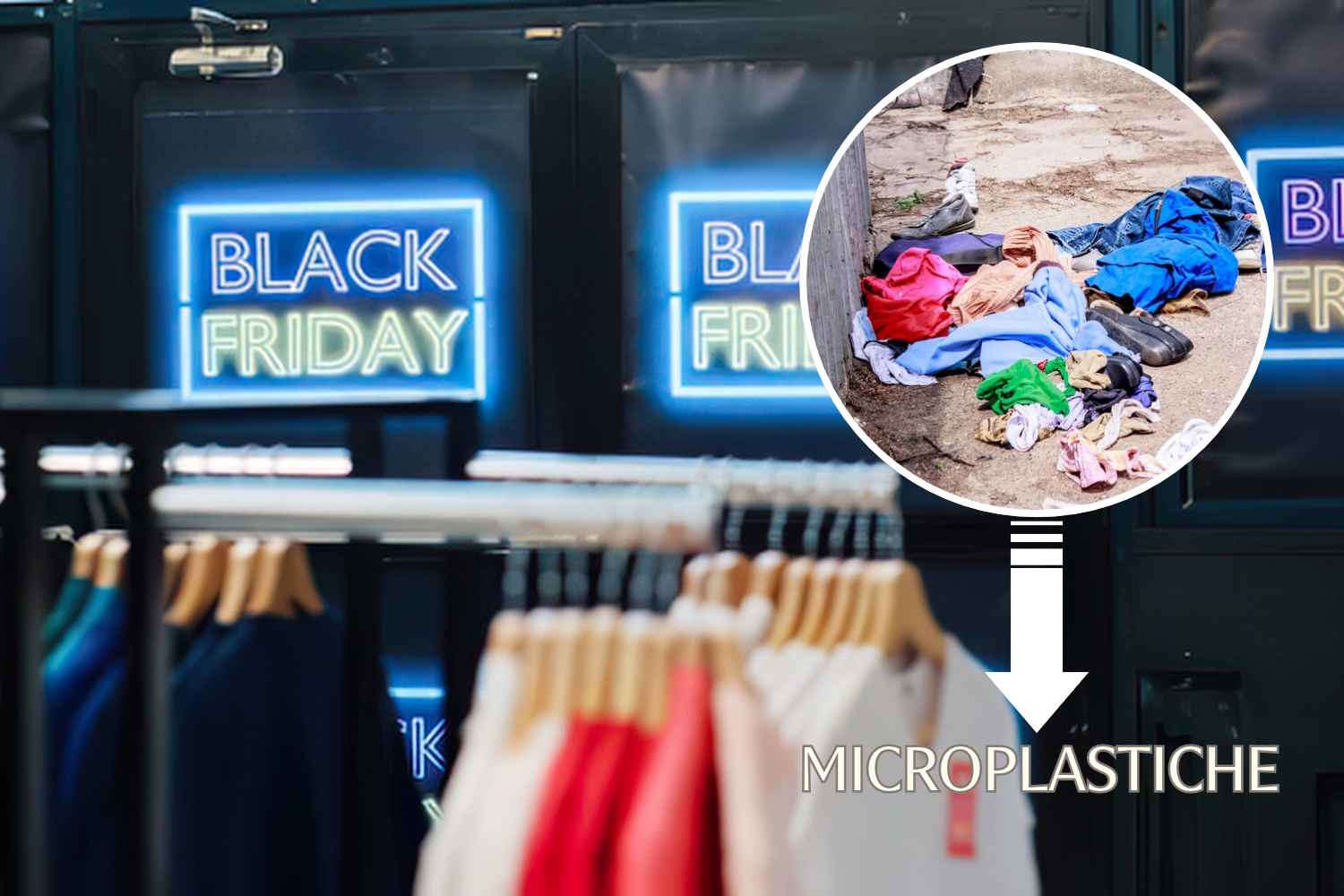
While today, on the occasion of Black Friday, we are bombarded with offers and invitations to buy new clothes, there is an environmental cost of fashion that is still talked about too little. It doesn’t just concern the production of clothing or the microfibers that come off during washing, but also what happens when we decide to throw them away.
According to a new report from EarthActiona research organization based in Switzerland, in 2024, synthetic clothing already present in landfills and waste warehouses around the world generated approximately 2.4 million tons of secondary microplastics. Of these, 878 thousand tons ended up in the environment.
A problem which, according to research, has become increasingly serious over the years and which reminds us why buying less, choosing carefully and using what we have for longer is not only a question of saving, but also an important choice for the environment.
Synthetic clothes thrown away, how many microplastics end up in the environment
The report highlights the dimensions of this phenomenon The Microplastic Ticking Time Bomb – A global assessment of secondary microplastic from discarded synthetic apparel. This is the first global assessment dedicated to secondary microplastics produced by synthetic clothing after being thrown away. The research expands knowledge on the problem of pollution linked to the clothing sector, focusing on a phase of the life cycle of clothes that has so far been less studied than production and washing.
The researchers reconstructed the path of discarded clothing in different countries and in the different disposal methods, also considering the fragmentation processes of the materials based on the climate and the context in which they are deposited.
The result is significant: in 2024, synthetic clothing already accumulated in landfills and waste deposits around the world generated an estimated 2.4 million tons of microplastics. Of these, approximately 878 thousand tonnes were released into the environment.
The two figures must not be confused: the 2.4 million represent the microplastics produced by the fragmentation of clothing, while the 878 thousand tonnes indicate the share that has actually escaped from the deposits. And the phenomenon grew rapidly. In 2000 the annual dispersion was estimated at 228 thousand tonnes, in just over twenty years it has therefore almost quadrupled.
One of the most interesting aspects of the research concerns where clothing ends up after being thrown away. In fact, it is not only how many clothes are disposed of that matters, but above all how they are managed.
According to Earth Action, nearly 30% of discarded synthetic clothing globally consists of poorly managed waste. Furthermore, 14% of discarded clothing is disposed of outside the country in which it was consumed, through the second-hand trade, which moves mainly from richer regions to those with lower incomes.
The most surprising data, however, concerns the clothes abandoned outdoors which represent only around 5% of the clothing accumulated in the deposits considered by the research, but are responsible for 90% of the microplastics that are dispersed into the environment.
And it is precisely the lack of containment that makes the difference. When clothes are exposed to atmospheric agents, they can fragment and release fibers that end up in the soil and water.
The research also highlights a strong geographical disparity: in 2024, sub-Saharan Africa alone accounted for 45% of the global dispersion of microplastics from discarded synthetic clothing.
But where do these particles end up? Approximately 90% of the microplastics that escape from the deposits reach the ground, while the remaining part is distributed in other environmental compartments.
Clothes can continue to release microplastics for around 200 years
There is another fact that makes the problem even more worrying. Synthetic clothes do not stop having an environmental impact when they are thrown away but continue to fragment long afterward.
According to the model developed by Earth Action, a buried garment can continue to fragment for about two centuries. And the phenomenon is far from over, the deposits still contain a quantity of plastic approximately 19 times higher than that which has already been dispersed into the environment.
Furthermore, 85% of the synthetic clothing deposited since 1963 has not yet begun to fragment. This means that a significant portion of the microplastics associated with the clothes we have already thrown away have yet to be released.
The report also compares possible intervention strategies. Improving waste management would have faster effects: in the modeled scenario, it could reduce annual waste by 2050 to around a third compared to the reference scenario. Reducing consumption, however, would have a slower effect, but in 2100 it could reduce waste expected for that year by 88%, compared to the 80% achievable with better waste management.
The message is clear: intervening on what has already been thrown away is essential, but avoiding continuing to fuel the problem with new purchases is equally important.
Even the washing machine releases microfibres: how to limit their dispersion
The problem of clothing-related microplastics doesn’t just affect clothing that ends up in landfill. Synthetic fabrics can also release fibers during use and especially during washing. The European Environment Agency (EEA) explored this phenomenon in depth in a report, highlighting that microfibres can become dispersed at different stages of the life cycle of textile products.
There are some precautions that we can also adopt at home. A study published in 2020 in the journal Plos One, which analyzed loads of actually dirty laundry from British households, found that using shorter cycles and lower temperatures can reduce the release of microfibres. In the comparison carried out by the researchers, going from a wash at 40°C lasting 85 minutes to one at 15°C lasting 30 minutes, the production of microfibres decreased by 30%.
In general, when the type of laundry allows it, preferring short programs and low temperatures can help reduce wear and tear on the fabrics. It is also important to avoid unnecessarily frequent washing and not to overload the drum.
Another help can come from devices designed to retain microfibers. A study published in 2020 on Science of the Total Environment compared six filter systems, including external filters and bags to be inserted directly into the basket. The XFiltra external filter reduced the release of microfibers into wastewater by approximately 78%, while the Guppyfriend bag achieved a reduction of approximately 54%. The latter seems to act above all by limiting the detachment of fibers from clothes during washing.
These are interesting results, but these devices do not completely eliminate the problem. However, they can represent additional help, especially if associated with more careful use of the washing machine.
Textile waste, what the European Union is doing
The European Union is also trying to intervene on the problem of textile waste, with new rules that aim to make the fashion sector more circular and make companies responsible. From 1 January 2025, Member States are required to ensure the separate collection of textiles, so as to prevent clothes and other textile products from ending up together with unsorted waste.
Another important step arrived with the EU Directive 2025/1892, which modified European waste legislation and came into force on 16 October 2025.
The main innovation concerns the mandatory introduction of extended producer responsibility (EPR) for clothing, accessories and footwear. In practice, all Member States will have to set up systems through which companies placing these products on the market contribute financially to their collection and management when they become waste.
The resources collected will be used to finance the collection, selection, reuse, recycling and disposal of textile products. The contributions can also be modulated based on sustainability characteristics such as the durability and recyclability of the items, thus encouraging the design of garments that last longer and are more easily recoverable. The directive also requires that fast fashion and disposable fashion practices be addressed in defining the economic contributions required from producers.
Member States will have to transpose the new provisions by 17 June 2027 and establish extended producer responsibility systems by 17 April 2028.
These are important steps, but legislation alone is not enough. We too can make a difference, starting from the choices we make every day. So, faced with Black Friday offers, before letting ourselves be convinced by a discount, let’s ask ourselves if we really need that dress and how long we will wear it. Because the most effective way to reduce the impact of fashion is first and foremost to buy less, choose better and give a longer life to what we already own. And remind us that the cost of a dress doesn’t stop at the price we find on the label.
Black Friday, how to buy less and better to reduce the impact of fashion
Faced with these numbers, Black Friday can also become an opportunity to rethink our way of purchasing clothes. It doesn’t necessarily mean giving up everything, but learning to distinguish what we really need from what we buy just because it costs less or because a discount seems too good to miss.
The first choice is to reduce unnecessary purchases. A garment that remains in the wardrobe after having been worn once or twice has still required raw materials, energy and resources to be produced and, if it contains synthetic fibres, it may contribute to microplastic pollution even when it is discarded.
When we really need a new garment, we can pay attention to the composition, preferring, where possible, natural fibers such as cotton, linen, hemp and wool over synthetic materials such as polyester, polyamide and acrylic.
This does not mean that natural fibers have no environmental impact or that they do not release microfibres during washing. Natural fabrics can also disperse fibres, but they do not generate microplastics of plastic origin like those coming from synthetic materials.
Even better, when possible, is to choose a second-hand item. Buying used clothes allows you to prolong the life of already produced garments and reduces the need to make new ones.
Another good habit is to repair what we have: a seam to fix, a zip to replace or a button to reattach should not be sufficient reasons to discard a still usable dress. The durability of a garment, after all, is one of the most important characteristics to consider before purchasing it.
