
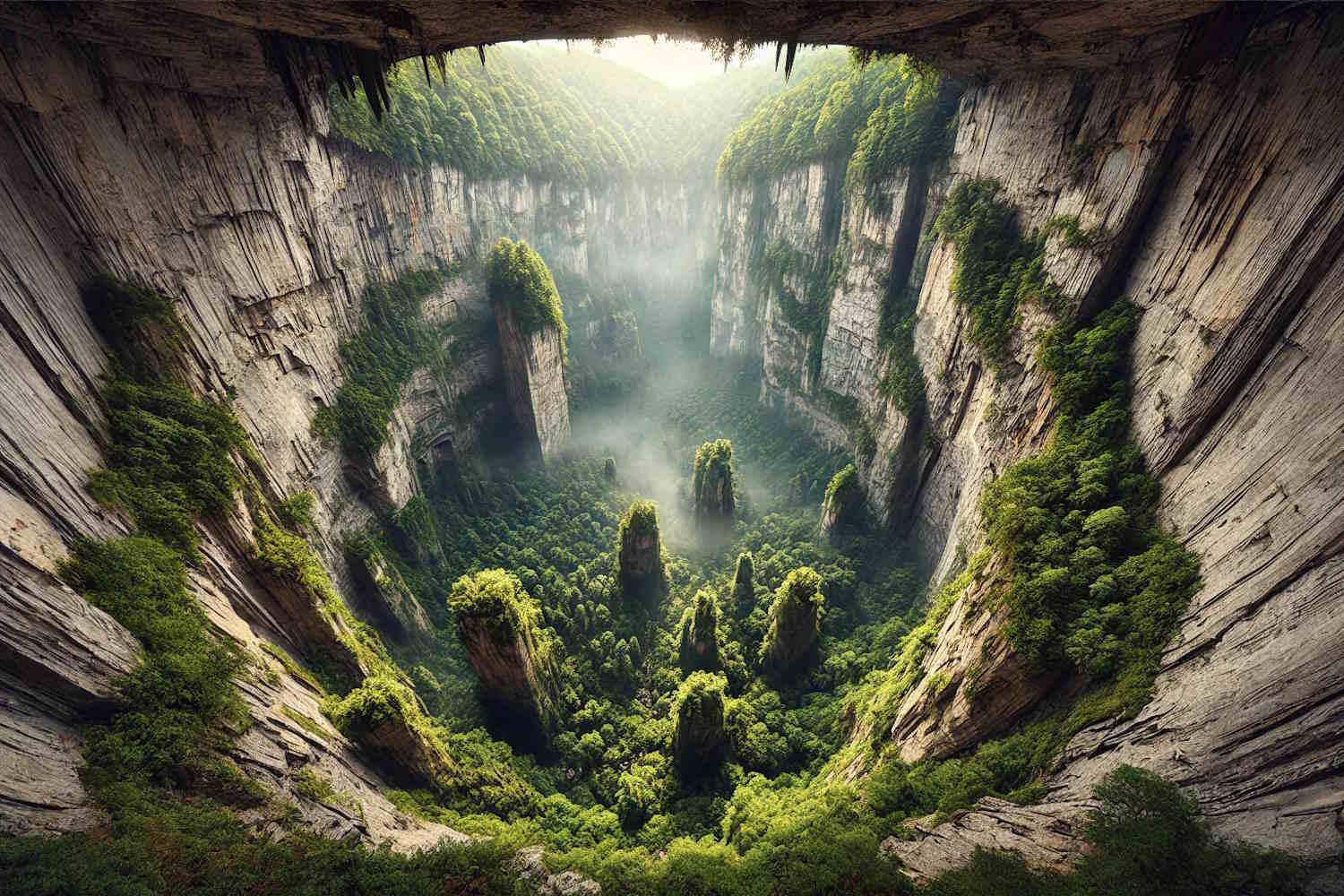
A group of Chinese speleologists discovered a huge chasm with a lush forest on the bottom. The cavity, deep 192 metersit is so big that it can contain the Colosseum 4 times. During exploration, the May 6ththe researchers identified Three inputs of caves inside the sinkhole, in addition to majestic trees 40 meters highwhose hair extended towards the light that filters from the upper opening.
Second George Veniexecutive director of National Cave and Karst Research Institute (Nckri) And a well -known speleology expert, this discovery is not surprising. The south of the China is characterized by a widespread presence of karst dolinea landscape marked by spectacular chasms and caves of great depth.
These phenomena are formed through the dissolution of the limestone rock. Rainwater, slightly acidic, absorbs carbon dioxide while crossing the ground, becoming even more corrosive. Over time, this chemical action Scava underground cavitieswhich can collapse suddenly, creating huge karst chasms, as explained by Veni:
In China, karst is manifested in a spectacular way, with gigantic chasms and monumental caves inputs. In other parts of the world, however, the karst landscape is more discreet, with little visible depressions and openings of very small caves.
Currently, about the 20% of the world earth surface It consists of karst or pseudo-carsic landscapes, which are formed through different processes, such as volcanic or wind erosion. In the United States, the 25% of the territory presents these geological characteristics.
Guangxi’s doline: an ecosystem hidden among the rocks
The new discovery is located in Autonomous region of Guangxi Zhuangclose to the village of Ping’ein Leye County. This area is renowned for its spectacular karst formationsincluding chasms, rocky pillars and natural bridgesto the point of having been recognized as UNESCO World Heritage Site.
Second Zhang Yuanhaisenior engineer ofInstitute of Karst Geologythe chasm measures 306 meters long and 150 meters wide. In mandarin, these huge cavities are called “Tiankeng”or “celestial wells”, and the bottom of the doline really seems to belong to another world.
Chen Lixinhead of the speleological expedition, said that the vegetation inside the chasm is so dense to reach the height of a person. The experts hypothesize that in this isolated ecosystem they can find themselves Species still unknown to science.
@somuchouthere This is the 30 Sinkwhole I THINK THAT WAS FOUND in that area #china #Sinkwhole #discoveries #holowearth #somuchoucthere
♬ Paris – 斌杨 Remix
In addition to being Natural refuges for biodiversitythe karst dolies play a fundamental role for the water cycle. Karst aquifersin fact, provide the main source of water supply for 700 million people in the world. However, precisely because of their structure, they are particularly vulnerable to pollution.
“These aquifers are the only ones in the world that can be contaminated with solid waste,” explained Ven. “During my explorations, I found car batteries, barrels of unknown substances and even carcasses of vehicles in underground waterways. “
With this new discovery, The number of voracins identified in the county of Leye rises to 30. The same researchers have already identified numerous dolines in the past in the province of Shaanxi and a system of Interconnected chasms in the Guangxi region.
