
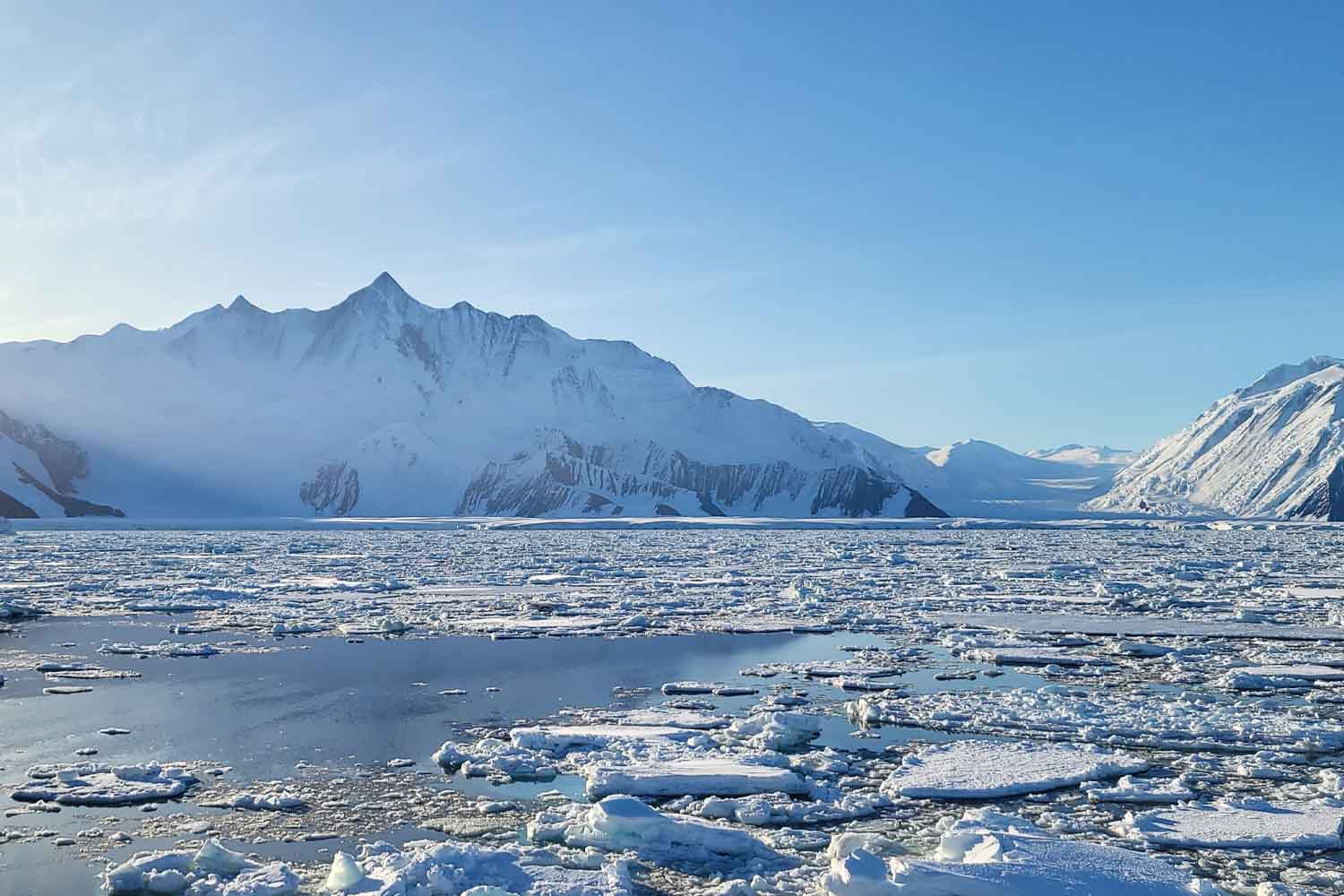
For a long time we took it for granted that Antarctic sea ice followed a simple script: It forms, holds, then breaks up, more or less every year. The reality, however, seems to be decidedly more complex. And in the midst of this story, surprisingly, the Sun also appears.
A study coordinated by the Institute of Polar Sciences of the CNR in Bologna and published in Nature Communications has reconstructed the trend of Antarctic coastal sea ice over the last 3,700 years, showing that its stability is linked to natural cycles much longer than a single season. Some of these cycles coincide with oscillations in solar activity.
From the bottom of the Ross Sea an ancient memory
To reach these conclusions, the researchers looked not at the sky, but at the seabed. In the Ross Sea, one of the most sensitive areas of Antarctica, sediment cores were taken in the Edisto Bight, in the northern part of Victoria Land. Layer after layer, those sediments have preserved a continuous trace of the presence and breakups of coastal sea ice.
By analyzing very high resolution images, chemical biomarkers and communities of diatoms – microalgae that live in close relationship with ice – it was possible to reconstruct a detailed chronology of the so-called fast icethe ice anchored to the coast. A type of ice that we observe today with satellites, but which in the past we can only know thanks to these natural archives.
It is precisely by going back in time that an interesting fact emerges: the breaking of the ice does not follow a regular annual rhythm. Instead, it shows broader oscillations, with cycles that repeat every 90 and 240 years, in sync with some phases of solar activity, when the Sun goes through periods of minimum and maximum.
Because coastal sea ice is a key piece of Antarctica
Coastal sea ice isn’t just a white expanse at the edge of the continent. It regulates water salinity, influences exchanges between ocean and atmosphere, supports entire ecosystems and, in some areas, even becomes a natural platform for scientific operations. Yet, it is one of the least studied elements of the Antarctic cryosphere.
The value of this research also lies here: it allows us to separate what is part of long-term natural variability from what is linked to more recent changes. Understanding how ice behaved centuries ago helps to read with greater clarity what is happening today, avoiding overly simplistic interpretations.
According to Michael Weber, of the University of Bonn, the technique used can be applied to other sedimentary archives present in Antarctica. A detail that is anything but marginal, because it paves the way for new reconstructions on a continental scale, useful for understanding the natural forcings that continue to shape the Antarctic ice.
The research is part of the activities of the National Antarctic Research Program and is the result of a collaboration between Italian and international universities and research institutes. A work that starts from the silence of the seabed and reaches the Sun, passing through a history almost four millennia long.
You might also be interested in:
