
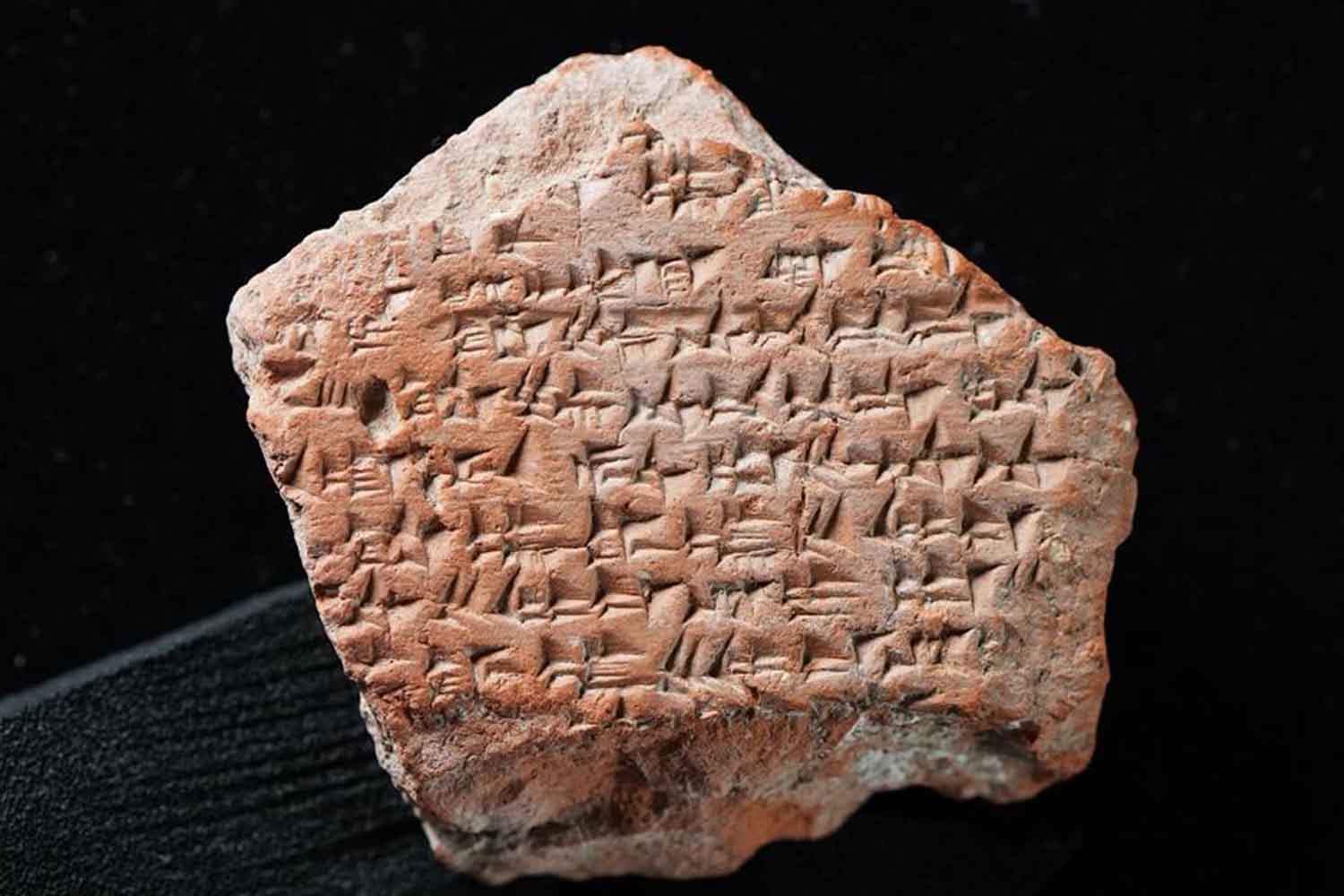
A broken piece of clay, a few lines in cuneiform and a rather precise rule: anyone who escaped from one kingdom to another had to be returned, but home and family should not be destroyed. The fragment found in Hattusa, the ancient capital of the Hittite Empire in present-day Türkiye, belongs to a copy of the Treaty of Kadeshone of the oldest international peace agreements that have come down to us. And it adds another small piece to a diplomatic history that is over 3,200 years old.
The discovery was announced by the Turkish Ministry of Culture and Tourism, on the occasion of the International Day of Peace. The fragment had emerged during the excavations of Büyükkalethe royal citadel of Hattusa, near the so-called Building E. It took archaeologists about a year to identify it: it is a portion of a copy in Akkadian, written in cuneiform scriptof the agreement made in the 13th century BC between the pharaoh Ramesses II and the Hittite ruler Hattusili III.
Those who fled had to return, with some limits to their revenge
The fragment belongs to the part of the treaty dedicated to people who left Egypt to reach Hittite territory or took the reverse route. The basic rule was pretty simple: the fugitives had to be returned. So far, to put it mildly, we are quite far from the modern concept of the right to asylum. Immediately afterwards, however, the text places some limits on the fate of those who returned to the hands of their sovereign.
In the already known copies of the treaty, also published by the Provincial Directorate of Culture and Tourism of Çorum, a very explicit clause appears: the returned fugitive should not be mutilated eyes, mouth, feet and other body parts; not even his wife, children and home were to be destroyed.
The newly identified fragment is incomplete and does not retain all of this formulation. The Turkish Ministry, however, reports between the legible lines the references to the fugitives from Egypt and from Hatti and to protection of their homes from destruction. Two thousand years before modern international conventions, in short, two great powers had already felt the need to write down how far retaliation could go. Forced repatriation was fine. Razing home and family to the ground, it seems, required at least one less line in the rulebook.
Peace came several years after the Battle of Kadesh
The name of the treatise leads directly to the famous one Battle of Kadeshfought around 1274 BC in the area of present-day Syria between the Egyptian army of Ramesses II and the Hittite army led by Muwatalli II. The clash did not give anyone a definitive victory. The Egyptians and Hittites continued to dispute the area for years, until diplomacy did what it had not succeeded particularly well on the battlefield: setting borders and trying to maintain them.
The agreement was concluded during the reign of Hattusili IIIsuccessor of Muwatalli, in the twenty-first year of the reign of Ramesses II, generally placed around 1259 BC. The two powers undertook not to attack each other, to help each other against external aggression and internal revolts and, indeed, to return fugitives to each other. More than a universal declaration of brotherhood, it was a contract between two empires that had discovered how much it could cost to continue to attack each other with armies.
The silver tablets disappeared, the clay remained
The originals of the treaty would be drawn up silver tabletswhich did not survive. However, the text has had much greater archaeological success. In Egypt some versions were engraved in hieroglyphics on temple walls. In Hattusa, however, over time several copies and fragments on clay tablets emerged in Akkadian, then a sort of lingua franca of international diplomacy.
The first Hittite fragments were recovered during the excavation campaigns started at the beginning of the twentieth century. Some are today preserved in the archaeological museums of Istanbul, in the Museum of Anatolian Civilizations in Ankara, in Berlin and in the Hermitage in St. Petersburg. The treaty has even become a small diplomatic celebrity: a copper reproduction donated by Türkiye in 1970 is exhibited in the headquarters of United Nations in New Yorknear the Security Council chamber.
Hattusa continues to return pieces of the same archive
The new fragment comes from Büyükkale, the political and administrative heart of the Hittite capital, where the royal complex stood. Archaeological investigations in the area have resumed in recent years and are part of the research on Boğazköy-Hattusa also documented by the Deutsches Archäologisches Institut.
Archaeologists now hope to find more fragments belonging to the Hittite copies of the treaty. It would not be a small detail: each piece can help to better reconstruct the text, the circulation of copies and the way in which one of the most powerful empires of the Bronze Age preserved its diplomatic documents.
This time a rather concrete rule has re-emerged from the clay. The fugitive went back, but his house had to remain standing. For the Bronze Age it wasn’t exactly little.
