
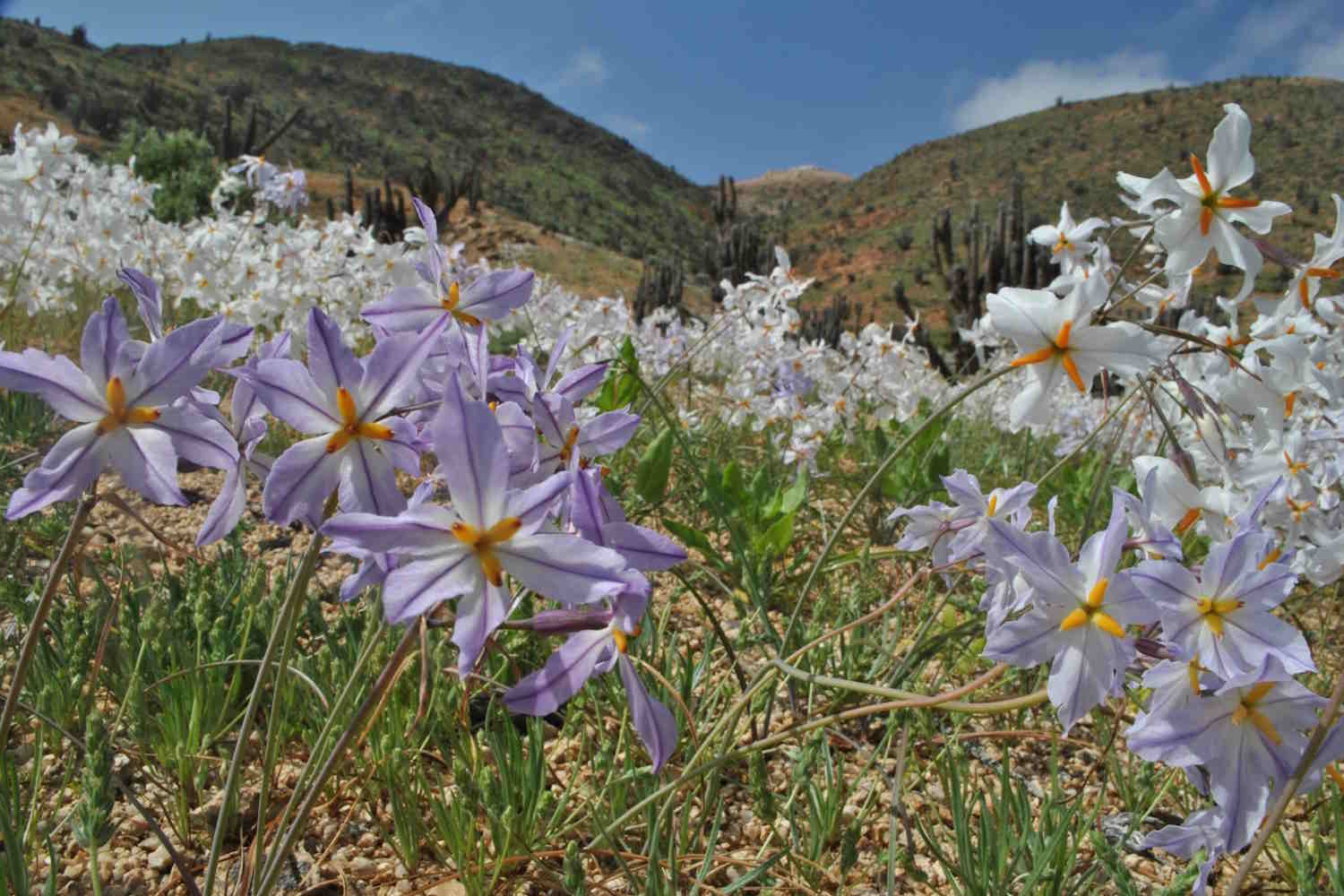
There is a place on Earth where rain is so rare that every drop can seem like a miracle. It is the Atacama Desert, in northern Chile, considered one of the driest places on the planet. Yet, right here, where for most of the year the ground is cracked, still and lifeless, something extraordinary is happening these days: the desert is covered in flowers.
Millions of seeds remained hidden in the sand, along with dormant bulbs and roots, patiently waiting for the right moment. Then came the intense rains linked to the El Niño climate phenomenon and what seemed like a barren expanse was transformed into an enormous natural garden.
An explosion of colors that seems almost impossible: purple carpets covering the ground, small white flowers popping up between cracks in the earth and, in some moments, even rainbows above the red desert landscape.
The desert that “awakens” after the rain
All thanks to a true natural bank of life that hides beneath the surface of the Atacama. Seeds and bulbs of around 200 different plant species can remain hidden in the ground for long periods, waiting for favorable conditions.
View this post on Instagram
https://www.facebook.com/Cadena3Argentina/posts/pfbid0AqGGyAGdQVxCgWa44qydSRu569UPCzd8iSmJYToCfo7qcNwXPzJKJFmkMwg2ZhuFl
When enough water arrives, the mechanism is reactivated: plants sprout, insects return to feed and pollinate and even small animals such as snails, reptiles, birds and mammals begin to populate the area again. These are plants adapted to arid and semi-arid conditions, capable of remaining in a state of dormancy under the soil in dry periods (scientifically called geophytes, such as bulbs, rhizomes, tubers or reserve roots) and even underground stems, in the case of shrubs.
It goes without saying that all this is a wonderful phenomenon that doesn’t just concern flowers: it’s an entire ecological network that is temporarily active again. The bees restart their pollination work, while some insects feed on the plant remains and contribute to the fertility of the soil through the natural cycle of nutrients.
The transformation was favored by exceptional rainfall. In some areas of the desert, more than 180 millimeters of seasonal rain fell, an amount defined as unprecedented in the available data. The water managed to penetrate deeper into the sand than normal, giving new energy to the nature reserve located about 800 kilometers north of Santiago.
According to CONAF, the Chilean forestry agency, the peak of flowering is expected for October: it is estimated that around 15,000 hectares could be transformed into an enormous mosaic of colours.
When El Niño can also create beauty
El Niño is a natural climatic phenomenon linked to the anomalous warming of the waters of the equatorial Pacific. It can change global atmospheric circulation, influencing winds and precipitation in many areas of the world. But the effects can be very different: while it is clear that in some regions it causes drought, extreme heat or intense meteorological events, in others it can bring conditions favorable to the temporary rebirth of particularly adapted ecosystems.
In Chile, however, these same rains also had dramatic consequences: the intense rainfall in July caused victims and destroyed or damaged thousands of homes.
Nature, once again, shows its complexity: the same phenomenon can bring destruction and, at the same time, favor an incredible explosion of life.
The “flowery desert” is not a miracle, but a survival strategy
The phenomenon of the flowering Atacama is not new. In years when climatic conditions allow it, the desert can transform for a few weeks into one of the most spectacular natural manifestations on the planet.
It has also happened in the past, especially during years characterized by strong El Niño episodes.
In 2015, for example, the Atacama experienced one of the most spectacular blooms in recent decades after exceptional rainfall that transformed vast desert areas into expanses of colorful flowers. Another important episode occurred in 2017, when after intense rainfall the desert once again filled with colors attracting thousands of visitors.
These events are a reminder of one fundamental thing: even the most seemingly extreme environments are not devoid of life. Simply, life has found a different way to wait.
