
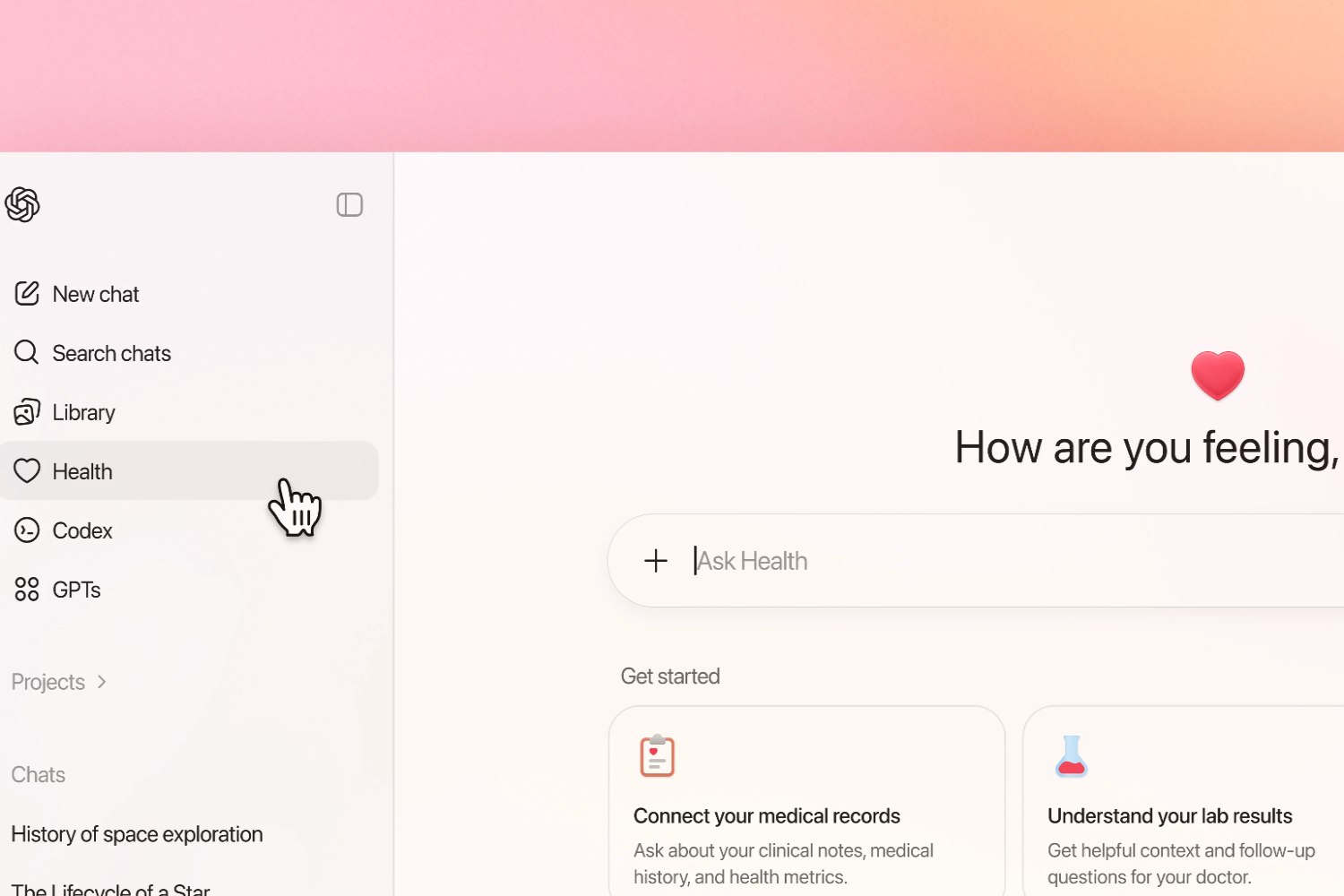
For millions of people, consult a chatbot before calling the doctor it is now a habitual gesture. ChatGPT Health was born precisely from this widespread practice: OpenAI decided to create a space dedicated to health and well-beingseparate from the generalist chatbot, designed to help users read reportsunderstand clinical data and prepare for medical visits. It’s no coincidence: every week hundreds of millions of users ask questions about symptoms, blood tests, common pains or healthy lifestyles, transforming AI into a first healthcare interlocutor.
What ChatGPT Health really is and what it can do
Officially unveiled on January 7, 2026, ChatGPT Health is a digital hub which allows you to upload health documents, connect electronic medical recordsapps like Apple Health or MyFitnessPalsmartwatches and fitness devices. The declared objective is not to diagnose or prescribe therapies, but to offer contextualization: explain the trend of a value over time, help formulate questions for a specialist, make suggestions workouts or meal plans consistent with available data. OpenAI claims to have worked for over two years with 260 doctors from 60 countriestesting the system with clinical benchmarks designed to evaluate not only accuracy, but also clarity, appropriateness and ability to report urgent situations.
Privacy and regulatory limits: the unresolved issues
One of the most delicate points concerns the protection of health data. OpenAI talks about an isolated space, with dedicated encryption and the promise that health information will not be used to train the underlying models. Users can disconnect sources at any time and delete chats and memories. However, ChatGPT Health remains a consumer productnon-clinical: Data is not automatically covered by regulations such as HIPAA and may be subject to legal requests. Furthermore, the most advanced integrations are currently only available in the United States, while in Europe and the United Kingdom access to health data is limited by more stringent rules.
Be careful not to confuse him with a doctor
The arrival of ChatGPT Health marks an important step, but it takes prudence. In the past, the same chatbot has often been imprecise on medical topicssometimes generating ambiguous or incomplete if not entirely incorrect answers. Even in this evolved version, AI: lacks the direct examination of the patient, the human context, the decision-making experience. The risk is that the promised autonomy turns into excessive confidence. Used correctly, ChatGPT Health can be a useful tool for orientation and information; used as a doctor’s surrogate, it remains a technological illusion that can have real consequences on our health.
