
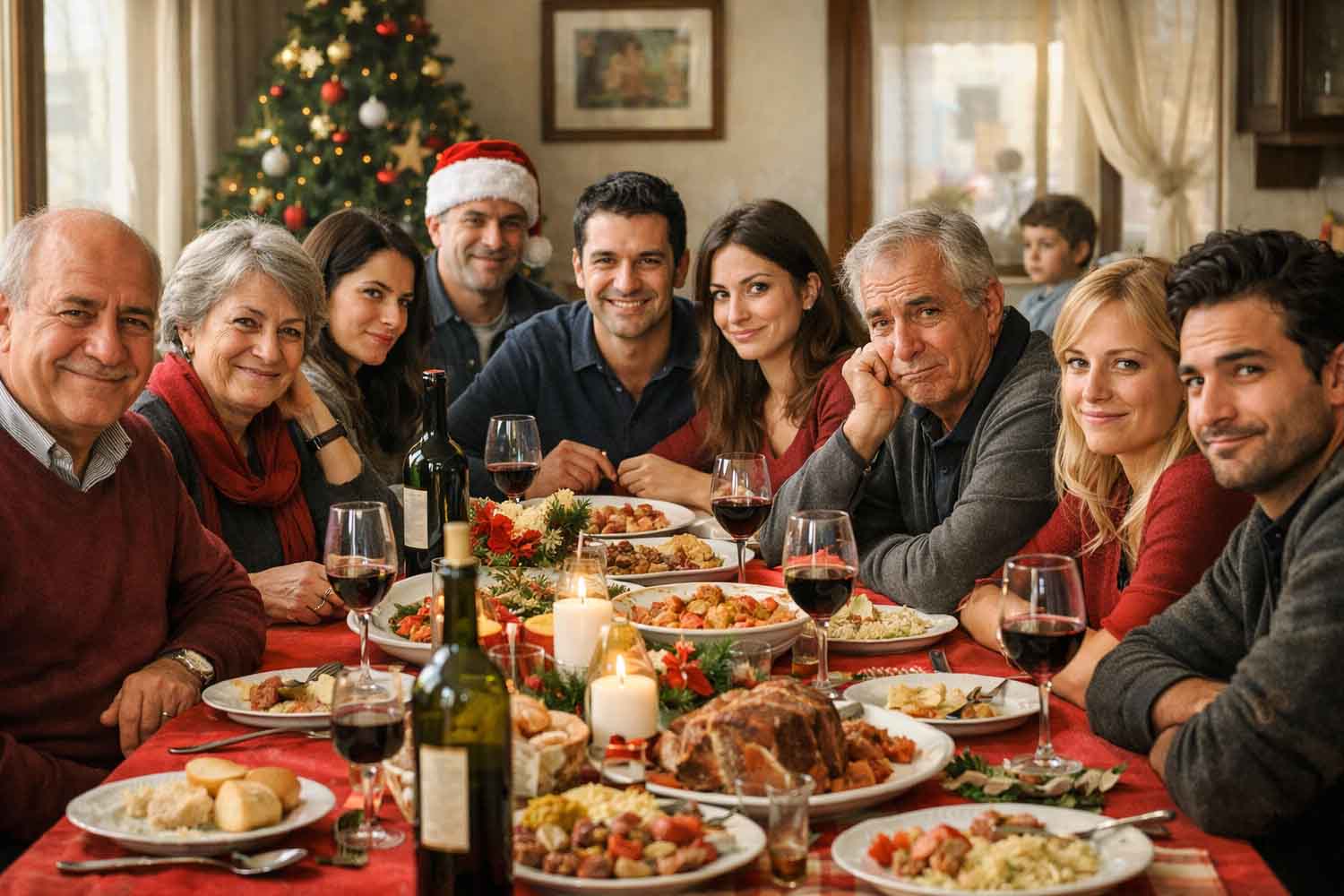
Christmas lunch always begins before sitting down. It starts when someone says “we’re among us anyway” and you understand that you won’t be home before sunset. The table is set well, with almost touching care. The air, however, is already heavy as if you had started half an hour ago. Everyone fakes an energy they don’t have and you sit with that precise feeling: I’ve already seen this episode, but I have to watch it again anyway.
There is no real plot, but a series of micro-events that have been repeating identically for years. The set is always the same: warm house, closed windows “letting air in”, chairs brought together until they take away the living space. You speak little, observe a lot and try not to make definitive statements before the first one. From experience.
Pilot episode: the aperitif and the white lies
At first everything goes smoothly. The aperitif is the moment in which everyone plays the best version of themselves, like the characters in Friends when they enter the scene smiling even if they have just argued off-screen. We talk about traffic, the weather, how “there are few of us this year”. It is the most serene moment of the entire day, and in fact it lasts very little.
The fixed cast: no one evolves, but everyone talks
The grandmother governs without moving from her chair. You don’t need to raise your voice: just a look is enough. He decides what is Christmas, what is not, and who has eaten too little. If you listen closely to the clinking of cutlery, you could swear you can hear the music The Godfather. The judging aunt observes in silence, piles up sentences and then drops one like this, at random, which sticks with you while you chew.
There is always someone who talks continuously, convinced he is lightening the atmosphere, and instead makes it more tense, like certain characters in Boris: They come in to help and make everything worse. “Just like that. Without meaning.”. And then there’s you, who decided to stay on the sidelines, you tried until the end not to meet anyone’s eyes and instead you’re already up to your neck in it. Because at Christmas no one really remains neutral.
Episode 1: The Lunch Odyssey
The starter is still safe territory. Everyone pretends to be moderate, someone says “just taste a little” and you understand that the concept of “little” is purely theoretical. The first arrives when you haven’t finished the starter yet, but no one notices, because at Christmas time works in its own way: it lengthens, it crumples, it disappears. And your stomach becomes a black hole that Stephen Hawking dodged.
Conversations open up that lead nowhere, but they drag on anyway. They are circular discussions, which start from a point and return to it without ever reaching a conclusion. Same themes, same sentences, same suspended endings. You listen, nod, chew slowly and understand that you are only at the beginning.
The second is the critical point. It comes when you’re at your limit, but you have to fake enthusiasm, because “hey, it’s Christmas!”.
Episode 2: the plot twist between a second and a side dish
It’s not a conversation. It’s a phrase said badly, at the wrong time, with that “you all knew it” look. Nobody reacts immediately. There is a short, very dense silence, one of those that you can also hear in your ears. Then someone tries to make a joke, someone else responds sharply, and suddenly there’s an argument, even if no one calls it that.
It is a composed, seated, polite discussion. Nobody raises their voice, but everyone has something to say. Old things are thrown in your face, useless details are corrected, you talk about something else pretending that it’s not exactly what you’re talking about. You continue to eat, because stopping would be worse, and meanwhile you think that this part wasn’t in the official script, but it happens every year.
Episode 3: the dessert toast cliffhanger
The toast arrives immediately afterwards, starting from the “boss” grandmother who in the meantime brings the dessert, as if nothing had happened. And this is where the real specialty of Christmas lunch comes in: pretending nothing happened. The glasses are raised, someone says “to the family”, someone else adds a phrase too sugary to be true. We smile more than necessary, we laugh without knowing why.
It’s a suspended moment. Nobody clarifies, nobody really closes. Everything remains there, under the table, together with the chairs brought together and the unspoken words. You watch the scene and understand that this is not an end: it is just the point at which you decide to postpone everything until the following year.
The ending: armed truce and shared tiredness
Lunch ends when emotional resistance ends. It clears away slowly, as if no one really wanted to end the episode. Some say that next year he will do something simpler. It’s a comforting phrase, not a promise. We greet each other with sincere affection and a slight satisfaction: this year too it happened.
Christmas lunch doesn’t solve anything, it doesn’t clarify anything, but it makes you laugh precisely because it is like that. Always the same, always a little crooked, always inevitable.
You might also be interested in:
