
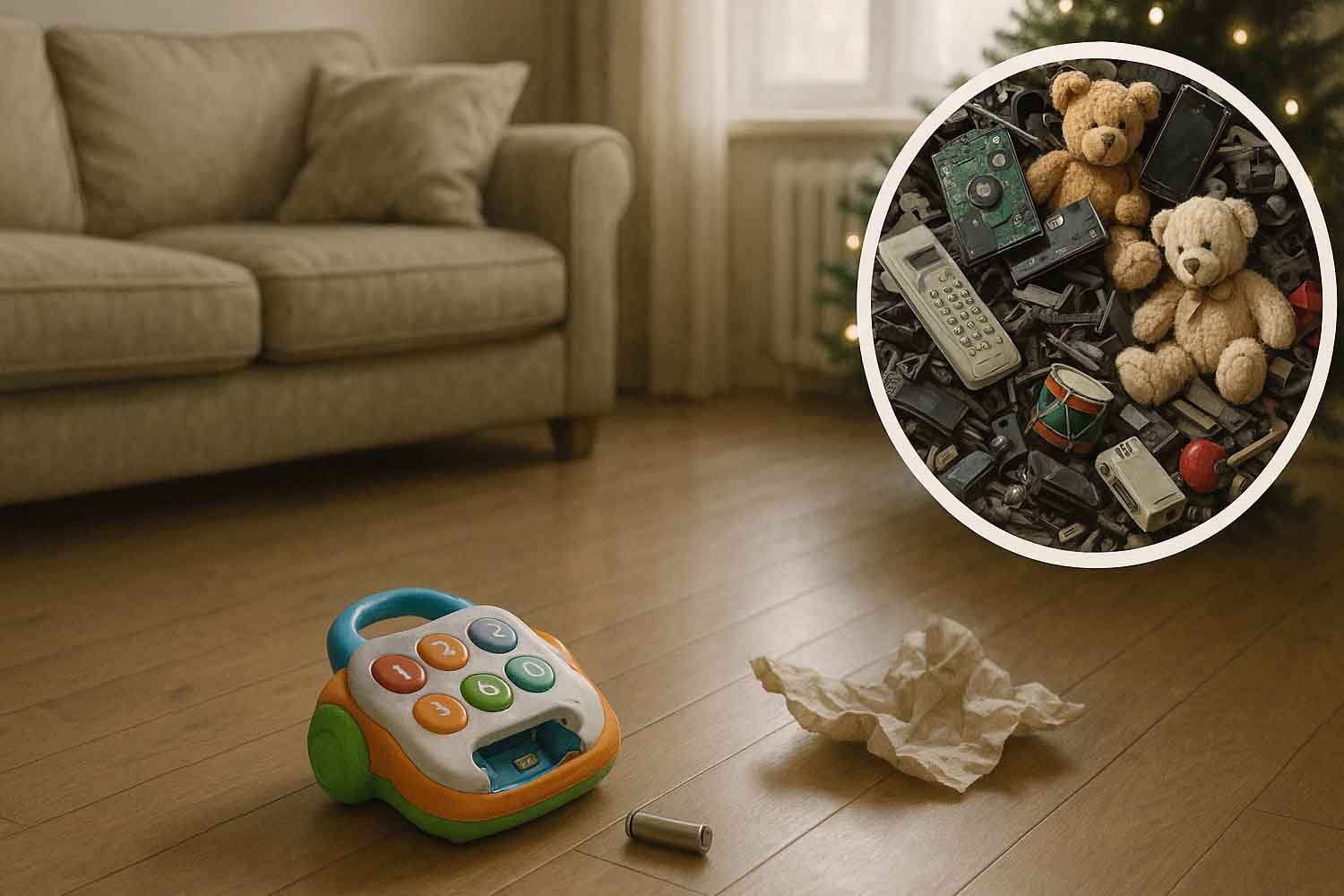
It happens every year, and it happens to everyone. You go into a shop, you see that little light toy, it rings, it’s cheap, “oh well, it’s Christmas”. You take it without thinking too much. Not because you are superficial or not attentive to the environment, but because our brain is like that: it reacts to quick stimuli, to a low price, to the promise of immediate joy. It’s normal. It happens to me too.
The problem arises later. When the holidays pass, the enthusiasm fades and that electronic toy stops working. Sometimes the next day. Sometimes the following week. And there, in front of a broken object that cannot be fixed, you realize that something doesn’t add up.
Because we buy electronic toys that last very little
Low-cost Christmas electronic toys are designed to speak directly to the most instinctive part of our brain. Lights, sounds, colors, affordable price. There is no malice in those who buy them, there is just a well-established mechanism. Mass production and marketing have learned to exploit mental shortcuts that we all use when we are tired, in a hurry, perhaps around Christmas.
The point is that these objects are not created to last. Non-removable batteries, fragile components, thin plastic: it doesn’t take much for them to become unusable. They don’t break by accident. They break because they are designed that way, to have a very short life.
When the game breaks, the e-waste problem begins
Once it ends up in the drawer or in the trash, that toy doesn’t disappear. It becomes electronic waste, even if it is small and seems harmless. Inside there are batteries, circuits, metals and chemicals that should not end up either in unsorted waste or in landfill.
Here comes a fact that we rarely talk about: most electronic waste is not recycled correctly. Many end up abroad, especially in countries in Africa, Asia and Latin America, where they are informally dismantled or burned.
This is also confirmed by a scientific study published in 2025 onInternational Journal of Environment and Climate Changewhich analyzed ten years of research on the environmental and health impacts of e-waste. Researchers explain how improper handling of e-waste contaminates soil, water and air with heavy metals and persistent toxins.
It’s not just the environment: e-waste has real health effects
This is the part that is often missing from the story. E-waste is not just an abstract ecological problem. They are a human problem. The scientific study shows a significant increase in respiratory disorders, neurological damage and oncological risks in communities living near informal disposal and recycling sites.
The most affected are children and pregnant women. Not because they are “weaker”, but because their body is more sensitive to prolonged exposure to certain substances. It is a very high price that we pay collectively for objects designed to last very little.
Christmas as the perfect accelerator of electronic waste
The Christmas period amplifies everything. In just a few weeks we buy millions of small electronic devices which, within days, become waste. We don’t realize them because they are small, cheap, seemingly irrelevant. But put together they make mass, and that mass weighs on the environment and people.
It’s not about demonizing Christmas or blaming those who give a gift. It’s about understanding the mechanism. When you understand this, some choices become almost automatic. Maybe you buy less, or choose something different.
You might also be interested in:
