
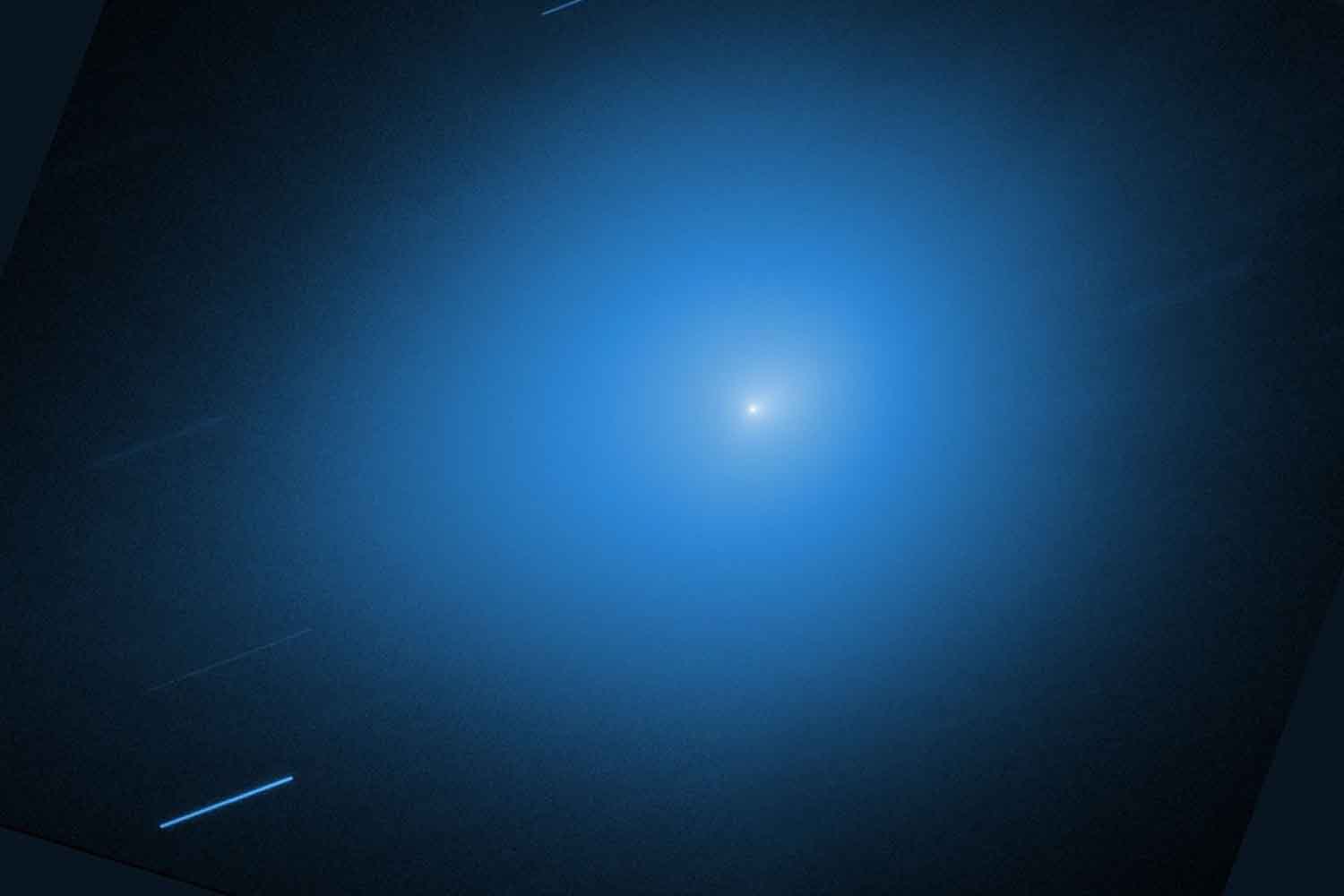
Matter that arrives from outside usually just passes through. A dot, a trajectory, some data, then darkness again. 3I/Atlas took a different path. In its passage through the Solar System it left behind a chemical trace precise enough to give rise to a dizzying estimate: it could have formed 10-12 billion years agowhen the Milky Way was still very young. Our galaxy is estimated to be around 13.6 billion years old, so the margin is very narrow: we are talking about a body born almost at the beginning of galactic history. The data comes from a preprint led by Martin Cordiner del Goddard Space Flight Center by NASA, still under review, and concerns the third interstellar object ever identified in our Solar System after 1I/’Oumuamua and 2I/Borisov.
The point from which everything starts is in the isotopesthat is, in different versions of the same elements. In the case of 3I/Atlasthe team measured ratios of carbon to hydrogen that escape the usual enclosure of Solar System bodies. The comet’s water shows a very high deuterium enrichment, while the ratios between carbon-12 and carbon-13 are compatible with an environment born early in the history of the galaxy, in very cold conditions and with a metallicity lower than that typical of our cosmic neighborhood. In simple terms, the comet’s coma carries a kind of chemical archive: each line tells which phase of the Milky Way it might have emerged from.
This reading works like a clockwork that is much less romantic than it seems and much more concrete. Isotopes matter because the evolution of the galaxy changes the relative abundance of the elements over time. Carbon, for example, is enriched over stellar generations; deuterium follows different paths and is affected by the physical conditions in which ice forms. When researchers compared the signature of 3I/Atlas with the models of galactic chemical evolution, the most surprising time window of the work emerged: an accretion that occurred roughly between 10 and 12 billion years ago. The right word, here, remains esteem. However, it is an estimate based on a rare and very difficult chemical signal to obtain in an interstellar visitor.
The James Webb did the work that was missing
The leap in quality bears the signature of James Webb Space Telescope. The instrument used is NIRSpec, the near infrared spectrograph that works between 0.6 and 5.3 microns and serves precisely this: take the light of an object, open it like a fan and read its physical and chemical composition within that spectrum. The observations cited in the preprint were performed on December 22 and 23, 2025, when 3I/Atlas it was already in the post-perihelion phase. From there the most delicate work began, that of interpretation, coordinated by a team based in NASA Goddard Space Flight Center.
This detail also matters for another reason. 3I/Atlas It comes after two visitors who sparked global curiosity, but under very different observing conditions. ‘Oumuamua opened the chapter in 2017 with a very rapid passage full of discussions. Borisov, in 2019, had shown the cometary face of an interstellar object much more clearly. With 3I/Atlashowever, we enter finer territory: the preprint talks about isotopic measurements obtained with Webb, that is, of an analytical depth that had not been achieved in this way in previous meetings. This is why the comet weighs more than the simple charm of the “third visitor”: here is a sample that really begins to tell where it comes from.
Much more than a visitor
The most interesting part starts right here. Such an age would be transformative 3I/Atlas in a kind of galactic archeology in motion. Looking at distant galaxies allows us to see the past on a large scale, but leaves out the minute details: the individual small bodies, the ice, the materials that participated in the construction of planetary systems. This comet, however, brings before the instruments a material fragment that could have formed in the initial phases of the Milky Way, perhaps in external regions or in the I drive oftenin a context different from that in which the Sun was born. ESA has shown in recent years that the oldest portions of the thick galactic disk began to form about 13 billion years ago. In this framework, the estimate on 3I/Atlas it stops looking like astronomical folklore and starts getting into a plausible chronology of the young galaxy.
The scientific value also lies in the comparison with what we know about the bodies of our Solar System. The comets of our home preserve memories of the first phases of the system born around the Sun. 3I/Atlas broadens the field: it puts on the table the icy remains of another formation environment, perhaps much older, perhaps born under more intense irradiation, perhaps grown in an interstellar cloud enriched in a different way. Within this chemical difference there is the possibility of better understanding how planetesimals form outside our neighborhood and how much variety the Milky Way’s factory of worlds had in its first billion years.
There remains a necessary prudence, and here it is best to keep it clearly in mind. Work is under review and the authors themselves use cautious formulas. The age of 3I/Atlas it does not have the solidity of a date of birth engraved in stone: it depends on models of galactic chemical evolution, on the reconstruction of the original environment and on an object which, by definition, brings with it an orbital history that is difficult to reconstruct at each step. The serious part of the news, however, remains intact: the comet really shows an exceptional isotopic signature, compatible with a very ancient origin and with formation conditions far from those typical of Solar System bodies.
At this moment 3I/Atlas it is already worth a lot even without the definitive stamp of peer review. It is valid because it forces us to change scale. From a curious object it becomes findfrom a passing comet it becomes a historical fragment, from a rare visit it becomes material proof of the fact that the galaxy still preserves pieces of its most remote ages and every now and then sends them to pass in front of us. This time that piece had ice, carbon, water, a hyperbolic run and an ancient smell. Cosmic archive stuff, with the dust still on it.
