
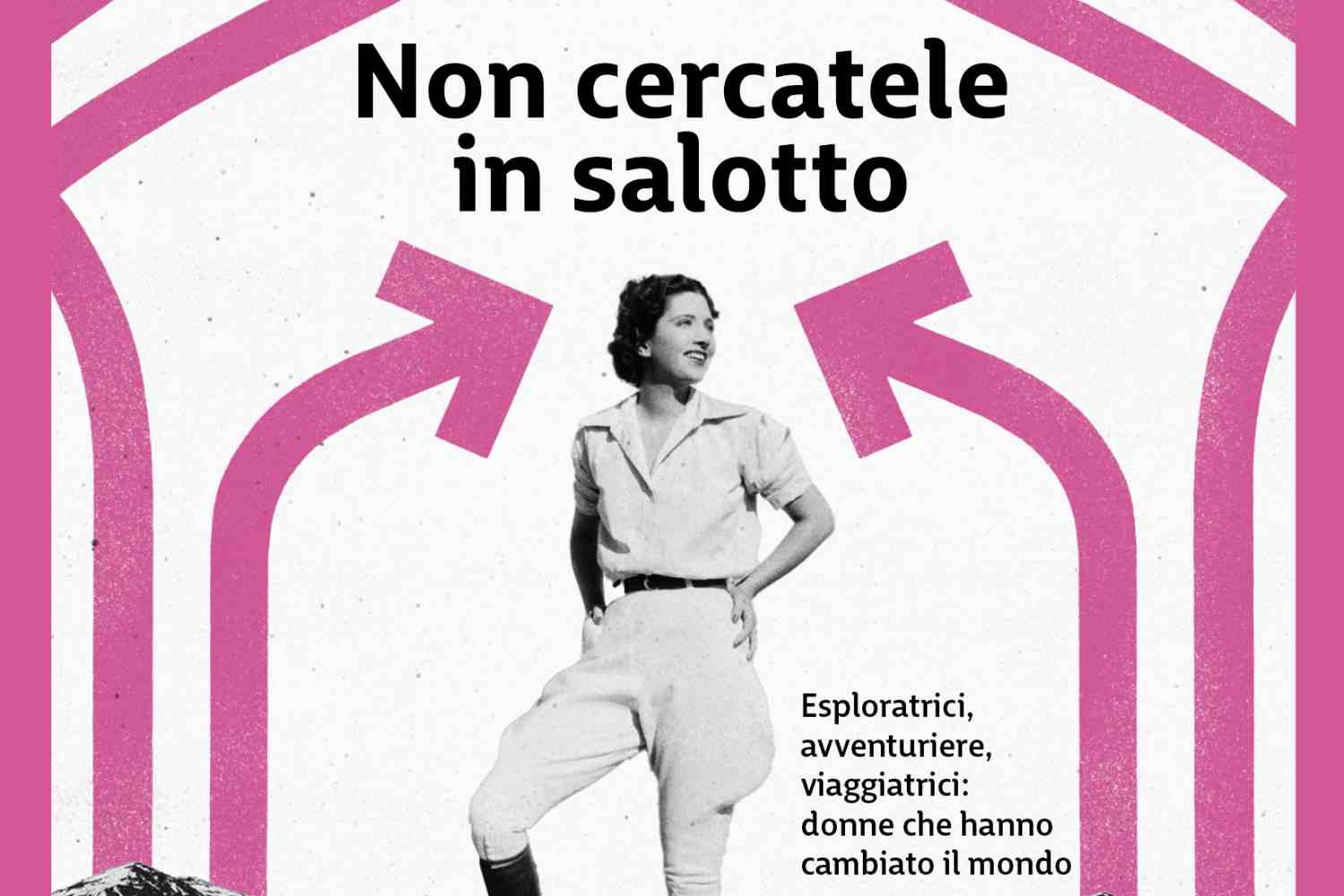
There is a type of journey that doesn’t end when you return home, that continues to work under your skin, calling habits and boundaries into question. It is this type of journey that “Don’t look for them in the living room” by Silvia Ugolotti, published by Ediciclo Editore, talks about: not a simple collection of biographies, but an atlas to orient oneself in the routes of one’s existence, a hymn to disobedience with grace and to exploration – be it geographical or internal.
Silvia Ugolotti, a long-experienced journalist and travel writer, has collected in this volume the lives of women who, far from stereotypes and social expectations, have chosen the path rather than the wait, the unknown rather than the imposed script. A work that presents itself as an invitation to get oneself back in motion, rediscovering the journey not only as a physical movement, but as a powerful act of personal and collective transformation.
Pioneers and rebels: who are the protagonists?
Ugolotti’s pages introduce us to extraordinary figures, women who literally rewrote the rules of their time. Think of Jeanne Baret, who at the end of the eighteenth century circumnavigated the globe disguised as a man in order to go on board; or to Annie Londonderry, who in 1894 effectively invented personal branding by traveling around the world by bicycle. And again, Egeria, the 4th century Spanish nun who was the author of the first travel report signed by a woman. The book also introduces us to the mountaineer Alison Hargreaves, who climbed Everest without oxygen, and the aviator Amelia Earhart, a symbol of audacity and determination.
These are not simple adventurers; they were explorers, travellers, but above all visionaries. They crossed deserts, climbed mountains, challenged empires and conventions, making nomadism a political gesture and walking a new grammar. Their stories are powerful examples of how courage, tenacity and an alternative vision can undermine predefined patterns and open new routes, not only geographical, but also mental and social.
The journey as an act of transformation and disobedience
The interpretation proposed by Ugolotti is fascinating: a journey is never just travel, but an identity process. The author recognizes her own in these women “wild mothers, unstable ancestors, uncomfortable sisters”creating a personal genealogy that intertwines their experiences with their own questions brought in their suitcase. This approach underlines how travel, understood in a broad sense, is a tool for understanding oneself and the world, far from any form of colonialism or abuse.
A “dream team” for female empowerment
The protagonists of “Don’t look for them in the living room” they form a real “dream team” from which to draw courage, method and inspiration. I’m one “constellation of rare women like tropical creatures in a goldfish aquarium”writes Ugolotti, capable of accomplishing extraordinary feats with firmness, restlessness and Argentine joy. Their perspective, often in stark contrast to the “male gaze – colonialist, heroic”stands out for being “empathetic, attentive to culture and society”. This female gaze, more sensitive and inclusive, is particularly relevant for those who, like us at GreenMe, promote tourism and a more sustainable and respectful way of life.
Offer
Don’t look for them in the living room. Explorers, adventurers, travellers: women who changed the world
Structure and special contents
The book is structured in three thematic movements that guide the reader through the deepest motivations of these women: the Urgency of those who understood that the only way out is the one without a return ticket; the disobedience of those who have stopped obeying a destiny written by others; and the Vision of those who have seen – in the world and in themselves – another possible form. This organization, not chronological but thematic, allows us to grasp the connections between the different biographies and the universal themes that animate them.
To close the volume, three sections enrich the reading experience: “The Boundless”with 19 mini-biographies of female travelers who deserve to be known; an original afterword in which the author imagines the women in the book writing theirs together “Futurist manifesto of accelerating travel”; and a bibliography of the original works of the protagonists, for those who wish to delve deeper. Beppe Conti’s collage illustrations add a further layer of charm and originality.
Why do these stories resonate today?
In a world seeking new directions, these women’s stories offer a beacon of inspiration. They represent a powerful message of female empowerment, resilience and the ability to reinvent oneself. They remind us that freedom and personal fulfillment often require overcoming barriers, internal and external, and embracing the unknown with confidence. These biographies are an invitation to reflect on one’s own way of traveling and living: a journey that is increasingly aware, respectful, and that leads to a profound internal and collective transformation, just as these pioneers desired.
Silvia Ugolotti’s book is a precious opportunity to explore a heritage of courage and vision, and to find one’s way in a world that needs new perspectives and open horizons more than ever.
