
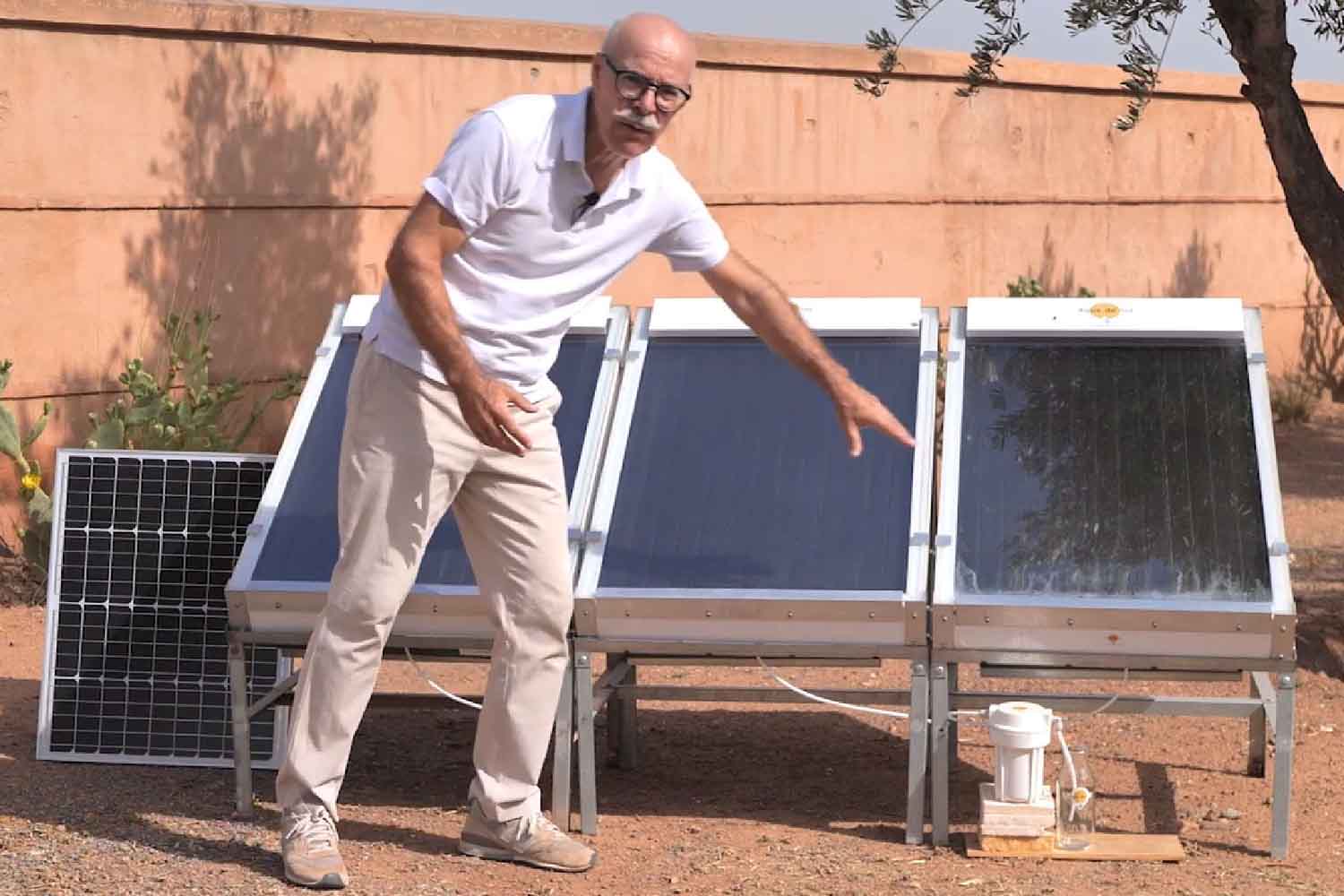
A panel on the roof, a sloped surface, the familiar look of photovoltaics. Except here electricity is not the main result. The SunAir Fountain, developed by the French startup Agua de Sol, was created to produce drinking water from the air, exploiting the humidity present in the atmosphere and the heat of the sun. The company speaks of a production of up to 1 liter per day per panel, a value that depends on climatic conditions: humidity, temperature, sun exposure, ventilation. Translated out of the brochure, it means a simple thing: it can be useful, especially in certain contexts, but it remains a technology to be read with your feet firmly planted on the ground.
How the moisture-trapping panel works
The principle is quite linear. During the night, when the air contains more humidity, the panel sucks in the air and an adsorbent material retains the water molecules. In the morning, with the arrival of the sun, the accumulated heat releases that humidity in the form of steam. The vapor then condenses on an internal surface, turns into droplets and is collected. Before use, the water passes through a filtration and mineralization system.
The interesting part, aside from the charm of the object, lies in the relative simplicity of the process. You don’t need a water network, a complex pump or large infrastructure. The panel works autonomously, at least according to the configuration indicated by the company, and can be installed individually or in series, multiplying production. A single module remains little for a family. Ten, twenty or one hundred panels change scale and become a support system for isolated places, temporary structures, communities with fragile access to water, schools, health centers or areas where the transport of bottles weighs on costs, logistics and waste.
The project obtained the Solar Impulse Efficient Solution label, a recognition given to technologies considered environmentally and economically efficient. This does not turn the device into a universal response to the water crisis, but it does signal that the idea has passed an initial independent technical evaluation. The difference is important: a commercial promise is one thing, a technology that is starting to have checks, tests and possible fields of use is another thing.
A liter a day doesn’t save a house, but it can avoid many bottles
The declared production, approximately one liter of drinking water per day per panel, should be taken for what it is: a small quantity, useful especially when multiplied. To cover the daily drinking water needs of more people, more modules would be needed. Agua de Sol also estimates that a panel can avoid the use of thousands of plastic bottles during its operational life and reduce emissions related to transportation and packaging production. Here too, caution is needed: these are estimates linked to usage scenarios, the actual life of the product, maintenance and the context in which it is installed.
The theme, however, remains concrete. Bottled water continues to be one of the most used solutions where there is a lack of trust in mains water or where the water network is absent. According to the United Nations University, the global market for packaged water has grown to enormous numbers, with environmental impacts related to plastic, transportation, resource consumption and waste management. A system capable of producing water on site can therefore make sense, especially where each bottle must be bought, transported, stored and then disposed of.
Useful technology is one that knows its limits
The SunAir Fountain does not replace aqueducts, wells, treatment plants, rainwater harvesting or serious water management policies. It works within a precise range: enough humid air, enough sun, regular maintenance, efficient filters, correct installation. In very dry areas the yield may drop. In urban contexts with a safe drinking network it may be more of a demonstrative object than a necessity. In isolated areas, however, it can become a useful support, especially if integrated with other solutions.
The value of the project lies not in the idea of “solving” water scarcity with a panel, but in the possibility of adding a local, modular and relatively simple source to a problem that rarely has just one answer. Drinking water from the air remains a fascinating prospect because it starts with something that seems empty and makes it measurable. One liter, one bottle, a small daily reserve. Not much, as long as the tap works. Very much so, when the tap is missing.
