
The energy transition also comes from a poorly written sentence. From a title that is too convenient, from a piece of data left without context, from a green word stuck on anything just to make it look better. Before the plants, the batteries, the energy communities, the electric cars and the agricultural supply chains, there is always someone who has to tell what is happening. And he can do it well, or he can turn everything into fog.
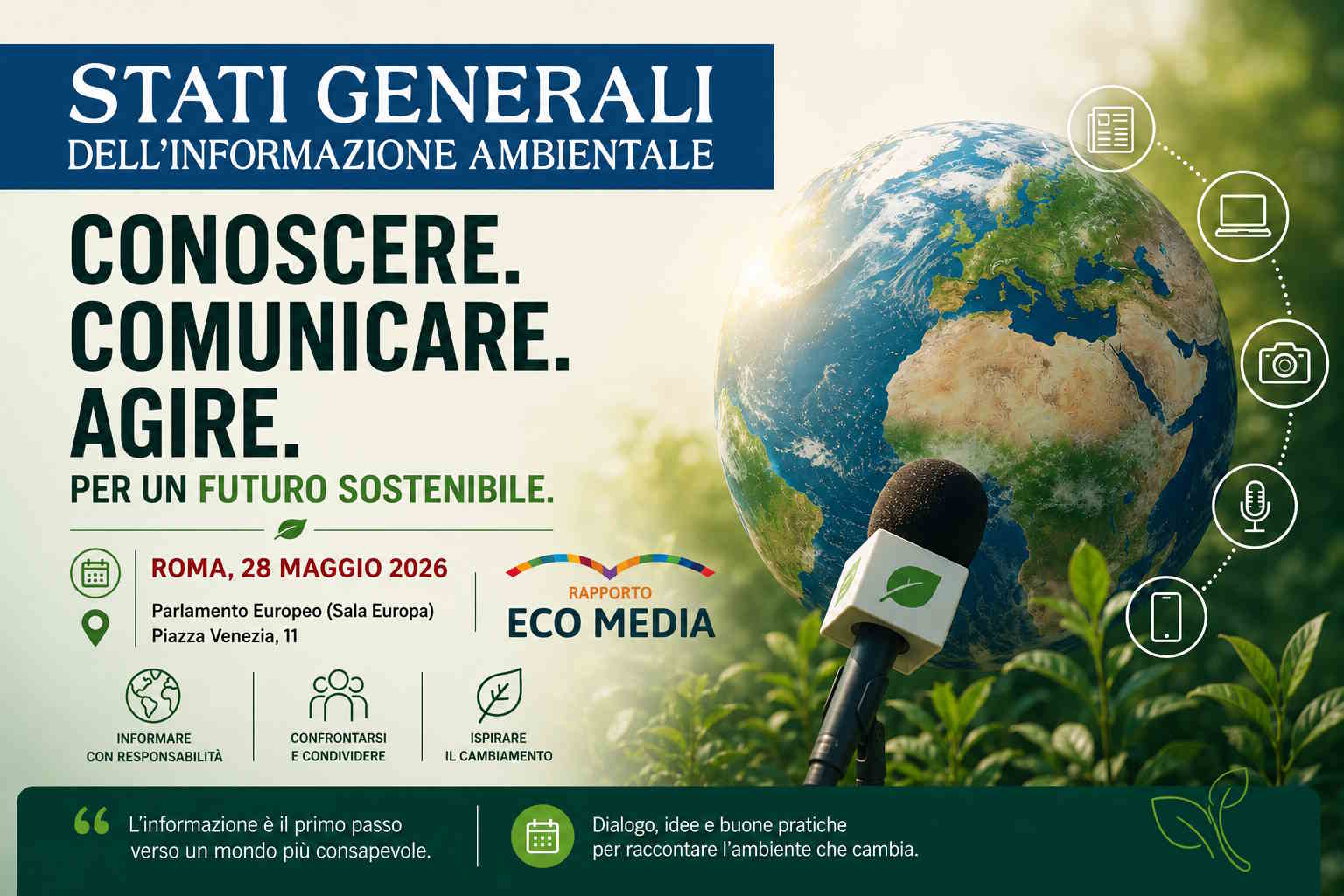
Tomorrow, May 28, we will talk about exactly this in Rome. From 9.30 to 18.00, in the Europa Room of the Italian Office of the European Parliament, in Piazza Venezia 11, the States General of Environmental Information will be held, a day dedicated to the way in which the media, institutions, businesses, research and civil society talk about sustainability, the climate crisis and transition. At the center of the event will be the presentation of the Eco Media Report 2025, promoted by Pentapolis Institute ETS and Eco in Città, with the technical collaboration of Volocom.
The report reaches its twelfth edition and tries to photograph something very concrete: which environmental issues have really entered the Italian press in the last year, how much space they have had, with what angle they have been treated, which topics have pierced the daily noise and which have remained more in the shadows. Because sustainability is now everywhere, at least in words. The most difficult work begins when you have to understand if those words still have weight.
Words weigh
The morning will open with a welcome from Carlo Corazza, director of the European Parliament’s Office in Italy, and with institutional greetings. Among others, the Minister of the Environment and Energy Security Gilberto Pichetto Fratin, Maria Alessandra Gallone, president of ISPRA, together with representatives of the journalistic, editorial and public relations world are expected.
Then the program will immediately enter the most difficult point: the challenges of information. Caterina Banella for FERPI, Fabrizio Carotti for FIEG and Alfonso Cauteruccio for Greenaccord will discuss it. Immediately afterwards, at 10.15, Massimiliano Pontillo, president of Pentapolis Institute ETS, and Andrea Franchini, editorial director of Volocom, will present the Eco Media Report 2025.
The topic seems technical, almost for experts. Instead it concerns anyone who reads an article, watches a TV report, scrolls through a piece of news on the phone and tries to understand whether a choice is truly sustainable or just well told. Environment, Agenda 2030, European Green Deal, energy, mobility and businesses are no longer conference words. They have become pieces of daily life: bills, transport, shopping, work, city, health, territory.
Energy and mobility
After the presentation of the report, the morning will continue with the panel dedicated to energy between science and industry, moderated by Agnese Cecchini, director of Canale Energia. Speakers will include Giorgio Boneschi of Elettricità Futura, Giulia Monteleone of ENEA, Nicola Procaccini of the ENVI Commission of the European Parliament and Ermete Realacci, president of the Symbola Foundation.
Here the energy transition will leave the most abstract framework and end up where it usually becomes complicated: within research, businesses, networks, renewable sources, industrial choices, real times. Telling it well means avoiding two opposite shortcuts: the miraculous promise and the biased refusal. In between there are plants to authorize, technologies to operate, territories to listen to, investments to measure.
At 11.30 it will be the turn of sustainable mobility, with a panel hosted by Simona Falasca, director of GreenMe. Speakers will include Enrico Giovannini, scientific director of ASviS, Fabio Pressi, president of Motus-E, and Dario Tamburrano of the ITRE Commission of the European Parliament. The best practice of Giovanni Fabi, president of Terravision Electric, is also expected.
The word greenwashing enters here without too many turns. Because sustainable mobility is one of the areas where the story can slide more easily: all it takes is a photo of an electric fleet, a promise on climate neutrality, a well-packaged campaign. But then there remain the real cities, public transport, private cars, suburbs, charging stations, costs, habits and distances. Sustainability is measured there, when theory meets the pavement.
Digital is not neutral
Before the lunch break, the program will also address digital innovation at the service of journalistic communication. Speakers will include Sergio Bellucci of the United Nations University for Peace, Senator Aurora Floridia, Benedetta Scuderi of the Industry and Research Commission of the European Parliament and Silvia Zucco of the scientific committee of the Digital Italy Foundation. The best practices will be entrusted to Giulia Boato, co-founder of TrueBees, and Emilio Misuriello, CEO of Esri Italia. The host will be Marco Fratoddi, director of Sapereambiente.
Digital can help environmental journalism greatly: maps, data, checks, satellite images, monitoring, tools for reading territories and transformations. It can also complicate everything. Artificial intelligence, manipulated images, synthetic content and the speed of social media have already changed the way news reaches people. The problem is not using or rejecting the tools. The problem is knowing what you are doing while using them.
After the networking buffet, with the toast for the 20 years of Pentapolis, the work will resume in the afternoon with the moderation of Alberto Giuffrè of Sky TG24. There will be institutional greetings from Patty L’Abbate, vice-president of the Environment Commission of the Chamber of Deputies, the presentation of the Pescasseroli Charter with Guido D’Ubaldo, president of the Order of Journalists of Lazio, and a passage on performing media for cultural biodiversity with Carlo Infante of Urban Experience.
Businesses, circular economy, food
In the afternoon we will also talk about businesses and ESG with Daniela Bernacchi, executive director of UN Global Compact Network Italy, and Alessandra Bucci, advisor to Assobenefit. Then it will be the turn of the circular economy along the path of the 2030 Agenda, with Annamaria Barrile, general director of Utilitalia, Tommaso Campanile, president of CONOE, Alfonso Pecoraro Scanio, president of Univerde, and Elena Sironi of the Senate Environment Commission. The best practice will be that of Tommaso D’Angelo, business developer of Adriatica Oli, led by Stefano Zago, director of TeleAmbiente.
The circular economy can be explained starting from processes, waste, raw materials, supply chains, possible recoveries and true limits. Or it can become a smooth word, good for any company brochure. The difference is made by the details: where a material goes, who recovers it, how much it costs, how much energy is needed, what is left out of the cycle.
In the late afternoon the focus will shift to Italian agri-food, described as world heritage. Speakers will include Francesco Giardina of Coldiretti Bio, Maria Grazia Mammuccini, president of FederBio, Dario Nardella of the Agriculture Commission of the European Parliament and Cinzia Rossi, president of the Communia Foundation. The host will be Antonio Cianciullo, director of Ultima Bozza.
Agri-food, perhaps more than other sectors, lives within a double narrative: on the one hand, heritage, quality, territories, supply chains; on the other climate crisis, soil, water, prices, work, pesticides, biodiversity, transformation of consumption. Telling it only as excellence risks taking away pieces. Talking about it only as a problem risks doing the same. We need fewer postcards and more field.
The day will end with the 2026 Pentapolis “Journalists for Sustainability” Award, a symbolic recognition awarded to professionals who have distinguished themselves in the dissemination of environmental and sustainability issues. Claudia Conte, Rai presenter and contractor, and Marzia Fiordaliso, editorial director of Eco in Città, are on the programme.
Download the Program
You might also be interested in:
