
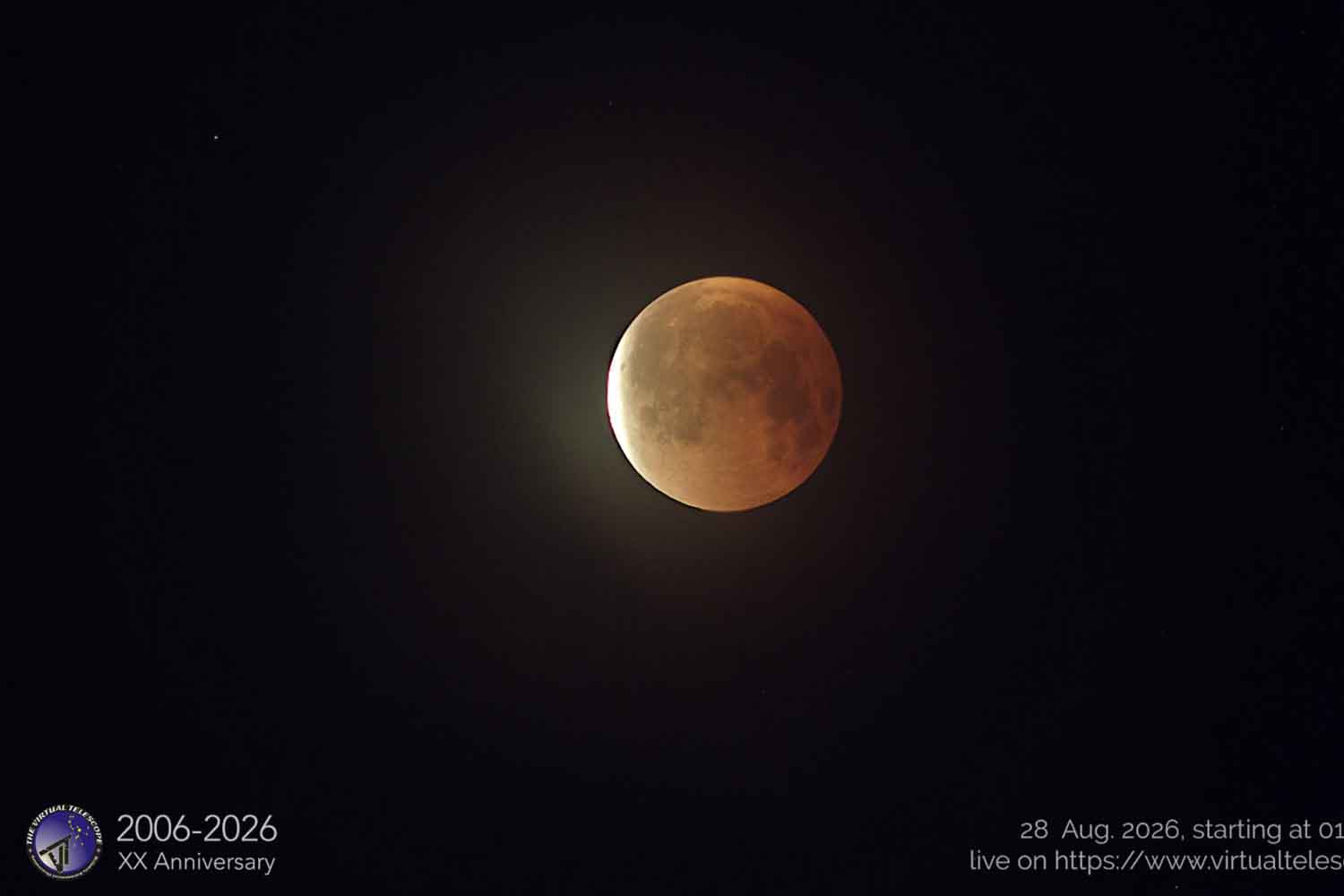
At 4.34am on Friday 28th August A dark bite will begin to appear on the Moon. Then the Earth’s shadow will continue to advance until only a small segment of the disk is illuminated. To see it from Italy you won’t need eclipse glasses, improvised filters or other strange paraphernalia recovered after the solar eclipse of August 12: a lunar eclipse can be easily observed with the naked eye. And also with binoculars and a telescope. NASA confirms this in its August 2026 sky guide.
View this post on Instagram
The phenomenon will be very profound while remaining technically partial. At most, expected around 6:13 Italian timethe umbral magnitude will be 0.9299: approximately the 93% of the lunar diameter it will be within the darkest shadow of the Earth. You can also find the figure of 96% without anyone having miscalculated: that number instead indicates the share of apparent surface of the lunar disk obscured, about 96.2%. Two different measures of the same show. The parameters of the eclipse are also reported in calculations by NASA’s Goddard Space Flight Center.
What time to see the lunar eclipse of August 28th from Italy
First indication, quite important to avoid showing up three-quarters of a day late: you have to watch on the night between Thursday 27th and Friday 28th Augustin the hours before dawn. The Italian Amateur Astronomers Union indicates the start of the partial phase at 4:34. The twilight will begin as early as around 3:24, but in this early phase the darkening is slight and may be difficult to distinguish.
From 4:34 the matter becomes much more evident. The Moon will begin to enterterrestrial umbrathe darkest part of our planet’s shadow, and the edge of the disk will be progressively devoured by darkness. The global maximum arrives at around 6:12:49 in Italy, so we can safely score 6:13 on the alarm clock. At that point, just a small portion of the Moon will remain outside the umbra.
The problem comes at just the best time: the Moon will now be very low towards the west-southwest and close to sunset. In Rome, for example, at most it will be just 3.6 degrees above the horizon and will set around 6.37am. The dedicated Timeanddate page allows you to check the height, direction and times of the eclipse from Rome; by changing location you can check the same data for your city. The partial phase will continue globally until around 7.52 am, but from Italy the Moon will already have set. For us, therefore, the show will stop before the earth’s shadow has finished its passage.
Why you don’t need glasses for the lunar eclipse
Confusion arises easily, especially two weeks after a solar eclipse for which we have rightly repeated until exhaustion.
With the Moon the mechanism is completely different. During a solar eclipse we look towards our star, an enormously intense source of radiation. In the partial phases, staring directly at it can damage the eyes and adequate solar filters are needed: NASA reminds you that eclipse glasses must comply with the international standard ISO 12312-2 and that normal sunglasses are not enough.
The Moon, however, . During the eclipse the Earth is between the Sun and our satellite and intercepts some of the direct light. This is why NASA explicitly indicates that the lunar eclipse on August 28 can be safely observed with the naked eye and even suggests binoculars or small telescopes to better see the curved edge of the Earth’s shadow.
Sunglasses, therefore, are simply useless here. Indeed, being designed to block almost all the light from the Sun, they risk transforming an already darkened Moon into an excellent exercise in observing nothing.
However, with binoculars or a telescope the same rule always applies: you can look at the Moon without a solar filter, never point those instruments towards the Sun without a specific filter correctly mounted in front of the optics.
Because part of the Moon can become more reddish
Even if totality is very close, the one on August 28 remains a partial eclipse. This means that we will not have a true completely red Moon, the popular “Blood Moon”, but much of the area immersed in shadow may take on coppery or reddish tones. NASA itself predicts that the darkened edge may show a rust or copper color.
Earth blocks direct sunlight, but a small amount passes through our atmosphere. Blue wavelengths are scattered more easily, while red and orange wavelengths are able to continue towards the Moon and are reflected back towards us. It is the same phenomenon that contributes to coloring sunrises and sunsets. The complete explanation is available on the NASA page dedicated to lunar eclipses and the so-called “Blood Moon”.
In the eclipse of August 28 the contrast could be particularly beautiful: a small segment still bright next to almost the entire disk immersed in shadow. Then the light of dawn will also arrive to complicate the vision.
Where to look: this time what matters above all is having a clear horizon
To observe the eclipse you don’t necessarily need to reach the darkest place within a hundred kilometres. The full Moon is very bright and the real obstacle, especially approaching the maximum, will be its very low height above the horizon.
It is therefore advisable to choose a place with a completely clear view towards west and west-southwest: a coast facing the right direction, a plain, a hill, a panoramic point without mountains, buildings or trees in front. In Rome, for example, at 4:33 the Moon will still be at around 19 degrees high; by 6:12 it will have dropped to less than 4 degrees. Here you can check visibility and times of the eclipse in the main Italian cities.
Clouds and low mist may of course decide to participate in the event in their own way. It is therefore advisable to check the local forecast the previous evening and, above all, not to wait exclusively for the maximum: between 4.30 and 5.45 the eclipse will already be evident and the Moon will be much easier to find.
Where to watch the lunar eclipse in streaming
Anyone who finds a wall of clouds, a mountain placed exactly to the west or simply prefers the least conflicting relationship possible with the alarm clock will have at least two live broadcasts already announced.
The Virtual Telescope Project will broadcast the eclipse for free from its facilities Manciano, in the Tuscan Maremma. The live broadcast will start at 3:30 am Italian timecorresponding to 01:30 UTC, through the telescopes of the project led by astrophysicist Gianluca Masi. Timeanddate will also follow the eclipse in live streaming, starting at 4:00 Italian02:00 UTC. It can also become a good plan B to compare the phenomenon observed from different locations.
The partial eclipse will continue globally until around 7.52am and the penumbra phase will end shortly after 9am, but from Italy the Moon will already be below the horizon. For us the show will all take place in those few hours before dawn. The most useful accessory, this time, is not the glasses. It’s the alarm clock. It is a piece of the western horizon that no building has had the courtesy to occupy.
