
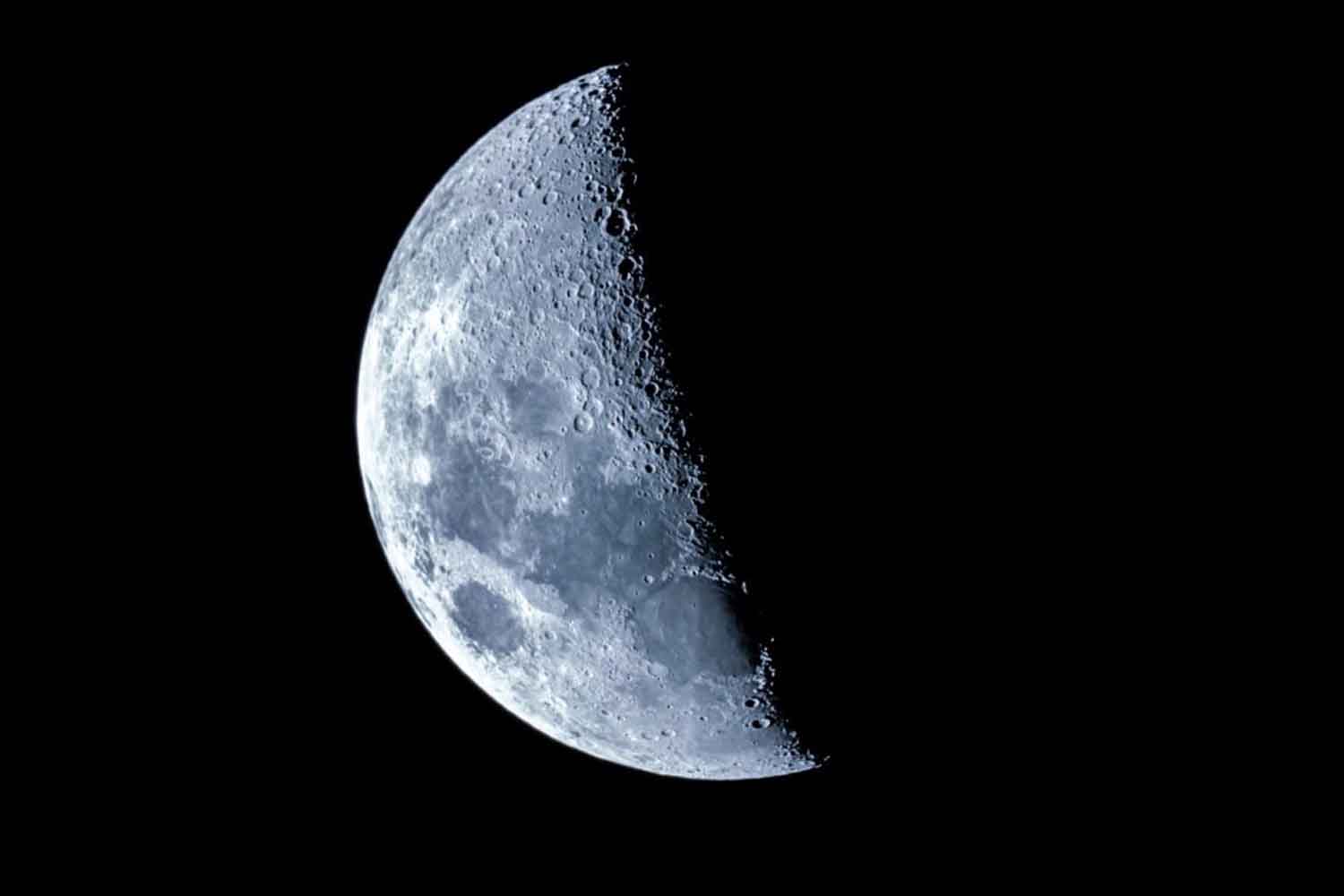
Going through the dust of the Moon under the microscope, grain by grain, looking for something that nature might have a lot of difficulty building: an impossible alloy, a regular structure, a material with a misplaced isotopic signature. If civilizations capable of traveling between the stars existed in the Milky Way, a tiny part of their technology may have reached us in the form of dust. And it may still be there, mixed in with the lunar soil.
It is the idea developed by a group of researchers led by Lewis J. Pinault, affiliated with the SETI Institute. Their calculations suggest that artificial particles just fractions of a micrometer in size could traverse enormous distances in interstellar space, reach the Solar System and, in some cases, arrive at the Moon slowly enough to not be completely destroyed on impact. The Moon, then, has a characteristic that is difficult to beat: it has retained material that has fallen on its surface for billions of years. A kind of cosmic archive that no one has ever really browsed through looking for something like this.
Here comes the necessary edge. No one has found alien technology in lunar dust. The study available on arXivcurrently under review, instead builds a quantitative method for understanding whether such research is physically possible and how it should be conducted. For the first time, an old, rather exotic idea is transformed into something that, at least in principle, can be tested in the laboratory.
Technological dust could travel thousands of light years
The hypothesis starts from a very terrestrial consequence applied on a galactic scale: the technology produces debris. A possible civilization capable of building spacecraft, probes or large infrastructures outside its planet could disseminate material into space through collisions, erosion, accidents or simple wear and tear. Over time, those remains would be shredded down to microscopic size.
Researchers call these fragments “Arkhipov particles”named after Alexey Arkhipov, who in the 1990s had already suggested searching the Moon for technological material from other civilizations. The difficult question is understanding how far such a grain can reach.
Simulations show that refractory particles with a radius around 0.3 micrometers they could survive in the interstellar medium for periods of approximately 100 million to a billion years. During this time they could cross distances on the order of kiloparsecs: thousands of light years, enough to connect a sizable portion of our galactic neighborhood. Not all of them would arrive in one piece. In fact, most would have a bad day.
A particle hitting the Moon at interstellar speeds risks vaporizing along with its history. However, the model identifies a small favorable window: pressure from solar radiation and filtering from the heliosphere can modify the trajectory of some grains and bring them towards the Earth-Moon system at speeds compatible with surviving the impact. And a tiny fraction is enough, because the proposed experiment specifically searches for needles inside a haystack.
Why look for them on the Moon
On Earth, a grain that arrived a billion years ago would have had several opportunities to disappear: water, wind, erosion, volcanoes, sediments and tectonics continuously recycle the surface. The Moon is much more conservative.
It has no oceans, rainfall or active geology comparable to ours and has been collecting material from space for about four billion years. The impacts of micrometeorites continuously mix the regolith, the dusty soil that covers the surface, but this very layer can preserve very ancient particles.
The SETI Institute describes it as an archive of the history of the Milky Way: inside the dust itself there can be materials from the Solar System, interstellar grains and, this is the hypothesis to be verified, some microscopic artificial residue. The advantage is also practical. There is no need to wait for an extraterrestrial civilization to politely decide to transmit a radio signal in the very years in which we are listening. A particle can survive much longer than its creator.
How to recognize a grain built by someone
Here the dirty work begins. Literally. The lunar soil already contains meteorites, fragments produced by impacts, pre-solar grains and rather strange minerals. Additionally, after decades of human exploration, some areas contain residues of paints, metals, propellants and other materials left behind by our missions. Finding an unusual particle, therefore, would be of little use.
The researchers propose to use automated microscopy and artificial vision systems to sift through huge amounts of material and isolate the strangest candidates. Only those would then be subjected to much more refined analyses, looking for characteristics that are difficult to explain all together through natural processes.
This may involve exceptional chemical compositions, particular isotopic ratios, layered structures, regular geometries or voids, and microstructures compatible with a manufacturing process. An unusual league alone would not be enough. Not even a curious shape. We would need a combination of clues robust enough to survive the much more banal hypothesis: “it’s just a strange rock”.
One cubic meter of the Moon can already tell us something
There is another part of the work that makes the proposal interesting even in the least cinematic case possible: . In fact, the authors tried to calculate how much material would need to be examined before a completely negative result began to have statistical significance. The answer is surprisingly concrete: approximately one cubic meter of lunar regolith analyzed in sufficient depth it could already allow us to put limits on some extreme scenarios on the spread of technological civilizations in the Galaxy.
With the hypotheses adopted in the study, a search without any result would exclude scenarios in which stars similar to the Sun have normally dispersed enormous quantities of durable technological material over the course of galactic history: approximately 0.09 Earth masses per star. A mountain of alien garbage, in short.
A negative result would therefore not prove that we are alone. There may have been civilizations that produced far less debris, materials unable to survive the journey, or simply nothing that reached our little piece of the Solar System. But at least we would have started putting numbers where so far there were mostly possibilities.
And there could be a lot more dust to watch in the coming years. The SETI Institute indicates the samples of future missions Artemis, Chang’e and commercial lunar missions as possible opportunities to try this type of research, together with analyzes directly on the surface.
For decades we have searched for possible extraterrestrial civilizations mainly by raising antennas towards the sky and waiting for something to listen to. The proposal by Pinault and colleagues also suggests doing the opposite: lower your gaze and observe the dust very, very carefully. If someone passed through these parts long before us, they may have left less than one vine. Maybe just a speck.
