
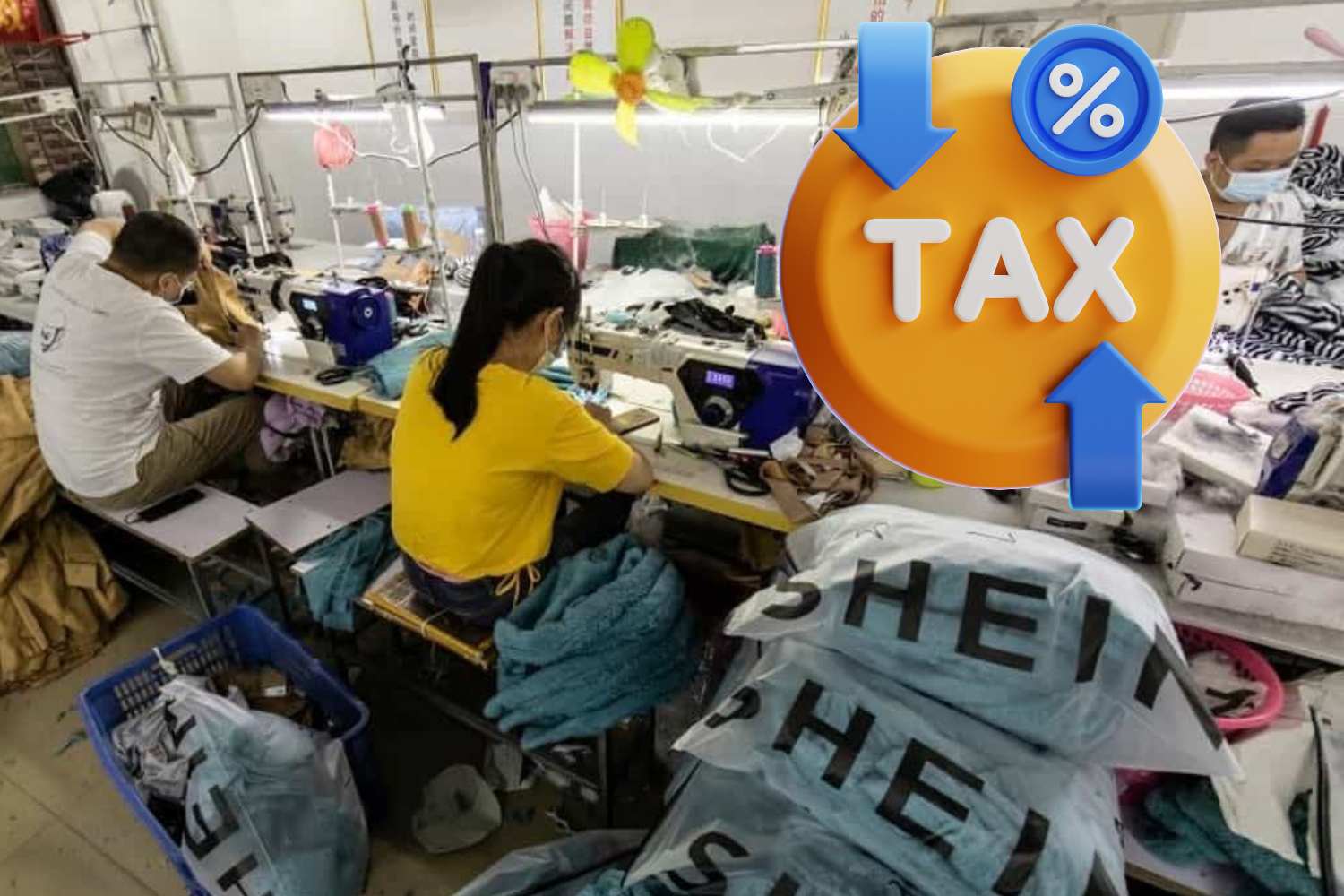
Clothes at rock-bottom prices, new collections appearing every day and items destined to be replaced in a very short time. It is the model of ultra-fast fashion, an even more extreme version of disposable fashion that has won over millions of consumers in recent years, but which presents an environmental bill that is increasingly difficult to ignore.
Faced with a textile production that continues to generate enormous quantities of waste and clothes often designed to have a short life, the first measures to try to change this model are also starting to arrive.
France, always at the forefront, has decided to intervene directly on the price: from 1 September 2026, a new penalty for disposable fashion products came into force, which can reach up to 12 euros per item in 2026.
The measure was introduced through the decree signed by the minister delegated to the ecological transition, Mathieu Lefèvre, and published in the “Journal officiel de la République française“, the French equivalent of our Official Journal.
The problem isn’t simply that some clothes are cheap. It is the production and commercial model that lies at the basis of so-called fast fashion. Specialized platforms make endless catalogs available, continually add new products and focus on speed: a trend goes viral, is quickly transformed into an item of clothing offered at rock-bottom prices.
The result is a continuous turnover of purchases and, consequently, an increasing quantity of products that end up being discarded. Added to this is another element: many of these garments have a poor propensity for repair and long life. When a dress costs very little, repairing it may seem less cost-effective compared to purchasing a new product.
It is precisely this mechanism that France wants to try to break.
How the new penalty works
The novelty provides for an economic penalty for products marketed by brands that fall within the definition of fast fashion.
The mechanism takes into account two main characteristics: the limited possibility or convenience of repairing the products and the breadth of the offer proposed by the brand.
The penalty can reach 50% of the price of the product, but in 2026 it cannot exceed 12 euros per item. However, the limit is destined to grow progressively and in 2030 it could reach 19.50 euros.
Be careful though: it doesn’t mean that every t-shirt sold by a fast fashion platform will automatically cost the consumer 12 euros more. The actual amount depends on the criteria provided by the system and the characteristics of the product and brand.
The objective is rather to introduce an additional cost for the commercial models considered most responsible for the environmental impact.
It should be noted that France is the first country in the world to introduce a system of this type specifically aimed at disposable fashion. As Serge Papin, Minister of Small and Medium Enterprises, Trade, Crafts, Tourism and Purchasing Power, stated:
France is the first country in the world to establish such a system. We fought, convinced and built this text with the industry. From September 1st, ultra-fast fashion will pay the true price of its damage – for the environment, for our companies, for our territories. It is a useful struggle, fought with committed parliamentarians, who brought this text to themselves and allowed its adoption.
But that’s not all, another squeeze is coming soon. From 1 January 2027, further restrictions are foreseen on the promotion of fast fashion, including the ban on promoting products and brands that fall into the category affected by the legislation through influencers.
The French strategy is therefore twofold: on the one hand, increasing the cost of products associated with the ultra-fast fashion model, and on the other, intervening on the advertising mechanisms that contribute to making them continuously desirable.
The European Union has also intervened on small parcels coming from non-EU countries. In fact, from 1 July 2026, a duty of 3 euros came into force on small parcels with a value of less than 150 euros sent directly to European consumers from non-EU countries.
However, the European measure and the French penalty are not the same thing: the former intervenes on shipments and the customs regime of goods arriving in the EU, while the latter was specifically designed to economically penalize the disposable fashion model and push brands towards more durable and repairable products.
Shein and Temu
When we talk about ultra-fast fashion, our thoughts inevitably turn to platforms like Shein and Temu, which have become the symbol of a model based on very low prices, enormous choice and continuous renewal of the offer.
However, it is important to make a clarification: the French legislation does not simply establish a tax by naming Shein or Temu, but defines the criteria that allow the identification of products and brands attributable to fast fashion. It is therefore the characteristics of the commercial model that determine the application of the malus.
The principle chosen by France is quite clear: if a business model contributes to multiplying the production and disposal of garments that are difficult to repair, it must also bear a greater part of the related environmental costs.
This distinction is important because the provision does not intend to generically affect all low-priced clothes. The target is a specific model. France therefore tries to use price as a lever to push the market towards more durable products.
In other words, the idea is to make a system in which an item is purchased to follow a trend, used for a short time and then replaced by another, progressively less convenient.
The hidden cost of disposable fashion
The price written on the label only tells part of the story. Behind a t-shirt sold for a few euros there are raw materials, water, energy, production processes, transport, often also exploitation of workers and, at the end of its life, there is waste to manage.
As the purchase and replacement cycle becomes increasingly rapid, the amount of textiles that are discarded also increases. It is one of the reasons why in recent years we have started to talk more and more about textile overproduction and the durability of clothes, as well as recycling. In fact, recycling what is produced in excessive quantities does not alone solve the root problem.
This is why France aims first of all to change this system.
Real change, however, cannot come from laws alone. As long as we continue to consider it normal to constantly buy new clothes just because they cost very little, the fast fashion mechanism will continue to feed itself.
The new French measure at least tries to make that price a little closer to the real cost.
